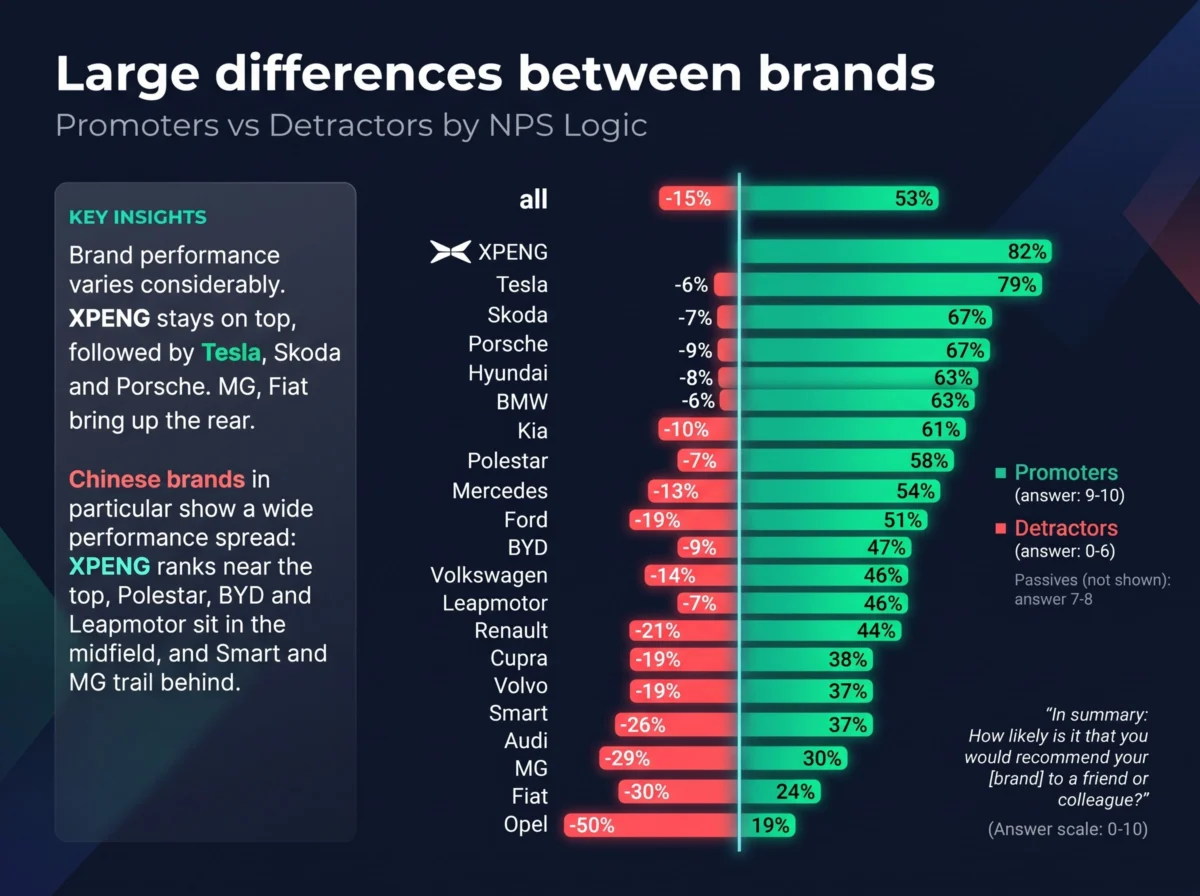
For the second year in a row, the Chinese electric vehicle manufacturer XPENG has claimed the highest position in the prestigious USCALE EV Satisfaction Study, a comprehensive assessment of the European electric vehicle market. The findings, released in 2026, underscore a significant shift in consumer sentiment across Germany, Austria, and Switzerland. With an 82% recommendation rate, XPENG has not only maintained its industry-leading status but has also improved upon its performance metrics from the previous year. This figure stands in stark contrast to the broader industry average of 53%, positioning the brand as a dominant force ahead of established American, European, and Asian automotive incumbents.
The Stuttgart-based consultancy firm, USCALE, conducted the survey by polling over 4,000 electric vehicle owners, utilizing the Net Promoter Score (NPS) methodology to gauge consumer loyalty and satisfaction. The metrics evaluated include technical performance—such as charging speed, range, and battery management—alongside user experience factors like mobile application integration and software interface fluidity. Notably, while most competitors saw a mix of promoters and detractors within their customer bases, XPENG’s data revealed an exclusively positive sentiment among its users, a rarity in the highly competitive automotive sector.
Chronology of Market Disruption
The rise of XPENG in the European market is not an overnight phenomenon but the result of a deliberate, multi-year strategy focused on globalizing its technological stack. In 2024, the brand began its formal push into European markets, prioritizing the deployment of its latest hardware and software iterations rather than the legacy models often associated with overseas expansion by other international manufacturers.

By 2025, the brand achieved its first top-tier ranking in the USCALE study, signaling to the industry that Chinese-engineered EVs could compete—and win—on the merits of software-defined features. Following this initial success, the company deepened its integration with local ecosystems, including partnerships with European giants like the Volkswagen Group, to bolster its manufacturing and supply chain presence. The 2026 results further confirm that this strategy has resonated with the European consumer, who is increasingly prioritizing seamless connectivity and software performance over traditional brand heritage.
Comparative Performance and Data Analysis
The USCALE report provides a granular view of why specific brands are failing or succeeding in the current climate. While XPENG leads the pack, other players have seen their standing fluctuate. Tesla, long considered the industry benchmark, holds the runner-up position, trailing XPENG for the second consecutive year. Other manufacturers, specifically legacy European brands like Opel and Fiat, as well as several Asian competitors, have recorded the lowest satisfaction scores, struggling to bridge the gap between their traditional internal combustion engine heritage and the demands of a software-first electric powertrain.
Dr. Axel Sprenger, founder and managing director of USCALE GmbH, notes that the shift in consumer expectation is profound. "EV drivers are more satisfied than ever, but they are also becoming more demanding," Sprenger stated. "What was exciting yesterday is standard today. Manufacturers have done their homework when it comes to range and charging. Now, the competition is decided by software, connectivity, and a seamless charging experience. Those who fail to deliver here will fall behind, and this is clearly visible in the ranking."
The data suggests that the "charging experience"—which encompasses everything from infrastructure reliability to the vehicle’s internal thermal management during rapid charging sessions—is a primary driver of the high NPS for XPENG. Customers consistently cited the efficiency of the vehicle’s charging management system as a standout feature, indicating that the company’s investment in proprietary high-voltage architectures is yielding tangible benefits for end-users.
The Human-Centric Technological Philosophy
Central to XPENG’s competitive edge is a philosophy articulated by Chairman and CEO He Xiaopeng: a human-centric approach to technology deployment. Unlike competitors that often reserve cutting-edge autonomous driving features for domestic Chinese markets, XPENG has moved to synchronize its global product launches.
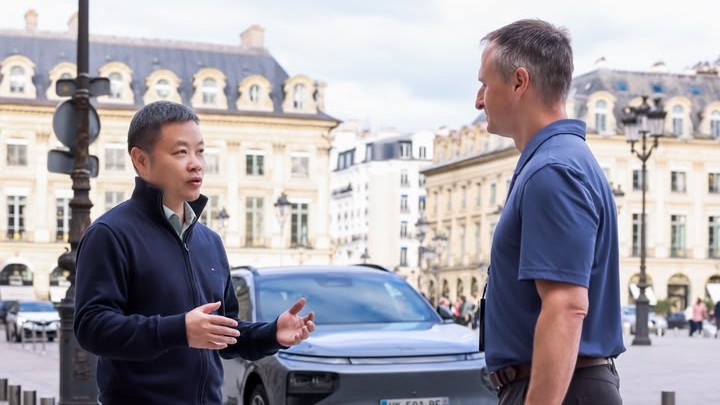
During a recent interview at the Paris Motor Show, He Xiaopeng emphasized that the company’s goal is to democratize advanced technology. "As a product manager with a technical background, I have always been driven by a desire to bring superior technology to as many people as possible at a fair price point," he said. He further explained that the company’s Navigation Guided Pilot (NGP) system was designed from the ground up to be "generalizable." By avoiding the pitfalls of hard-coding region-specific driving rules, the software is better equipped to adapt to the nuanced driving habits and cultural norms of European motorists.
This approach serves as a counterpoint to the "winner-takes-all" mentality often seen in global expansion strategies. By prioritizing collaboration and mutual respect with local partners, XPENG aims to position itself as a long-term participant in the European automotive landscape rather than a transient importer of goods.
Implications for the Global EV Market
The implications of the 2026 USCALE findings are significant for the automotive industry at large. First, the data highlights that brand loyalty in the EV era is fluid. Consumers are increasingly willing to pivot toward brands that provide superior digital experiences, regardless of the manufacturer’s historical pedigree. This creates an existential challenge for legacy automakers that are still grappling with the transition from mechanical engineering to software-centric vehicle development.

Second, the success of XPENG’s NGP autonomous driving technology in Europe, which analysts like Dan Caesar of Electric Vehicles GLOBAL suggest is directly comparable to Tesla’s Full Self-Driving (FSD) capabilities, suggests that the gap in AI and machine learning development between Chinese and Western firms is closing rapidly. Caesar notes that while English-speaking markets have been relatively slow to adopt or even acknowledge the brand, the reality of the European experience indicates that XPENG is "the one to watch" in the coming years.
Finally, the study serves as a bellwether for the importance of "localizing" technology. XPENG’s success is not merely due to the performance of its hardware, but to its efforts to adapt its software to the specific road infrastructure and driving customs of Europe. By partnering with local tech entities and focusing on regulatory compliance—such as preparing for UN DCAS standards—the company has effectively mitigated the "foreigner" stigma that often hampers new entrants in the tightly regulated European automotive market.
Looking Toward Future Scalability
As XPENG continues to expand its footprint, the challenge will shift from initial market entry to maintaining this high level of satisfaction at scale. Rapid growth often introduces friction in customer service and maintenance infrastructure. The company’s focus on building long-term relationships through a consistent and transparent technological offering suggests a departure from the high-turnover sales models seen in other segments of the industry.
By fostering a community of "advocates" rather than just customers, XPENG is positioning itself to benefit from the network effects of consumer recommendation. In an industry where software updates can fundamentally alter the vehicle’s utility over time, the relationship between the manufacturer and the owner is no longer a one-time transaction at the point of sale, but an ongoing partnership.

In conclusion, the 2026 USCALE EV Satisfaction Study provides a clear mandate for the industry: the future of mobility will not be defined by range or horsepower alone, but by the intelligence, connectivity, and, above all, the human-centric design of the vehicle. With its consistent performance and commitment to global technological equity, XPENG has established a new benchmark that competitors will be forced to match if they wish to remain relevant in the evolving European EV ecosystem. As the market matures, the brands that survive will be those that view their customers not just as buyers, but as participants in a shared, technologically advanced future.