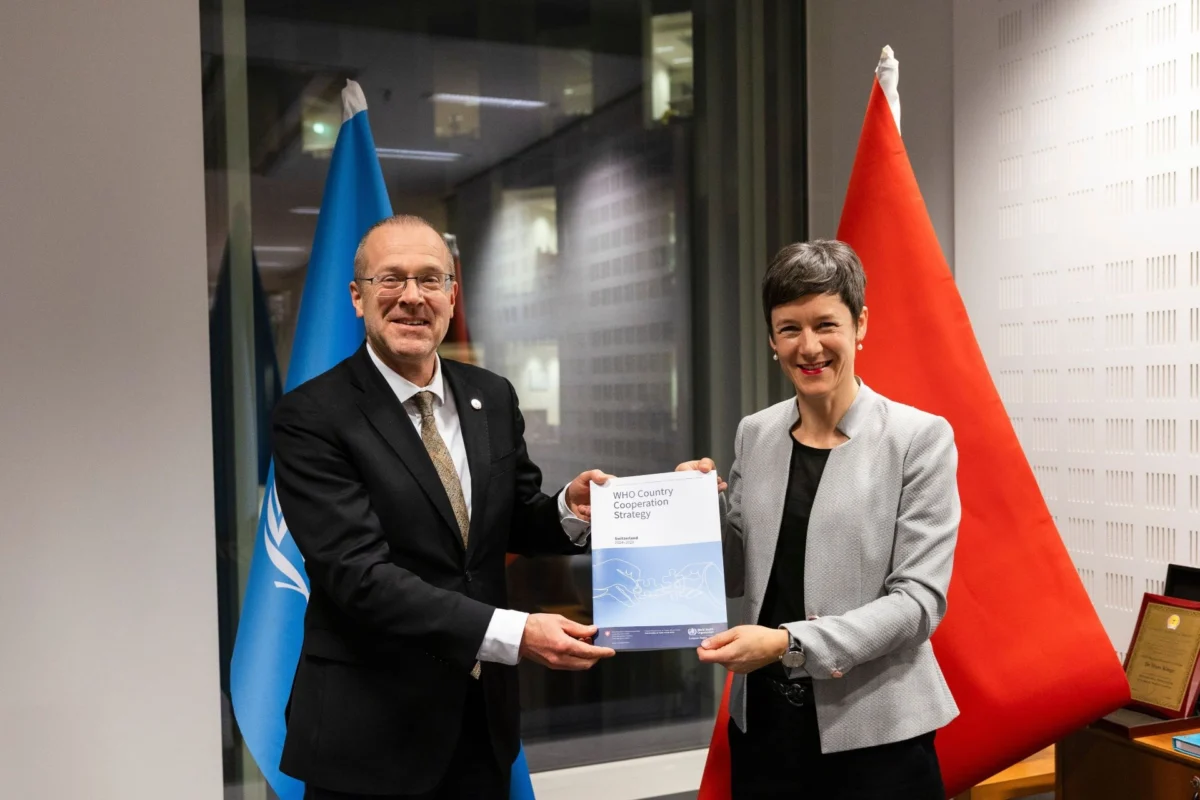
The World Health Organization (WHO) and the Swiss Confederation have officially formalized the renewal of their bilateral cooperation framework, establishing a strategic roadmap for public health initiatives through 2028. The agreement, finalized on March 4, 2025, at the WHO Regional Office for Europe in Copenhagen, Denmark, builds upon a uniquely longstanding partnership between the global health agency and a high-income member state. The renewed pact is designed to address contemporary health security challenges, reinforce multilateral health governance, and drive innovation in pathogen surveillance and pandemic preparedness.
The signing ceremony brought together key diplomatic and public health figures, including Dr. Hans Henri P. Kluge, WHO Regional Director for Europe, and Barbara Schedler, Ambassador for Global Health at the Swiss Federal Office of Public Health. Their endorsement of the 2024–2028 Country Cooperation Strategy marks a crucial step in aligning Swiss domestic and international health priorities with the broader strategic objectives of the WHO European Region and global health mandates.
Historical Context and Evolution of the Partnership
The formalized relationship between Switzerland and the WHO holds a distinctive place in international public health administration. In 2013, Switzerland made history by becoming the first high-income country within the WHO European Region to pilot a structured country cooperation strategy. Traditionally, these cooperative frameworks were deployed primarily in low- and middle-income nations requiring targeted developmental assistance and institutional capacity building.
However, Switzerland’s integration of a country cooperation strategy recognized that high-income nations also benefit from a formalized, mutually accountable mechanism to govern their contributions to, and alignments with, global health standards. This pilot model proved remarkably successful, bridging Swiss domestic health policies—such as universal healthcare administration, pharmaceutical innovation, and advanced research infrastructure—with global health security initiatives.
Over the ensuing decade, the scope of cooperation expanded organically. Switzerland transitioned from a primarily financial donor and host country for international organizations to an active, operational partner in specialized health emergencies, digital health initiatives, and global pathogen data-sharing networks. By 2022, recognizing the shifting landscape of post-pandemic public health, WHO and Swiss authorities initiated a comprehensive review to update the framework, culminating in the newly minted 2024–2028 strategy.
The Chronology of the 2024–2028 Renewal
The pathway to the March 2025 signing ceremony involved a multi-year consultative process driven by joint working groups from the Swiss Federal Office of Public Health, the Swiss Agency for Development and Cooperation (SDC), and various departments within the WHO Regional Office for Europe.
- 2022: WHO and Swiss leadership formally decide to update and renew the bilateral cooperation framework, expanding its scope to reflect post-COVID-19 priorities, including health resilience, bio-surveillance, and equity in access to medical countermeasures.
- 2023: Drafting and stakeholder consultations take place, integrating lessons learned from global health emergencies and aligning the strategy with the WHO’s Thirteenth General Programme of Work (GPW 13) and the European Programme of Work (EPW).
- June 2024: Switzerland and the WHO strengthen their operational partnership further by signing landmark agreements regarding the Global BioHub System, establishing Switzerland as a pivotal node for secure pathogen sharing and genomic sequencing.
- March 4, 2025: Barbara Schedler, Ambassador for Global Health, and Dr. Hans Henri P. Kluge officially sign the WHO–Switzerland Country Cooperation Strategy 2024–2028 during a high-level diplomatic meeting at the WHO Regional Office in Copenhagen.
Core Pillars of the New Cooperation Strategy
The newly adopted cooperation strategy is structured around several strategic pillars designed to maximize the comparative advantages of both the WHO and Switzerland. These priorities reflect both domestic public health competencies and international commitments to global health security.
-
Strengthening Global Health Security and Bio-Surveillance:
Building upon previous agreements, the strategy prioritizes the integration of advanced laboratory networks and bio-banking initiatives. A central component of this is the Global BioHub System, which facilitates the rapid, safe, and transparent sharing of novel pathogens with pandemic potential between Member States and WHO-designated repositories. Switzerland’s advanced scientific infrastructure and rigorous biosafety standards make it an ideal anchor for these high-security operations. -
Advancing Multilateral Governance and Policy Alignment:
As a major diplomatic hub—hosting the global headquarters of the WHO in Geneva alongside numerous other international organizations and non-governmental entities—Switzerland plays an outsized role in shaping international health law and policy. The strategy seeks to leverage Swiss diplomatic channels to advocate for sustainable financing for global health, adherence to the International Health Regulations (IHR), and successful negotiations surrounding international pandemic agreements. -
Promoting Universal Health Coverage (UHC) and Health Equity:
While Switzerland boasts one of the most robust healthcare systems globally, the cooperation framework addresses shared challenges such as workforce shortages, the integration of digital health solutions, and the management of non-communicable diseases (NCDs). By sharing best practices in health economics and regulatory science, the partnership aims to support health system resilience across the wider European region. -
Tackling Antimicrobial Resistance (AMR) and Climate-Health Nexus:
Reflecting mounting global concerns, the 2024–2028 strategy emphasizes coordinated action against antimicrobial resistance—a silent pandemic threatening modern medicine. Furthermore, the framework addresses the intersection of climate change and human health, promoting environmentally sustainable healthcare infrastructure and climate-resilient public health planning.
Statements and Official Reactions
During the signing ceremony in Copenhagen, leadership from both delegations emphasized the strategic importance of the renewed partnership in an increasingly fragmented geopolitical and epidemiological landscape.
Dr. Hans Henri P. Kluge, WHO Regional Director for Europe, praised Switzerland’s unwavering commitment to international solidarity and technical excellence. "Switzerland is not merely a host nation for international health governance; it is an active innovator and a steadfast pillar of global health security," Dr. Kluge stated. "By renewing this cooperation strategy through 2028, we are ensuring that our joint efforts are agile, evidence-based, and equipped to confront the complex health threats of the 21st century—from emerging pathogens to the compounding crises of climate change and antimicrobial resistance."
Ambassador Barbara Schedler, echoing these sentiments, highlighted the mutual benefits of the structured framework for Swiss domestic policy and international cooperation alike. "Our collaboration with the World Health Organization demonstrates that high-income nations have a vital role to play in mutual learning and collaborative standard-setting," Ambassador Schedler noted. "This strategy allows Switzerland to channel its expertise in research, biotechnology, and multilateral diplomacy directly where it is most urgently needed, reinforcing the global architecture required to protect populations everywhere."
Integration with the Global BioHub System
A critical dimension of the strengthened partnership—and a major focal point of the 2024–2028 roadmap—is Switzerland’s integration into the WHO Global BioHub System. Initiated to address historical bottlenecks in the sharing of biological materials during outbreaks, the BioHub system provides a mechanism for member states to share physical samples of novel pathogens swiftly and securely.
Through specialized facilities in Switzerland, the country provides state-of-the-art containment and analytical capabilities. This operational integration ensures that when a new variant or pathogen emerges, global scientific networks can immediately access characterization data, facilitating the rapid development of diagnostics, therapeutics, and vaccines. The inclusion of these technical mechanisms within the broader cooperation strategy ensures that political commitments are directly translated into operational readiness on the ground.
Broader Implications for Global Health Architecture
The formalization of the WHO–Switzerland Country Cooperation Strategy for 2024–2028 carries notable implications for the broader architecture of international public health.
First, it serves as a blueprint for other high-income nations seeking to formalize their engagement with the WHO. While traditional aid models focused on donor-recipient dynamics, the Swiss model reframes cooperation around mutual technical exchange, joint research, and shared stewardship of global public goods. This approach acknowledges that health security is indivisible; a vulnerability in any national health system poses a potential threat to all others.
Second, the timing of the agreement—arriving in early 2025—coincides with a critical period of global reflection and reform following the acute phases of the COVID-19 pandemic. As member states continue to negotiate strengthening instruments for pandemic prevention, preparedness, and response, concrete bilateral partnerships like the one between WHO and Switzerland provide operational momentum. They demonstrate that multilateral institutions and individual governments can effectively operationalize commitments to transparency, solidarity, and scientific collaboration.
Looking Ahead: The 2028 Horizon
Over the next four years, implementation of the WHO–Switzerland Cooperation Strategy will be monitored through joint steering committees and periodic progress reviews. Key performance indicators will measure success not only in terms of policy alignment and diplomatic milestones but also through concrete deliverables in bio-surveillance capacity, regulatory harmonization, and technical assistance delivered across the WHO European Region.
As the international community navigates an era defined by rapid environmental, technological, and demographic shifts, the renewed pact between the World Health Organization and Switzerland reinforces a shared vision: that sustainable global health security is achieved through proactive partnership, rigorous science, and unyielding multilateral cooperation.