The global transition toward electrification, championed by advocates such as Tony Seba and Mark Jacobson, continues to redefine the automotive and energy landscapes. Yet, a pragmatic assessment of the transportation sector—encompassing heavy-duty land transit, maritime shipping, and aviation—suggests that internal combustion engines will remain integral to global infrastructure for the remainder of this century. As the search for carbon-neutral or carbon-negative liquid fuels intensifies, researchers at the Worcester Polytechnic Institute (WPI) have identified a promising, often overlooked candidate: bamboo.
A study published on September 24, 2026, in the Royal Society of Chemistry journal Sustainable Energy and Fuels, details how bamboo could outperform traditional biofuel feedstocks like corn ethanol and switchgrass. Led by Michael Timko, head of the chemical engineering department at WPI, and researcher Timothy Woodard, the study posits that bamboo’s unique biological properties could bridge the gap between economic viability and environmental necessity.
The Limitations of Conventional Biofuels
For decades, the United States has relied heavily on corn-based ethanol to meet renewable fuel standards. While intended to reduce the emissions profile of gasoline, the practice has faced significant criticism from environmental scientists and economists. The conversion process for corn ethanol is energy-intensive, frequently offsetting the greenhouse gas (GHG) reduction benefits. Furthermore, the land-use requirements for corn cultivation often create a direct conflict between "food versus fuel," a tension that has historically driven up commodity prices.
From an engineering perspective, corn stover—the stalks and leaves left in the field after harvest—has been studied extensively as a cellulose-rich biofuel source. However, its high ash content presents a technical hurdle. During thermochemical conversion processes like hydrothermal liquefaction (HTL), high ash levels lead to inorganic fouling and catalyst poisoning, which degrades the quality of the resulting biocrude and drives up production costs.
The Case for Bamboo: A Biological Advantage
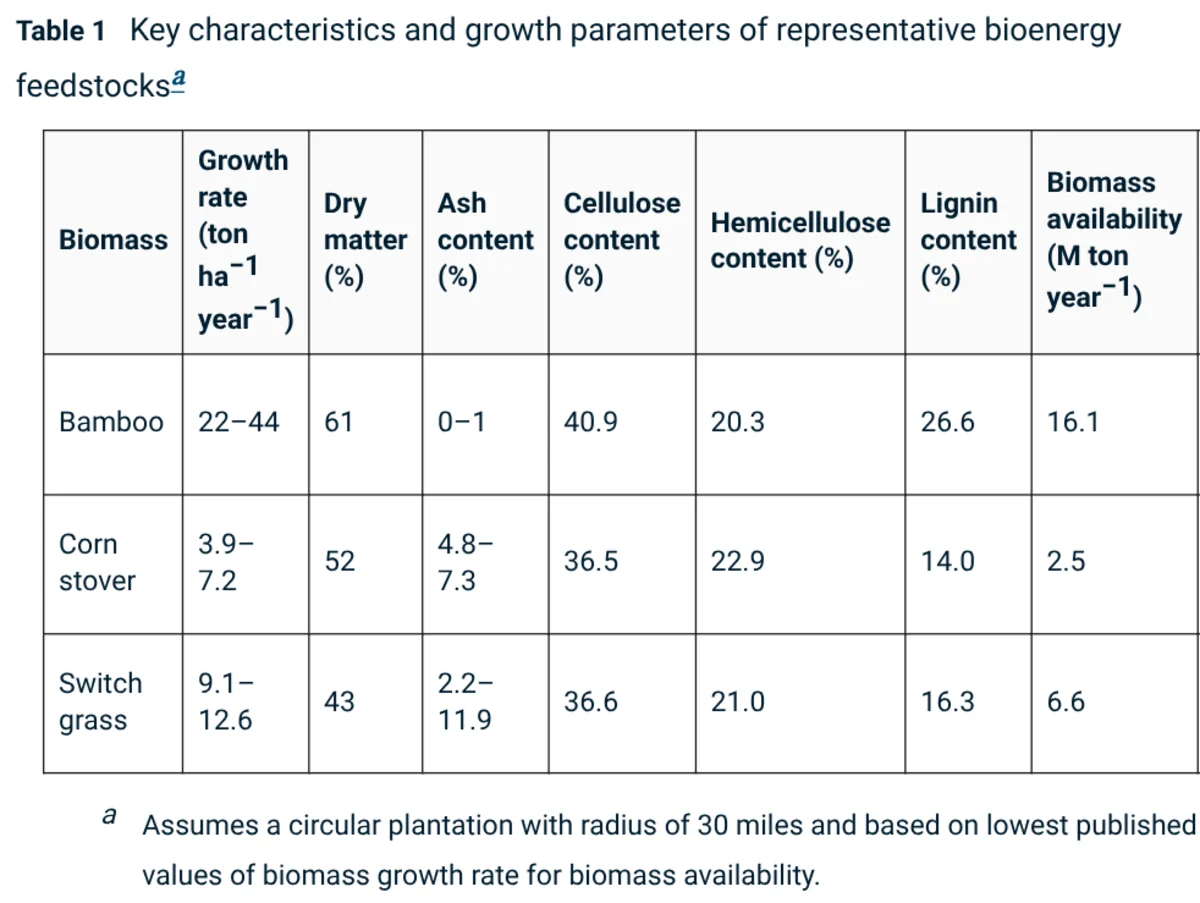
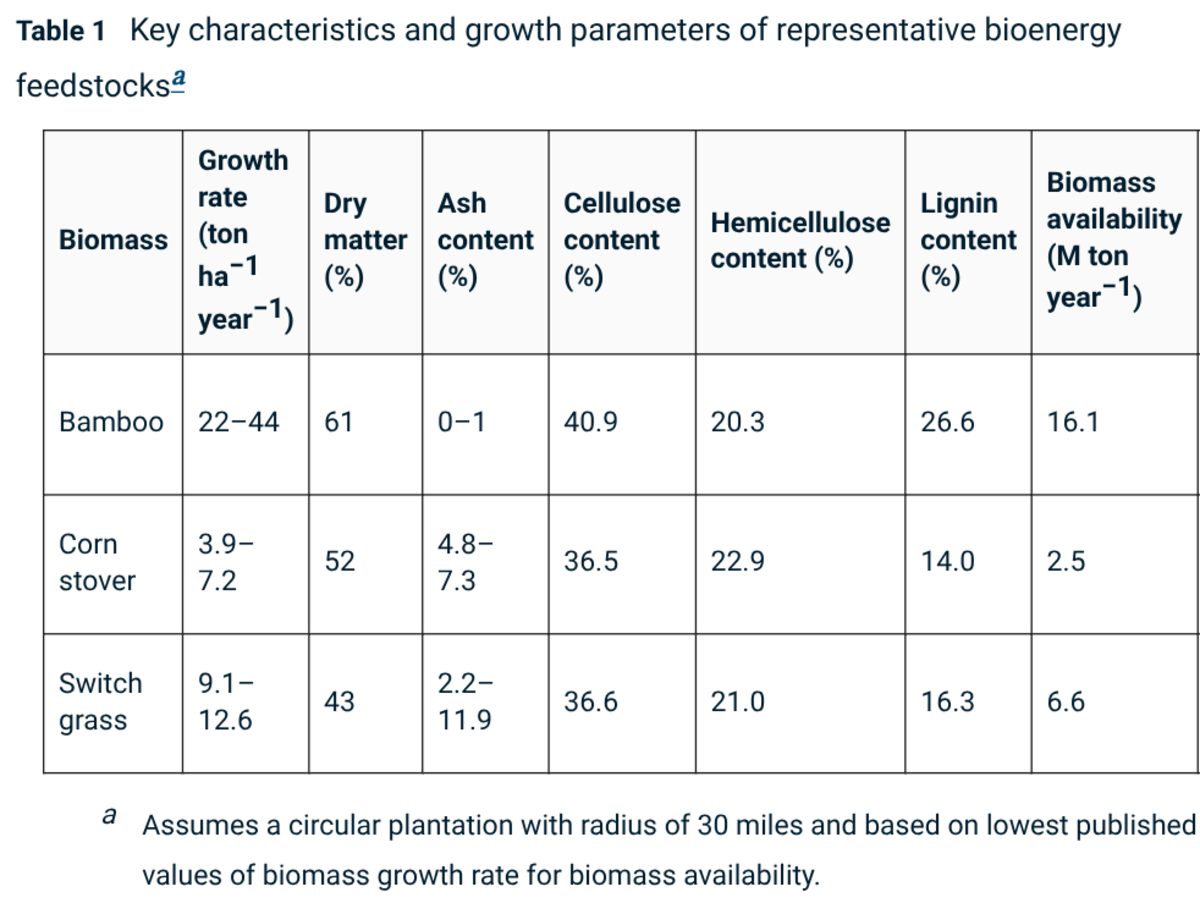
The WPI research highlights that bamboo, a rapidly growing perennial grass, solves many of the efficiency issues inherent in annual crop residues. Bamboo exhibits an exceptionally low ash content—typically less than 1 percent by dry weight—compared to corn stover (4.8–7.3 percent) and switchgrass (2.2–11.9 percent). This low mineral profile is critical for maintaining the integrity of industrial catalysts and maximizing the efficiency of liquid fuel synthesis.
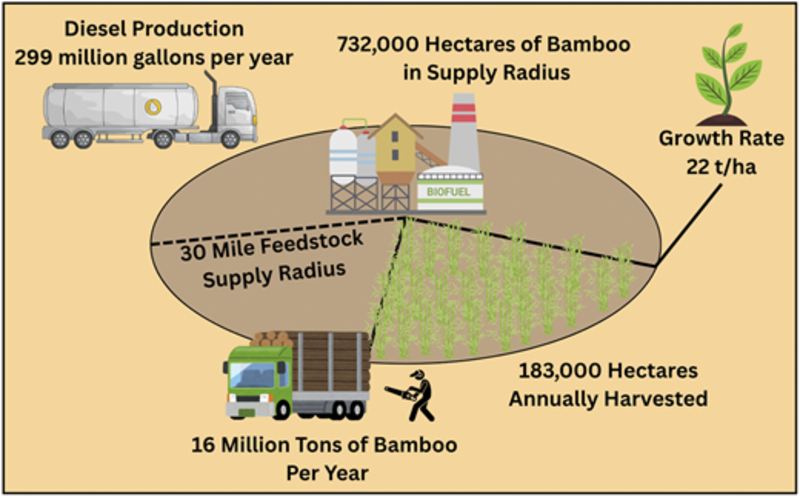
Beyond its chemical composition, bamboo’s growth characteristics are transformative for the bioenergy sector. Certain species can reach full height in months and reach maturity within four years, allowing for rapid biomass turnover. Because bamboo is a perennial with an extensive root system, it promotes soil stability, prevents erosion, and improves water conservation. Crucially, bamboo can be cultivated on marginal or degraded lands unsuitable for food crops, effectively eliminating the land-use trade-off that has hindered the expansion of first-generation biofuels.
Economic Modeling and Performance Data
The WPI research team conducted an economic and environmental impact analysis comparing bamboo to other feedstocks. The findings suggest that under mature commercial-scale conditions, bamboo-based fuel could reach a production cost of approximately $2.75 per gasoline gallon equivalent (GGE). This figure is highly competitive, falling well below current market prices for both gasoline and diesel.
The environmental benefits are equally stark. According to the study, the greenhouse gas intensity of bamboo-based fuel is estimated at 3.5 grams of carbon dioxide-equivalent per megajoule (gCO2e/MJ). This represents a drastic reduction in emissions, with the researchers noting that the fuel could produce up to 26 times fewer emissions than conventional diesel when considering the lifecycle carbon sequestration provided by the bamboo plant’s rhizome-heavy growth pattern.
Chronology of Biofuel Development
The pursuit of alternative liquid fuels has evolved through several distinct phases over the last quarter-century:
- 2000s – Early 2010s: The dominance of first-generation biofuels, primarily corn ethanol and soybean biodiesel, focused on government mandates and energy security.
- 2015 – 2020: Increased scrutiny regarding the land-use impact and the carbon footprint of industrial-scale ethanol production led to the "Advanced Biofuels" movement, targeting cellulosic materials.
- 2021 – 2025: Research expanded into non-food crops, including switchgrass and miscanthus, though scaling issues remained persistent.
- 2026: The WPI study marks a shift toward "high-performance" biomass, focusing on low-ash, high-yield perennials like bamboo as a definitive solution for sectors difficult to electrify, such as heavy-duty transport and aviation.
Implications for Energy Policy
The transition to bamboo-based biofuels would require a fundamental restructuring of agricultural and energy policies. Currently, federal subsidies are heavily skewed toward corn production. If policymakers are to support a shift to more efficient feedstocks, it would necessitate a transition in the subsidy framework—a move that would likely face significant political headwinds from well-entrenched agricultural lobbies.
Furthermore, the integration of bamboo into the national energy supply chain would require investment in new, specialized biorefineries. While the technology for hydrothermal liquefaction is maturing, the logistics of harvesting, processing, and transporting bamboo at scale are currently underdeveloped compared to the existing corn infrastructure.
The WPI team’s research, funded in part by the Pacific Northwest National Laboratory and the National Science Foundation, serves as a proof-of-concept that suggests a path toward sustainable liquid fuel production. By utilizing degraded land and minimizing the input of synthetic fertilizers, bamboo-based fuel systems could create a dual benefit: providing an economic lifeline for rural communities while supplying a low-carbon energy source for industries that cannot rely solely on battery-electric systems.
Addressing the Hard-to-Abate Sectors
The aviation and long-haul shipping sectors represent some of the most significant challenges in the global decarbonization effort. Battery weight density remains a limiting factor for transoceanic flights and heavy-duty maritime freight. Consequently, the demand for "drop-in" liquid fuels—fuels that are chemically compatible with existing engines—remains high.
Bamboo-derived biocrude offers a potential solution. Because the fuel is chemically similar to fossil-based hydrocarbons, it can be refined into jet fuel or high-grade diesel using existing infrastructure. This capability is vital for a realistic energy transition, as it allows for the decarbonization of current engine fleets without requiring the immediate retirement of millions of vehicles and vessels before the end of their operational lives.

Future Outlook and Research Trajectory
The next phase for this technology will likely involve pilot-scale demonstrations to verify the economic modeling presented in the WPI study. Scaling a bamboo supply chain requires not only engineering excellence but also a coordinated agricultural strategy. Since bamboo is a perennial, the harvesting cycle is fundamentally different from annual corn crops, requiring new equipment and supply chain logistics.
Should the findings hold in field trials, the potential for bamboo to revitalize abandoned or marginal agricultural land could provide a major boost to the rural economy. By decoupling fuel production from food production, the bamboo-to-biofuel pipeline represents a strategic evolution in the global energy mix. As the international community seeks to meet the stringent emissions targets set by climate accords, the adoption of high-efficiency, low-ash biomass like bamboo may prove to be a crucial component in the toolkit of 21st-century energy planners.
In conclusion, while electrification remains the primary goal for the passenger vehicle sector, the role of high-quality biofuels in decarbonizing the broader global economy cannot be dismissed. The WPI study provides a robust, evidence-based argument that, with sufficient investment and policy support, bamboo could transition from a niche ornamental plant to a foundational pillar of the renewable fuel industry.