When our Sun finally runs out of hydrogen fuel in its core some five billion years from now, astronomers have long predicted a catastrophic end for the inner solar system. Mercury, Venus, and almost certainly Earth will be swallowed, scorched, or entirely vaporized as our star swells into a bloated red giant. For decades, however, conventional astronomical wisdom held that the outer reaches of our stellar neighborhood would be spared. Protected by vast distances from the central inferno, the four gas and ice giants—Jupiter, Saturn, Uranus, and Neptune—were expected to drift outward, maintaining their stable, orderly orbits and largely preserving the architectural blueprint of the outer solar system for hundreds of billions of years.
New research published on September 21 in The Astrophysical Journal Letters challenges this comforting celestial consensus. According to a pioneering study conducted by astrophysicists, the death of the Sun will not spell peace for the outer planets. Instead, the dramatic loss of solar mass will destabilize the intricate gravitational choreography that keeps the gas giants in check. As the Sun sheds its outer layers and contracts into a dim white dwarf, perturbations within the system will cause the giant planets to develop increasingly eccentric, or weirdly shaped, orbits. Within approximately three billion years of the Sun’s red giant phase, these distorted paths will intersect, resulting in catastrophic planetary collisions, the ejection of worlds into interstellar space, and the ultimate destruction of the outer solar system as we know it.
This startling revelation fundamentally alters humanity’s theoretical models of stellar evolution and galactic dynamics. Beyond rewriting the final chapter of our own cosmic backyard, the findings carry profound implications for the study of exoplanetary systems, potentially explaining why astronomers observing distant white dwarfs frequently find polluted atmospheres laden with the planetary debris of dead worlds.
The Life and Death of a Yellow Dwarf Star
To understand the mechanics of this newly proposed cosmic catastrophe, researchers must first look at the predictable life cycle of stars like our Sun. Currently classified as a main-sequence yellow dwarf (a G-type main-sequence star), the Sun has been steadily fusing hydrogen into helium in its core for roughly 4.6 billion years. It is currently in the most stable phase of its existence and will continue to shine in this manner for another five billion years.
Eventually, however, the hydrogen fuel in the core will become depleted. As core pressure drops and hydrogen fusion moves outward into a shell surrounding the core, the Sun’s outer layers will begin to expand dramatically. During this red giant phase, which is expected to begin roughly 5 billion years from now, the Sun’s radius will swell outward, engulfing the inner planets. Mercury and Venus will be completely consumed, and Earth’s oceans will boil away, leaving our home planet a scorched, lifeless rock—assuming it is not also swallowed by the expanding solar envelope.
For the outer planets, this phase was previously viewed as a period of relative safety combined with gentle expansion. As the Sun loses mass through powerful stellar winds and the ejection of its outer envelopes during the asymptotic giant branch (AGB) phase, the total gravitational pull of the Sun will decrease. Because the central mass is shrinking, the orbits of Jupiter, Saturn, Uranus, and Neptune are expected to expand outward in response to the weakened gravitational tether.
For many years, orbital simulations suggested this outward migration would be stable. Astrophysicists believed that while the planetary system would spread out, the fundamental distances between the planets would remain large enough to prevent gravitational chaos. The new study, however, demonstrates that long-term numerical models failed to account for subtle, cumulative gravitational instabilities triggered during the transition from a main-sequence star to a white dwarf.
Unraveling the Gravitational Stability of the Outer Solar System
The research team behind the new publication utilized advanced N-body simulations—computational models that track the motion of multiple interacting gravitational bodies over vast spans of time. By modeling the changing mass of the Sun and mapping the subsequent gravitational reactions of the four outer planets, the researchers observed a troubling phenomenon.
As the Sun loses nearly half of its total mass during its red giant and planetary nebula phases, the delicate gravitational balance holding the outer solar system together is disrupted. While the initial expansion pushes the planets outward, the loss of a massive central anchor reduces the system’s overall damping mechanisms. Without a massive, tightly bound gravitational center, minor orbital eccentricities—deviations from a perfect circle—begin to amplify over time.
Over millions and billions of years, these eccentricities compound. Uranus and Neptune, the two ice giants, are particularly susceptible to these shifts. Their orbits begin to stretch, elongating into ovals that slice across the pathways of Saturn and Jupiter. Once these orbits begin to cross, the gravitational resonance that has kept the planets separated for billions of years breaks down completely.
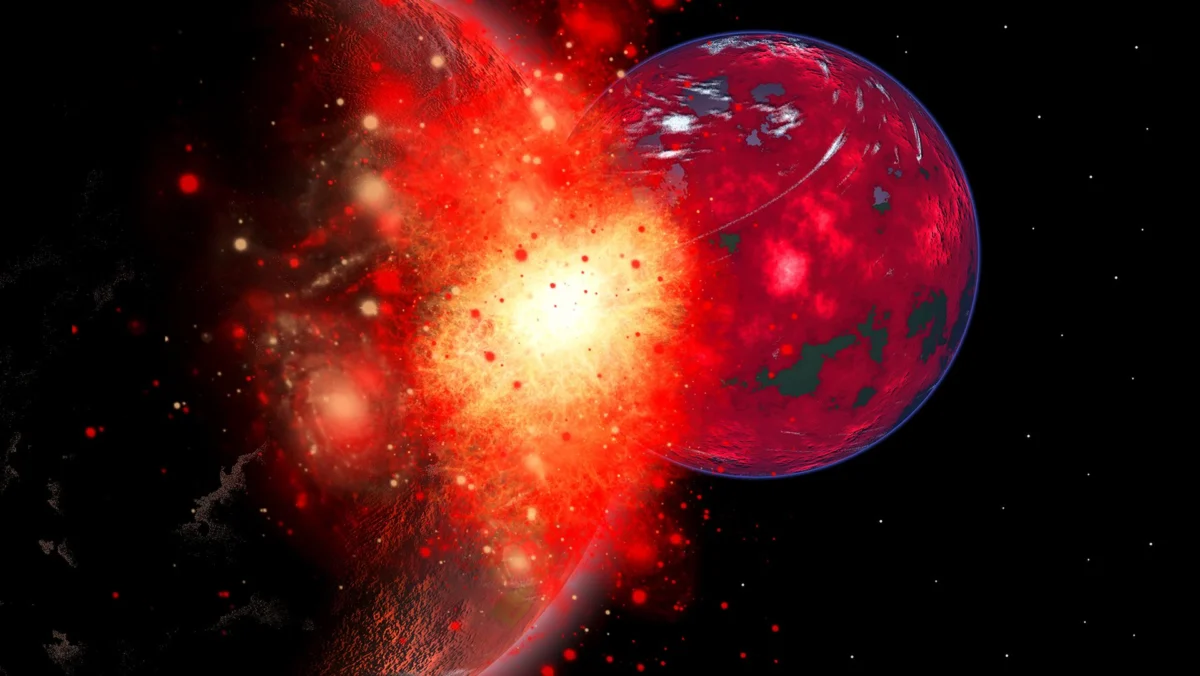
Within roughly three billion years after the Sun completes its transformation into a white dwarf, the simulations show that the outer planets will experience close gravitational encounters. These near-misses will act as cosmic billiard shots. Some planets will be accelerated to escape velocity, hurled out of the solar system entirely to wander the galaxy as rogue planets drifting through the interstellar void. Others will be thrown inward toward the dead white dwarf, where intense tidal forces will shred them apart, or they will collide directly with one another in violent, high-speed impacts that pulverize rock, ice, and gas into vast disks of debris.
A Timeline of the Final Epoch
While humanity will not be around to witness these events—having either vanished, evolved, or migrated to other star systems billions of years prior—astronomers have mapped out a tentative chronological sequence for the twilight of the solar system based on current astrophysical models:
- Present Day to +5 Billion Years: The Sun remains stable, fusing hydrogen and supporting life on Earth (though solar luminosity will slowly increase, rendering Earth uninhabitable to complex life in about one billion years).
- +5 Billion Years to +5.5 Billion Years: The Sun enters its red giant phase. The inner planets (Mercury, Venus, and Earth) are destroyed or rendered into barren husks. The outer planets begin their outward migration as the Sun sheds mass via stellar winds.
- +5.5 Billion Years to +6 Billion Years: The Sun sheds its outer layers into space, forming a planetary nebula and leaving behind a dense, cooling white dwarf star with roughly half of its original mass.
- +6 Billion Years to +8 Billion Years: The long-term instability phase begins. Gravitational resonance fades, and the orbits of Jupiter, Saturn, Uranus, and Neptune begin to stretch into eccentric, crossing ellipses.
- +8 Billion Years to +9 Billion Years: The chaos peaks. Close planetary encounters result in gravitational scattering, leading to catastrophic collisions between planets or the complete ejection of worlds into interstellar space. The outer solar system is entirely obliterated.
Broader Implications for Exoplanetary Astronomy
The significance of these findings extends far beyond our own solar system, offering crucial context for astronomers studying distant planetary systems across the Milky Way.
Over the past three decades, space telescopes such as Kepler, TESS, and James Webb have confirmed the existence of thousands of exoplanets orbiting distant stars. Furthermore, astronomers have identified numerous white dwarf stars that exhibit "pollution"—spectroscopic signatures of heavy elements like iron, magnesium, and silicon in their atmospheres. Because white dwarfs are composed almost entirely of carbon and oxygen, any heavy elements detected in their atmospheres must have fallen onto them recently from external sources.
For years, scientists debated the origin of this debris. The prevailing theory suggested that rocky asteroids and inner planets left over from the main-sequence phase were occasionally nudged inward to be devoured by the white dwarf. However, the new study on outer solar system instability suggests that giant planets themselves—or the massive belts of icy comets and planetesimals they scatter during their death throes—may be primary contributors to this stellar pollution.
When the outer gas and ice giants collide or are torn apart by gravitational forces, they release massive quantities of dust, gas, and rocky-icy fragments. A fraction of this material inevitably spirals inward, raining down upon the surface of the white dwarf star. By modeling the fate of our own outer planets, astrophysicists gain a universal template for how planetary systems die across the cosmos.
The Legacy of a Distant Future
The realization that even Jupiter and Saturn are not destined to endure forever serves as a humbling reminder of the transient nature of the cosmos. Everything in the universe, from the smallest asteroid to the grandest gas giant, is ultimately subject to the inexorable laws of stellar evolution and gravitational physics.
While the destruction of the outer solar system is an event so distant that it defies human comprehension, the research published in The Astrophysical Journal Letters bridges the gap between theoretical astrophysics and observational reality. It transforms our view of stellar death from a quiet, orderly fading of light into a dynamic, chaotic finale where even the heaviest worlds in the universe ultimately meet their doom.