
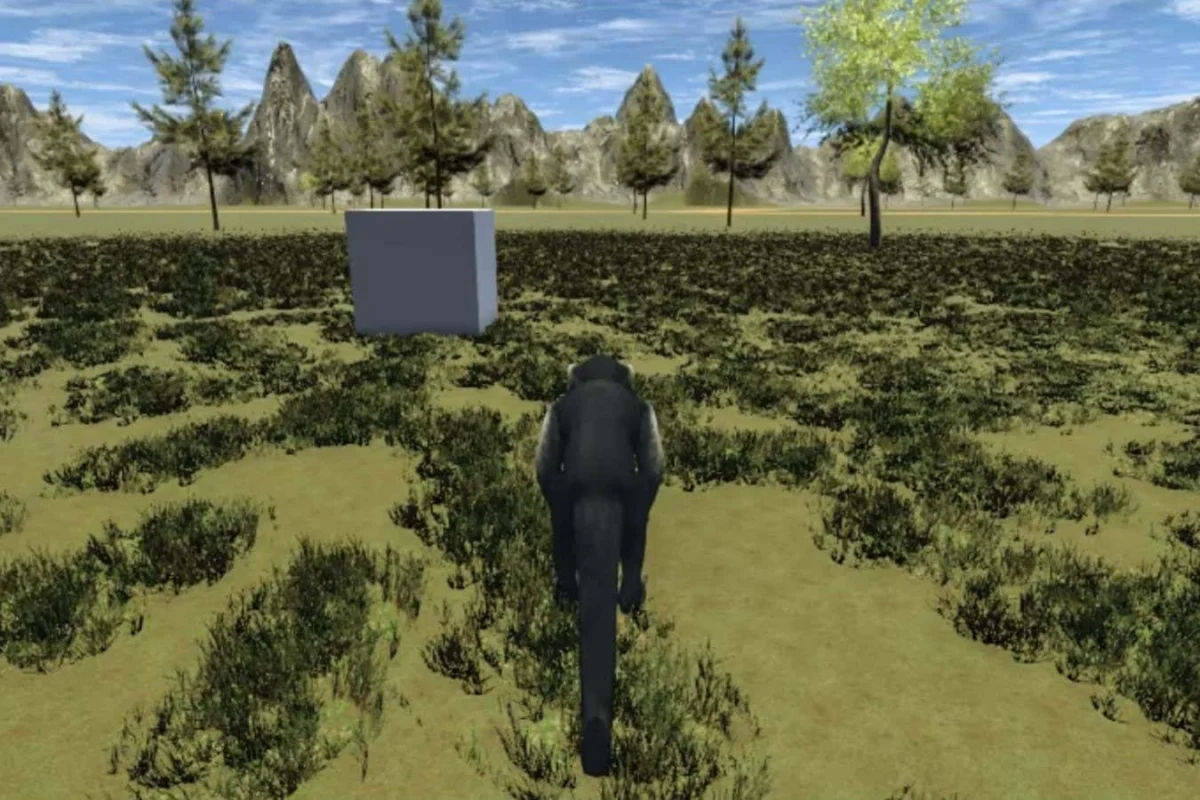
Monkeys have demonstrated an unprecedented ability to navigate complex virtual environments using only their thoughts, thanks to advanced brain-computer interfaces (BCIs). Researchers at KU Leuven in Belgium have successfully implanted three rhesus macaque monkeys with multi-electrode arrays, enabling them to control avatars in virtual reality with remarkable intuitiveness. This breakthrough, published in the scientific journal Nature Neuroscience in early 2026, offers a tantalizing glimpse into a future where individuals with severe paralysis could regain the ability to explore digital realms or operate advanced assistive devices like electric wheelchairs with greater ease and natural control.
The Neuroscience of Virtual Navigation
The core of this groundbreaking research lies in the precise placement and sophisticated interpretation of neural signals. Peter Janssen and his team implanted each of the three rhesus macaques with three separate BCIs. These implants, each comprising 96 electrodes, were strategically positioned within key areas of the monkeys’ brains: the primary motor cortex, known for its direct role in executing physical movements, and crucially, the dorsal and ventral premotor cortices. These latter areas are increasingly understood to be involved in the higher-level planning and conceptualization of movement, suggesting a more abstract and intuitive neural pathway for control.
"Our hypothesis was that by accessing these premotor areas, we could tap into a more abstract representation of movement, rather than just the direct motor commands," explained Dr. Janssen in a press briefing following the study’s publication. "This approach aims to bypass the often laborious and abstract process of learning to map specific thoughts, like imagining moving a finger, to a desired action on a screen. Instead, we’re aiming for a more direct translation of intent into action."
The electrical signals harvested from these neural implants were then fed into a sophisticated artificial intelligence (AI) model. This AI was trained to decode the complex patterns of neural activity and translate them into commands for controlling virtual reality (VR) avatars. The monkeys were exposed to a 3D monitor displaying various virtual scenarios, where their brain activity directly dictated the movement of their digital counterparts.
From Simple Spheres to Complex Environments
The experiments progressively increased in complexity, showcasing the versatility of the BCI system. Initially, the monkeys were tasked with controlling a simple sphere moving across a virtual landscape, starting from a fixed point of view. This foundational exercise allowed the AI to learn the basic neural correlates of directional intent.
The research then advanced to more dynamic and engaging scenarios. The monkeys were able to control animated monkey avatars from a third-person perspective, akin to how a player would experience a video game. This required a more nuanced understanding of spatial navigation and goal-directed movement within the virtual environment.
Perhaps the most impressive demonstration of the BCI’s capability came in subsequent phases of the study. The monkeys successfully navigated through virtual buildings, autonomously opening doors and moving between rooms. This level of environmental interaction suggests that the BCIs were not merely tracking gross motor commands but were capable of deciphering more complex sequences of actions and spatial reasoning.
"The ability to open doors and move through different rooms signifies a substantial leap," commented Dr. Janssen. "It implies that the system is not just about moving forward or turning, but about understanding and executing a series of actions to achieve a specific spatial objective. We believe this is a testament to the intuitive nature of the neural signals we are accessing."
Redefining Intuitive Control
The success of this research is particularly significant when contrasted with previous BCI trials involving human participants. Many earlier human BCI studies have relied on participants learning to associate specific, often arbitrary, mental tasks with cursor movements or other digital actions. For instance, a common method involves training individuals to imagine raising or lowering a finger to control a cursor on a screen. While effective, this process can be mentally taxing and require extensive training periods, often described by users as feeling akin to "trying to move your ears"—a disconnected and sometimes frustrating experience.
Dr. Janssen’s team believes their approach, by targeting the premotor cortices, taps into a more innate and "higher-level" understanding of movement within the brain. This could lead to a more seamless and intuitive user experience, reducing the learning curve significantly.
"While we cannot directly solicit feedback from the monkeys, our interpretation is that this represents a more intuitive way of interacting with a computer," Dr. Janssen stated. "It’s about translating the intention to move or act into a digital output, rather than learning a complex set of arbitrary mental exercises. We’re aiming for a control scheme that feels more like thinking about where you want to go or what you want to do, and having it happen."
Implications for Human Rehabilitation
The ultimate goal of this research is to translate these findings into tangible benefits for individuals with paralysis. Dr. Janssen expressed optimism about the potential for this BCI technology to revolutionize assistive technologies for humans.
"We envision a future where people with paralysis can explore the rich possibilities of virtual worlds, engage in immersive gaming, or participate in virtual social spaces," he said. "Furthermore, this technology could lead to far more intuitive and responsive control of electric wheelchairs, allowing for greater independence and freedom of movement in the real world."
However, Dr. Janssen also acknowledged that the path to human trials requires further meticulous research. "There’s a considerable amount of work still needed to precisely map these brain regions in humans," he explained. "While the general areas are understood, the exact anatomical locations and functional specializations can vary. Once we have that precise mapping, the transition to human application should be significantly smoother, especially as we can directly communicate and guide human participants through the process."
Expert Perspectives on the Breakthrough
The significance of this research has been recognized by leading neuroscientists in the field. Andrew Jackson, a professor at Newcastle University in the UK, who has been involved in developing BCIs for human use, highlighted the remarkable adaptability demonstrated by the monkeys.
"One of the most impressive aspects of this work is the monkeys’ ability to control movement from different viewpoints and in diverse contexts using the same BCI system," Professor Jackson commented. "This suggests that the interface has successfully tapped into abstract representations of movement within the brain. It’s as if the brain is thinking about movement in a more general, conceptual way, allowing it to adapt to various scenarios, much like a human gamer can adapt to different virtual environments using a familiar controller."
Professor Jackson drew an analogy to video game controllers: "You have a set of buttons, and for each game, you learn the specific mapping between those buttons and the in-game actions. It’s manageable because there are only so many combinations to learn. However, if a new game suddenly required you to physically get up and open a real-world refrigerator to proceed, that would be a much more complex and challenging task. The monkeys’ performance in this study suggests their BCI is handling such a leap in contextual adaptation."
A Developing Landscape of BCI Technology
This research emerges against a backdrop of rapidly advancing BCI technology, with both academic institutions and private companies pushing the boundaries of what’s possible. Previous human trials have already showcased promising applications. For instance, a man with paralysis was able to pilot a virtual drone through a challenging obstacle course using a BCI that interpreted his imagined finger movements. In another notable development, individuals have been able to generate text by simply imagining handwriting, with AI converting their brain signals into written words.
The field has also seen significant investment and attention from high-profile figures. In 2024, Neuralink, the company co-founded by Elon Musk, announced the successful implantation of its BCI in a human for the first time, enabling the individual to control a computer cursor. However, reports later indicated that a substantial portion of the electrode threads had shifted within the brain after just one month, leading to a significant reduction in the user’s control capabilities. This underscores the ongoing challenges in achieving long-term stability and reliable performance in human BCI implants.
The work by Dr. Janssen and his team, by focusing on higher-level motor planning areas and demonstrating consistent, multi-contextual control in animal models, offers a promising new direction. While challenges remain in translating these findings to humans, the successful navigation of virtual worlds by monkeys using thought alone represents a significant stride towards a future where advanced BCIs can restore and enhance mobility and interaction for those who need it most. The continued collaboration between neuroscience, AI, and engineering will be critical in realizing this transformative potential.
Future Directions and Challenges
The success of the KU Leuven study prompts several avenues for future research. Firstly, the team aims to refine the AI algorithms for even more precise and nuanced control. Secondly, they plan to investigate the long-term effects of these implants and explore methods for ensuring their stability and efficacy in the human brain. The ethical considerations surrounding BCIs, particularly regarding data privacy and potential misuse, will also need to be carefully addressed as the technology progresses.
The journey from animal models to human application is often lengthy and complex, but the progress made in this study offers a powerful beacon of hope. The ability of monkeys to intuitively navigate virtual environments using their minds is not just a scientific curiosity; it is a testament to the remarkable plasticity of the brain and the burgeoning potential of neurotechnology to overcome profound physical limitations. As research continues, the prospect of individuals regaining lost autonomy and experiencing newfound freedoms, both in digital and physical realms, moves ever closer to reality.










Leave a Reply