
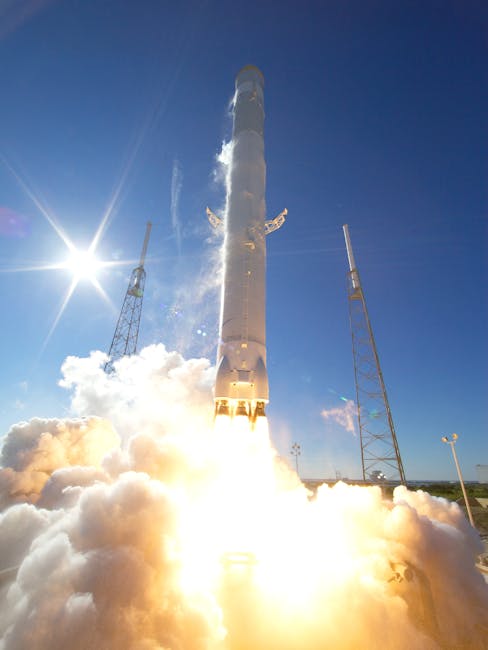
Anduril’s Rapid Payload Deployment for Launch Defense
Anduril Industries is revolutionizing the aerospace and defense sector with its innovative approach to rapid payload deployment for launch defense. This capability is not merely an incremental improvement; it represents a paradigm shift in how nations and commercial entities can protect their space assets and ensure the continuity of critical launch operations. The core of Anduril’s advantage lies in its integrated systems design, leveraging software-defined hardware and advanced artificial intelligence to achieve unprecedented speed and agility. Traditional launch defense systems are often bespoke, slow to develop, and require significant lead times for integration and deployment. Anduril bypasses these bottlenecks through a modular, software-centric architecture that allows for rapid customization, testing, and fielding of defensive payloads. This means that as threats evolve or new launch capabilities emerge, Anduril’s systems can be adapted and deployed with a speed previously unimaginable, providing a dynamic and responsive shield for vital space infrastructure.
The genesis of Anduril’s rapid payload deployment capability is rooted in its foundational philosophy of employing modern software engineering principles and commercial off-the-shelf (COTS) components where applicable, combined with purpose-built, high-performance hardware. This dual approach allows for accelerated development cycles, reducing the traditional lengthy timelines associated with military system acquisition. For launch defense, this translates directly into the ability to quickly integrate and launch a variety of defensive payloads, from kinetic interceptors designed to neutralize immediate threats to electronic warfare systems capable of disrupting adversary capabilities. The software-defined nature of their platforms means that the core functionality can be rapidly reconfigured or augmented with new algorithms and mission profiles through over-the-air updates or expedited software integration. This agility is paramount in the rapidly evolving landscape of space-based threats, where static defenses can quickly become obsolete.
Anduril’s approach to launch defense is inherently tied to its broader vision of distributed, intelligent defense networks. Rather than relying on a single, massive, and vulnerable defense platform, Anduril advocates for a constellation of interconnected and highly autonomous systems. These systems can be rapidly deployed to augment existing launch infrastructure or to create entirely new defensive perimeters. The speed of deployment is critical here. Imagine a scenario where a nation announces an aggressive new space capability that poses a direct threat to an allied launch site. With traditional systems, the response time could be measured in months or even years. Anduril’s architecture allows for the rapid adaptation of existing defensive elements and the swift integration of new payloads, potentially enabling a robust countermeasure to be operational within weeks or even days. This is achieved through a combination of pre-validated hardware modules and highly sophisticated simulation and testing environments that can rapidly assess the efficacy of new payload configurations.
The specific payloads that Anduril can rapidly deploy for launch defense are diverse and designed to address a spectrum of threats. This includes high-agility interceptors, capable of tracking and neutralizing both ballistic missiles during their ascent phase and potential space-based threats targeting launch vehicles or satellites. These interceptors are designed for rapid launch and precise guidance, enabled by advanced onboard processing and real-time data fusion from multiple sensor networks. Beyond kinetic solutions, Anduril is also developing and integrating sophisticated electronic warfare (EW) payloads. These can be employed to jam enemy sensors, disrupt command and control links, or even spoof navigation signals, effectively neutralizing threats without kinetic engagement. The speed of deployment allows for EW capabilities to be positioned dynamically, responding to emerging threats or adapting to changing operational environments around launch facilities.
Furthermore, Anduril’s focus on AI-driven autonomy plays a pivotal role in enabling rapid payload deployment for launch defense. Autonomous decision-making algorithms allow defensive systems to react to threats with minimal human intervention, reducing response times and increasing engagement probabilities. This is particularly important for launch defense, where split-second decisions can mean the difference between mission success and failure, or between the protection of critical assets and their destruction. The AI can rapidly assess threat vectors, identify optimal intercept points or jamming strategies, and execute defensive maneuvers. This level of autonomy is not achieved through brute force, but through sophisticated machine learning models trained on vast datasets, allowing for rapid adaptation to novel threat signatures and operational scenarios. The ability to quickly integrate new AI models or refine existing ones into the deployed payloads further enhances the speed and effectiveness of the defensive posture.
The integration of Anduril’s systems with existing command and control (C2) infrastructure is another key enabler of rapid deployment. Their platforms are designed to be interoperable with a range of legacy and modern C2 systems, allowing for seamless integration into existing defense architectures. This avoids the need for extensive and time-consuming modifications to established command structures. The software-defined nature of their payloads means that new defensive capabilities can be "plugged in" to existing networks, receiving targeting data and transmitting engagement status in real-time. This plug-and-play approach drastically reduces the integration time, a significant hurdle in traditional defense procurement. The speed at which new defensive doctrines or operational concepts can be implemented through software updates further underscores the rapid deployment advantage.
Consider the implications for national security and commercial space endeavors. For nations, rapid launch defense ensures the survivability of their strategic assets, including their space-based early warning systems, communication satellites, and navigation constellations, all of which are critical for military operations. The ability to quickly deploy defensive countermeasures around key launch sites protects the continuity of their space programs and prevents adversaries from holding their space capabilities hostage. For commercial space companies, this translates into greater security for their valuable satellite constellations and launch operations. As the commercial space industry continues to grow, with an increasing reliance on space-based infrastructure for telecommunications, Earth observation, and navigation, the threat landscape will undoubtedly expand. Anduril’s rapid payload deployment capability offers a crucial layer of security, enabling the industry to expand with confidence.
The economic impact of rapid payload deployment should also not be overlooked. Traditional defense acquisition processes are notoriously expensive and time-consuming. By accelerating development and deployment, Anduril’s approach can lead to significant cost savings and a more efficient allocation of defense resources. The ability to quickly upgrade and adapt existing systems rather than requiring complete replacements also contributes to long-term cost-effectiveness. This agility allows for a more iterative and cost-controlled approach to building out robust launch defense capabilities, making advanced protection accessible to a wider range of defense organizations and commercial entities. The reduced timelines also mean that threats can be countered at an earlier stage, potentially preventing more costly and escalatory conflicts.
The underlying technology powering Anduril’s rapid payload deployment is a testament to their commitment to innovation. This includes advanced robotics, sophisticated sensor fusion algorithms, high-performance computing, and secure, resilient communication networks. The rapid development of these components, often leveraging bleeding-edge research and rapid prototyping, allows for the swift assembly and testing of specialized defensive payloads. For instance, the development of a new interceptor variant might involve rapid iteration on propulsion systems, guidance algorithms, and warhead designs, all facilitated by integrated simulation environments and rapid manufacturing techniques. Similarly, EW payloads benefit from advancements in signal processing, electronic countermeasures, and jamming technologies that can be quickly integrated into modular hardware.
The future of launch defense is undeniably one of agility and adaptability. Anduril’s focus on rapid payload deployment is a clear indicator of this trend. As the space domain becomes increasingly contested, the ability to respond quickly and effectively to evolving threats will be paramount. This means moving beyond static, long-lead-time systems and embracing a more dynamic, software-defined, and AI-driven approach. Anduril’s innovative architecture and commitment to rapid development position them at the forefront of this critical evolution, providing the tools and capabilities necessary to secure the vital launch infrastructure of the 21st century. The continued advancements in their modular payload design, AI integration, and C2 interoperability will further solidify their role as a leader in this rapidly developing field, ensuring that space operations can proceed with a heightened level of security and resilience. The ability to dynamically reconfigure and redeploy defensive capabilities, tailored to specific threats and operational contexts, represents a significant leap forward in ensuring the strategic advantage in the space domain. This is not just about defending against immediate threats to launches, but about creating a pervasive, adaptable, and responsive defensive posture that can deter aggression and preserve freedom of action in space for years to come. The speed of deployment is the ultimate enabler of this proactive and resilient defense strategy.





Leave a Reply