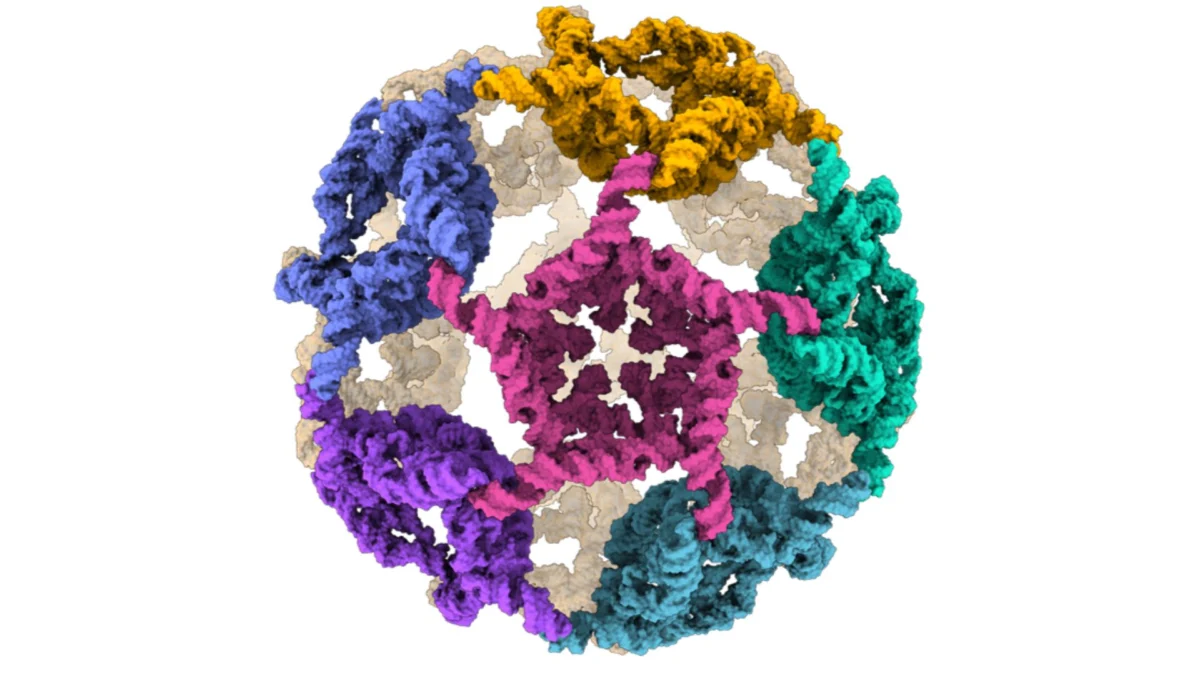
For decades, the prevailing scientific narrative regarding the origins of life on Earth has centered on the remarkable molecule RNA (ribonucleic acid). It was long believed that when RNA first kick-started biological processes approximately four billion years ago, it was capable of forming only rudimentary, simple structures. These early RNA molecules were thought to function primarily as simple building blocks, storing genetic information and catalyzing basic chemical reactions. However, groundbreaking new research is dramatically reshaping this understanding, revealing that naturally occurring RNA molecules can, in fact, adopt remarkably large and sophisticated geometries, including intricate filaments and robust cage-like structures. This paradigm-shifting discovery has ignited a fervent debate among scientists: were these complex RNA architectures present at the very inception of life, playing a more pivotal and elaborate role than previously imagined?
The RNA World Hypothesis: A Foundation Under Scrutiny
The concept that RNA played a central role in early life is embodied by the "RNA world hypothesis." This influential theory posits that RNA-based life-forms predated the modern biological systems that rely on DNA for genetic storage and proteins for catalytic functions. In contemporary cells, RNA still performs vital roles, such as protein synthesis and gene regulation, but it is not the primary carrier of genetic blueprints. In stark contrast, the hypothesis suggests that primordial organisms harnessed RNA for both storing genetic information and acting as versatile, stand-in enzymes, performing a wide array of chemical transformations essential for survival.
This hypothesis gained traction because RNA possesses a unique duality: it can encode genetic information, much like DNA, and it can also fold into three-dimensional structures capable of catalyzing chemical reactions, a property known as ribozyme activity. This dual capability made RNA a plausible candidate for the first self-replicating and metabolizing entities, bridging the gap between simple organic molecules and the complex cellular life we see today.
Challenging Conventional Wisdom: The Emergence of Complex RNA Geometries
The recent research, which has yet to be formally published in a peer-reviewed journal but has been presented at scientific conferences and discussed within the research community, challenges the long-held assumption about the structural limitations of early RNA. Scientists have historically focused on the ability of RNA to form relatively small, functional units. The prevailing view was that the conditions on early Earth, coupled with the inherent properties of RNA, would have restricted its assembly into anything beyond simple strands or small folded complexes.
However, the new findings demonstrate that under specific, and potentially naturally occurring, conditions, RNA molecules can self-assemble into far more elaborate and stable structures. These include:
- Filamentous Structures: RNA strands can aggregate and link together to form long, chain-like or fibrous assemblies. These filaments could have served various purposes, such as providing scaffolding, facilitating molecular transport, or acting as early forms of cellular compartmentalization.
- Cage-like Architectures: Perhaps even more astonishing is the observed ability of RNA to fold and interconnect into enclosed, three-dimensional cage-like structures. These intricate geometries suggest a level of molecular organization that was previously thought to be beyond the capabilities of RNA alone in the early stages of life. Such cages could have encapsulated other molecules, creating primitive internal environments for chemical reactions, or protected genetic material from degradation.
The research involved both computational modeling and laboratory experiments designed to simulate the conditions that might have existed on early Earth. By varying parameters such as temperature, pH, and the concentration of RNA and other relevant molecules (like mineral catalysts or metal ions), scientists were able to observe the spontaneous formation of these complex RNA architectures.
Implications for the Origin of Life
The implications of this discovery are profound. If RNA could indeed form such sophisticated structures early in Earth’s history, it significantly strengthens the RNA world hypothesis and provides a more robust framework for understanding the transition from non-living chemistry to the first primitive life forms.
1. Enhanced Catalytic Efficiency and Specificity: Complex RNA structures, particularly those forming internal cavities or organized surfaces, could have provided more efficient and specific catalytic environments than simple, linear RNA molecules. These intricate formations might have concentrated reactants, stabilized transition states, or even mimicked the active sites of modern protein enzymes with greater precision. This could have accelerated the development of essential metabolic pathways.
2. Primitive Compartmentalization: The formation of cage-like RNA structures suggests a mechanism for early compartmentalization, a key feature of all life. These RNA cages could have acted as proto-cells, enclosing genetic material and other molecules, thereby creating a distinct internal environment separate from the external surroundings. This would have been a crucial step towards the development of true cellular life, allowing for the concentration of resources and the protection of vital components.
3. Increased Stability and Resilience: Larger, more complex RNA assemblies might have offered greater stability and resilience against the harsh conditions of early Earth, such as UV radiation and chemical fluctuations. This increased robustness would have been essential for the survival and propagation of early life forms.
4. A More Complex "Primordial Soup": The discovery suggests that the "primordial soup" from which life arose was not merely a collection of simple organic molecules but potentially contained pre-formed, complex supramolecular structures. This adds another layer of sophistication to our understanding of prebiotic chemistry.
Expert Reactions and Future Directions
While the research is still in its early stages of dissemination, the scientific community is abuzz with excitement and anticipation. Dr. Sarah Chen, a leading astrobiologist not directly involved in the study, commented, "This is a truly remarkable finding. For years, we’ve been constrained by the assumption that early RNA was structurally simple. If these complex geometries are indeed achievable under plausible early Earth conditions, it forces us to reconsider the entire timeline and complexity of life’s origins. It opens up entirely new avenues of research into how these structures might have functioned and interacted."
Dr. Michael Evans, a biochemist specializing in RNA folding, added, "The ability of RNA to form such intricate structures, like cages and filaments, is a testament to its inherent versatility. It suggests that RNA was not just a passive carrier of information but an active architect of its own environment and function. The key now is to rigorously test these findings and explore the specific biochemical pathways that might have led to their formation and stability."
The research team, led by Dr. Anya Sharma at the Institute for Prebiotic Studies, plans to conduct further experiments to:
- Elucidate Formation Mechanisms: Detail the precise chemical and physical conditions that favor the formation of these complex structures. This includes investigating the role of specific minerals, metal ions, and environmental gradients that may have been present on early Earth.
- Investigate Functional Properties: Explore the catalytic activities and other potential functions of these RNA filaments and cages. Can they bind specific molecules? Can they catalyze more complex reactions than previously known ribozymes?
- Explore Evolutionary Potential: Assess the potential for these complex RNA structures to evolve and self-replicate, a critical step in the transition to life. Could these structures have served as the progenitors of more complex genetic systems?
- Search for Extraterrestrial Analogues: Consider whether similar complex RNA structures could exist or have existed on other celestial bodies, potentially broadening the search for extraterrestrial life.
A New Dawn for Origin-of-Life Research
The traditional view of the RNA world, while foundational, has often been depicted as a somewhat limited precursor to the DNA-protein world. This new research injects a significant dose of complexity and sophistication into that picture. It suggests that RNA, even in its earliest forms, possessed an inherent capacity for intricate self-assembly, laying the groundwork for the complex molecular machinery that underpins all life on Earth.
The discovery that RNA can form large, sophisticated geometries like filaments and cages has moved the needle on our understanding of life’s beginnings. It raises the tantalizing possibility that the very first steps towards life involved a level of molecular organization far beyond what was previously imagined. As scientists delve deeper into these complex RNA architectures, they are not only rewriting the history of life on our planet but also potentially uncovering universal principles that could guide the search for life beyond Earth. The RNA world hypothesis, once a compelling but somewhat abstract concept, is now being fleshed out with structural complexity, hinting at a far richer and more dynamic genesis for life itself.