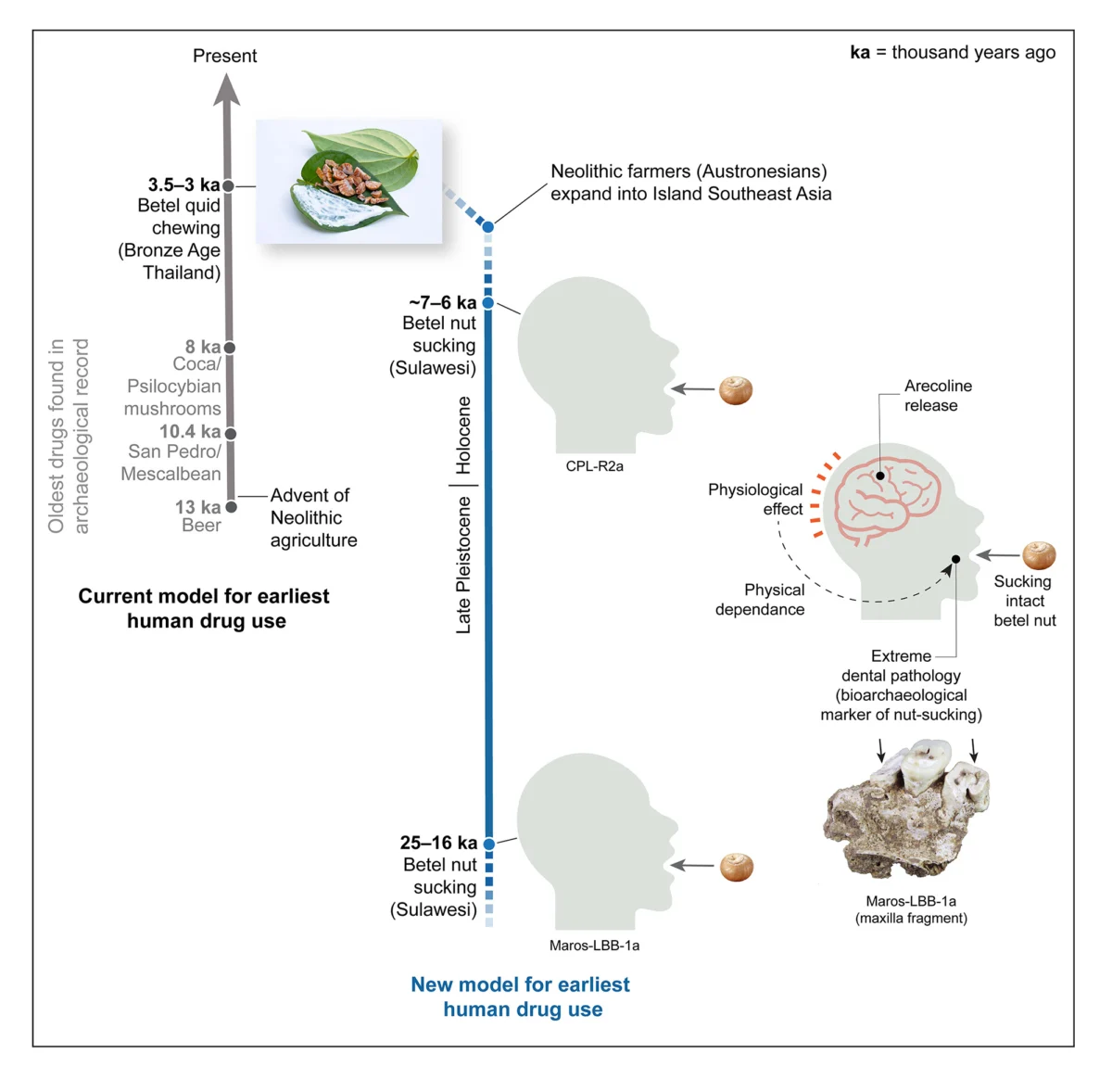
New archaeological findings from an Indonesian island have pushed back the known timeline of habitual human drug consumption by thousands of years. According to a study published on Wednesday in the journal Science Advances, ice age hunter-gatherers inhabiting the region engaged in the regular, habitual consumption of betel nuts—the seeds of the palm tree Areca catechu, which contain potent neuroactive compounds. This discovery marks the earliest documented evidence of routine psychoactive substance use in human history, offering a rare window into the self-care, dietary habits, and cultural behaviors of prehistoric populations in Southeast Asia.
The breakthrough emerged from a detailed examination of dental remains recovered from two prehistoric individuals who lived during the late Pleistocene epoch. Researchers identified distinct, highly unusual wear patterns and deep grooves etched into the enamel of the teeth. Following extensive analysis, scientists concluded that these dental modifications were not the result of natural mastication of coarse foods or accidental injury, but rather the cumulative mechanical effect of chronically sucking and chewing on fibrous betel nuts. This repetitive friction over many years left permanent physical signatures on the dental architecture of the ancient foragers.
Main Facts of the Archaeological Discovery
The study centers on human fossils excavated from archaeological sites in island Southeast Asia, a crucial geographic stepping stone for early human migrations into Sahul, the prehistoric continent that once united Australia and New Guinea. The distinctive grooves discovered on the teeth of the two hunter-gatherers point directly to the frequent handling and mechanical processing of Areca catechu nuts within the oral cavity.
Betel nut use typically involves combining the seed of the areca palm with leaves or inflorescences of the piper betel plant and slaked lime, creating a quid that is chewed for its stimulating and mildly euphoric effects. While modern practices often incorporate tobacco, prehistoric consumption was far more organic. The primary active constituent in betel nuts is arecoline, a powerful alkaloid that stimulates the central nervous system, increases alertness, reduces sensations of fatigue, and induces a feeling of warmth and well-being.
However, researchers believe that the motivations driving these ancient islanders to suck on the nuts were primarily medicinal rather than purely recreational. The dental analysis revealed that both individuals suffered from severe dental pathologies, including advanced tooth decay, wear, and structural damage. The astringent and analgesic properties of the betel nut likely served as an early form of self-medication, providing much-needed relief from chronic oral pain and toothaches in an era devoid of modern dentistry or pharmacology.
Chronology of Human Psychoactive Plant Use
To contextualize this discovery, researchers evaluated the global timeline of early psychoactive and medicinal plant use among prehistoric human populations. Until now, the earliest definitive evidence of habitual drug use was largely associated with the Neolithic period, the rise of agriculture, and the domestication of specific crops, which facilitated the widespread production and storage of intoxicants, fermented beverages, and medicinal herbs.
During the Upper Paleolithic and late Pleistocene epochs, human societies operated almost exclusively as mobile hunter-gatherers. While anthropologists have long theorized that foraging populations utilized a vast array of local flora for medicinal, ritual, and psychoactive purposes, direct physical evidence has remained exceedingly rare due to the perishable nature of plant materials.
- Late Pleistocene (approx. 50,000 to 12,000 years ago): Island Southeast Asian hunter-gatherers exploit local ecosystems, developing an intimate knowledge of regional flora. Recent dental evidence indicates the onset of habitual betel nut consumption for pain management and stimulation.
- Early Holocene (approx. 10,000 to 6,000 years ago): Evidence of plant domestication expands globally. Residues on pottery and stone tools begin to reflect the brewing of fermented beverages and the processing of various psychoactive agents across Eurasia and the Americas.
- Neolithic Era (approx. 4,000 BCE onward): Betel nut chewing becomes deeply embedded in the cultural, social, and medicinal practices of societies throughout South Asia, Southeast Asia, and the Pacific, frequently documented in later archaeological layers through stained teeth and specialized paraphernalia such as lime pots.
- Modern Era: The publication in Science Advances formally establishes the deep prehistoric roots of the practice, identifying the Pleistocene specimens from Indonesia as the oldest confirmed habitual users of the substance.
Supporting Data and Methodological Insights
The research team employed advanced bioarchaeological techniques to examine the microscopic morphology of the dental wear. By utilizing high-resolution scanning electron microscopy (SEM) and 3D digital dental casts, scientists were able to differentiate between abrasion caused by grit in coarse diets, tooth-tool usage, and the unique chemical-mechanical erosion patterns generated by betel nut fibers.
Data gathered from the dental enamel indicated that the wear was chronic and sustained over a significant portion of the individuals’ adult lives. The depth and orientation of the grooves matched experimental models simulating the long-term holding and sucking of fibrous plant materials against the teeth. Furthermore, geochemical and botanical analyses of the surrounding cave deposits confirmed that Areca palms were native to the local rainforest ecosystems exploited by these prehistoric communities.
Nutritional and pharmacological data underscore the potency of the habit. Arecoline acts directly on muscarinic acetylcholine receptors in the brain. Regular consumption triggers physiological responses such as increased salivation, elevated heart rate, and constriction of bronchial passages, alongside its analgesic effects. For hunter-gatherers subsisting on hard-to-chew wild foods while battling dental decay, the localized numbing and systemic stimulation provided a functional survival advantage.
Scientific and Anthropological Implications
The confirmation of ice age betel nut use carries significant implications for our understanding of Pleistocene behavioral modernity and human adaptability. It demonstrates that prehistoric populations possessed a sophisticated pharmacological knowledge of their surrounding environment long before the advent of agriculture or complex civilizations.
Anthropologists note that the transition from a purely instinctual interaction with nature to the habitual use of targeted neuroactive substances reflects an advanced cognitive capacity for self-medication and therapeutic innovation. In remote island environments, where isolation limited access to external resources, indigenous populations relied entirely on botanical pharmacopoeias to maintain health and manage injury.
Moreover, this discovery bridges a critical gap in the cultural history of the Asia-Pacific region. Betel nut chewing holds profound social, ritual, and medicinal significance in contemporary indigenous cultures across Melanesia, Micronesia, and parts of South and Southeast Asia. Tracing this tradition back to late Pleistocene hunter-gatherers reveals an astonishing cultural continuity spanning many millennia, making betel chewing one of the most enduring behavioral traditions in human history.
As paleopathological techniques continue to advance, researchers anticipate that further examination of ancient human remains from island Southeast Asia and neighboring regions will yield additional insights into prehistoric pharmacology. The current findings underscore the depth of human ingenuity, highlighting how ancient populations utilized the natural chemistry of their environment to navigate the physical challenges of life during the last ice age.