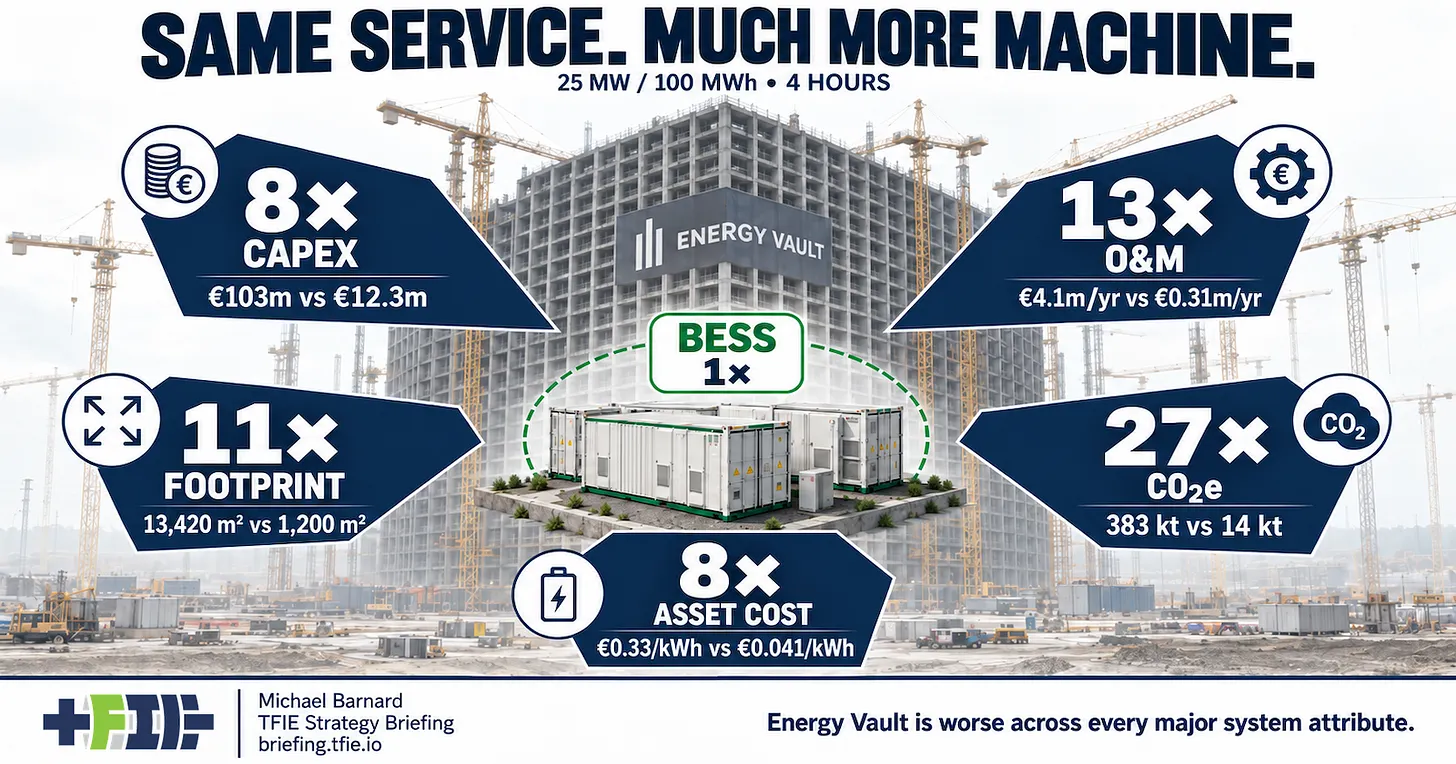
The Rudong gravity-storage project in China serves as a critical litmus test for the viability of mechanical energy storage, revealing that for an identical 25 MW / 100 MWh four-hour service output, the facility requires significantly more capital, land, and embodied carbon than a contemporary Chinese battery energy storage system (BESS). While the promise of gravity-based storage—lifting and lowering solid masses to store and release potential energy—appears intuitive and elegant in theory, the practical implementation at Rudong suggests that the engineering requirements to make such a system functional at scale create a set of economic and environmental challenges that are difficult to justify in an era of rapidly maturing, standardized battery technology.
A Test Case in Ideal Conditions
The Rudong project is particularly significant because it was constructed in an environment optimized for success. Located in China, the project benefited from access to deep domestic supply chains for essential materials including high-grade concrete, industrial steel, electric motors, and sophisticated power electronics. Furthermore, the development was bolstered by robust government backing, seamless grid coordination, and the involvement of an experienced domestic construction partner.
If the concept of stacking and lowering heavy blocks within a purpose-built structure were to become a competitive alternative to electrochemical storage, the Rudong facility represented the most favorable possible conditions to prove its merit. By removing the variables typically associated with "first-of-a-kind" projects—such as supply chain bottlenecks or lack of infrastructure—the project allows for a clearer assessment of the technology’s inherent design limitations.
The Scale of Engineering versus Output
What has emerged from this high-profile demonstration is a project that requires an extraordinary amount of physical infrastructure to deliver a relatively modest amount of electricity. The Rudong facility is rated at 25 MW of power capacity and 100 MWh of energy capacity, providing a four-hour duration at full output. To achieve this, the site utilizes a massive structure reaching approximately 148 meters in height.
The structural requirements are staggering: the facility relies on more than 12,000 blocks, each weighing roughly 25 tons, supported by a complex network of 96 lifting mechanisms and thousands of deep-bored piles to stabilize the massive weight of the tower. Despite assertions that the project would achieve full grid interconnection by the end of 2023, documentation regarding its commissioning status has remained persistent, highlighting the immense complexity involved in moving thousands of tons of material with the precision required for grid-scale energy management.

Comparative Analysis: Gravity vs. Lithium-Ion
The economic and physical footprint of the Rudong tower becomes even more stark when compared to contemporary BESS installations. In the current Chinese market, four-hour battery storage has moved beyond the "experimental" phase and into a period of routine infrastructure procurement.
A standard 100 MWh utility-scale installation, such as those utilizing the Sungrow PowerTitan 2.0 system, offers a high-density alternative. These systems typically package 5 MWh of battery capacity and 2.5 MW of power conversion within a single 20-foot AC block. A complete 100 MWh station utilizing this technology requires a land footprint of approximately 1,200 square meters. By contrast, the footprint of the Rudong gravity tower alone is estimated to be roughly eleven times larger.
Beyond the land use, the capital expenditure (CAPEX) for the Rudong project has been estimated by industry analysts to be approximately eight times higher than that of an equivalent lithium-ion battery plant. When factoring in the operational and maintenance (O&M) costs associated with thousands of moving parts—motors, gearboxes, brakes, and control sensors—the long-term financial model faces significant headwinds. Furthermore, the carbon debt embodied in the massive civil engineering works required to construct the tower is substantially higher than that of battery-based storage, effectively tying the project’s environmental footprint to the intensity of industrial-scale concrete and steel production.
The "Storage Medium" Fallacy
Energy Vault has long argued that the use of low-cost, potentially waste-derived materials for the gravity blocks provides a distinct advantage over the electrochemical degradation found in lithium-ion cells. While it is true that the blocks themselves do not suffer from thermal runaway or chemical aging, a storage medium is not, in itself, a storage system.
The "storage system" at Rudong encompasses the entire mountain of civil engineering: the foundation, the crane architecture, the horizontal handling equipment, and the complex array of power electronics. While the blocks are durable, the apparatus required to manipulate them on command for decades introduces a level of mechanical duty that creates its own failure modes and maintenance burdens. The apparent simplicity of the concept—lifting blocks when energy is cheap and lowering them when it is needed—is belied by the reality of maintaining a high-precision, multi-story mechanical tower that must operate with near-perfect reliability for 20 to 30 years.
Corporate Evolution and Strategic Pivot
The trajectory of Energy Vault since its inception provides additional context for the challenges of gravity-based storage. Following its transition from an earlier "six-arm crane" concept to the current EVx architecture, the company went public during the peak of the cleantech Special Purpose Acquisition Company (SPAC) boom.

In the years following its IPO, the company’s portfolio has shifted significantly. While it continues to highlight its gravity-storage installations, Energy Vault has increasingly positioned itself as a broader integrator of battery-storage systems. Its current project pipeline includes a variety of conventional lithium-ion battery deployments and, in some cases, unconventional projects such as battery-plus-hydrogen configurations. This evolution suggests a corporate recognition that gravity storage, while technically feasible, faces steep hurdles in competing with the rapidly declining costs and increasing energy density of lithium-ion technology.
Implications for the Utility Sector
The question for utilities and independent power producers is not whether gravity storage works, but whether it is the most efficient use of capital. The Rudong project proves that, with enough engineering effort and material investment, solid-mass gravity storage can be deployed at utility scale. However, the engineering achievement of the structure itself does not necessarily translate into a superior economic value proposition.
As grid operators look to fulfill the massive demand for four-hour duration storage, they are increasingly favoring standardized, modular, and mass-manufactured battery solutions. These systems provide predictable performance curves, established maintenance protocols, and a clear path for end-of-life recycling or repowering.
The Rudong project serves as a definitive case study in the trade-offs of mechanical energy storage. While gravity offers a theoretical solution to some of the limitations of chemistry-based storage, the physical and economic denominators—system footprint, capital intensity, maintenance complexity, and embodied carbon—suggest that gravity-based systems must overcome significant barriers before they can be considered a mainstream rival to the rapidly evolving BESS market.
For investors and policymakers, the lesson of Rudong is that energy storage technology must be evaluated not just on its ability to store energy, but on the efficiency and scalability of the entire system architecture. As the energy transition accelerates, the demand for storage that can be deployed rapidly and affordably favors solutions that minimize civil engineering complexity, a criteria that continues to keep traditional gravity-storage designs at the periphery of the global energy strategy.