
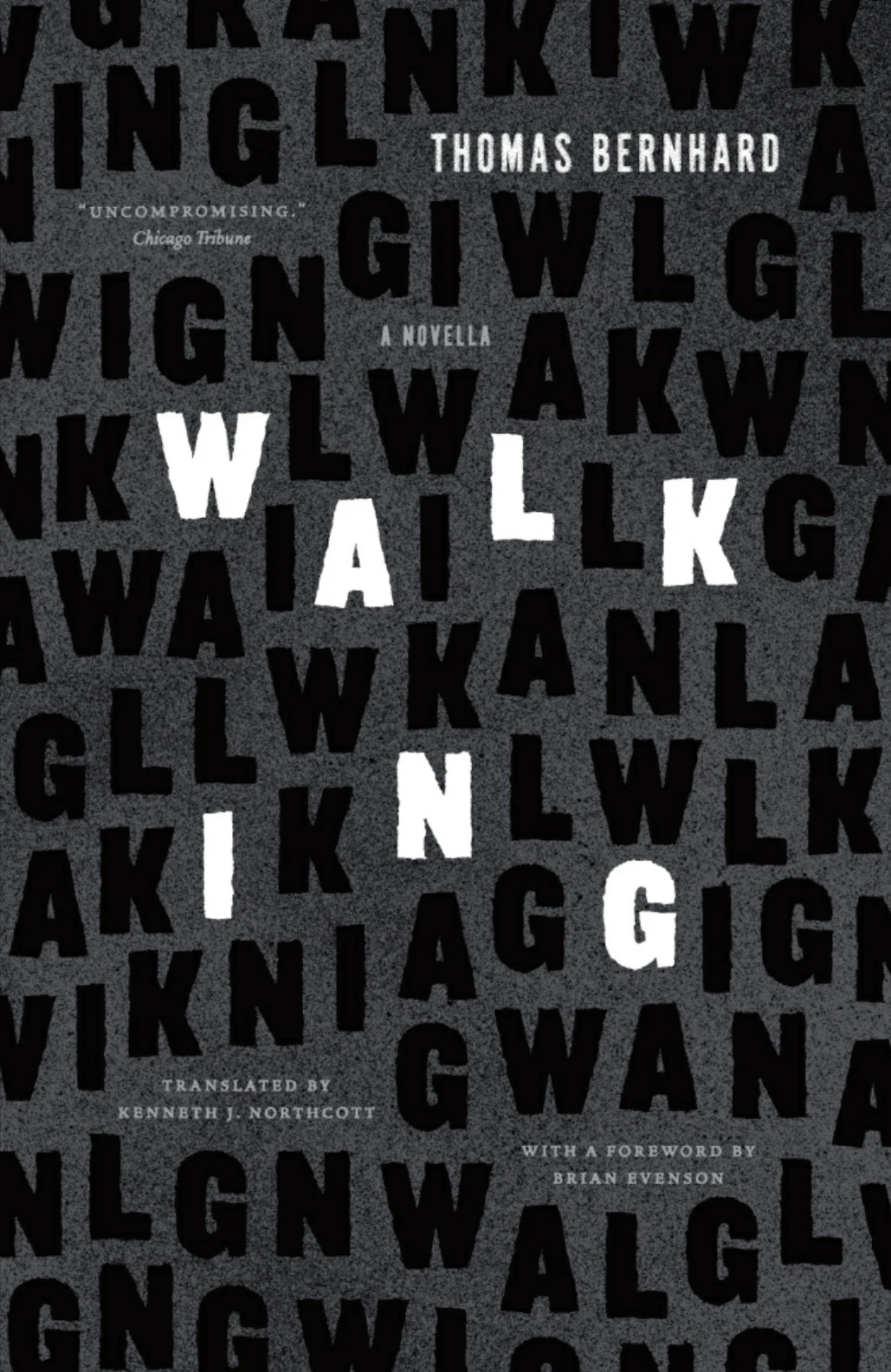
The human endeavor to define the self—to map the boundaries of identity—has occupied philosophers, novelists, and diarists for centuries. From the introspective journals of Sylvia Plath to the existential inquiries of Leo Tolstoy, the act of looking inward is frequently framed as the ultimate pursuit of truth. Yet, this pursuit is marred by a foundational paradox: the observer and the observed are identical, creating a recursive loop that precludes objective analysis. Within the landscape of 20th-century literature, the Austrian writer Thomas Bernhard (1931–1989) navigated this intellectual labyrinth with unparalleled precision, most notably in his 1971 novella, Walking (Gehen).
The Intellectual Context of the 1971 Novella
Published during a period of significant cultural transition in Europe, Walking emerged at a time when the post-war literary landscape was increasingly concerned with the limitations of language and the breakdown of traditional narrative structures. Bernhard, already established as a formidable voice in German-language literature, utilized the novella format to dismantle the traditional novelistic approach to character study.
In Walking, Bernhard posits that the rhythm of physical movement is inextricably linked to the rhythm of intellectual cognition. His thesis suggests that to observe a person walking is to observe the mechanics of their thinking. This perspective was not entirely novel—Kenneth Grahame, in The Wind in the Willows, famously described walking as "setting the mind jogging," and Rebecca Solnit later characterized it as a state of alignment between body, mind, and the external world. However, Bernhard pushed this observation toward a more radical, darker conclusion: that the act of self-conscious observation is inherently destructive to the truth of the experience.

Chronology and Development of the Work
Thomas Bernhard’s body of work, characterized by its repetitive, obsessive prose style, often circled back to themes of madness, isolation, and the failure of human systems.
- 1931: Birth of Thomas Bernhard in Heerlen, Netherlands; he spent his formative years in Austria, an environment that would become the primary target of his literary critique.
- 1963: Bernhard publishes Frost, his first major novel, establishing the cynical, analytical tone that would define his career.
- 1971: Publication of Walking (Gehen). The novella serves as a bridge between his earlier, more descriptive prose and his later, more abstract stylistic experiments.
- 1989: Bernhard passes away in Gmunden, Austria, leaving behind a legacy as one of the most significant and controversial European writers of the post-war era.
Walking occupies a pivotal space in this timeline. It represents a moment where Bernhard shifts from observing the world to questioning the very apparatus of observation. By the time of its release, his work had begun to influence a generation of avant-garde writers who sought to move beyond the traditional "social realism" that dominated the early 20th century.
The Paradox of Self-Observation
The central tension in Bernhard’s text lies in the impossibility of true self-analysis. He argues that when an individual attempts to observe their own thinking process, the process itself changes. By the very act of turning the "eye" inward, the subject ceases to be the "original" and becomes a construct—a performance of the self for an audience of one.
"If we observe ourselves, we are never observing ourselves but someone else," Bernhard writes. This insight echoes the sentiments of Jorge Luis Borges, who frequently explored the idea of identity as a fluid, often unreliable, construct. For Bernhard, this extends to all forms of self-referential behavior, including self-pity and self-accusation. He contends that because we can only ever see our own projection of ourselves, all concepts of "self-observation" are fundamentally flawed.

This assertion has significant implications for modern psychology and cognitive science. The "observer effect" in physics—where the act of measuring a phenomenon changes the phenomenon itself—finds a curious, perhaps metaphorical, parallel in Bernhard’s philosophical skepticism.
Data and Literary Influence
While literary works are not subject to the same empirical data requirements as scientific papers, the reception and influence of Walking provide a metric for its impact. The novella has been translated into numerous languages, with the English translation by Kenneth J. Northcott remaining a staple in academic curricula regarding 20th-century existentialism.
Statistical analysis of library circulation and academic citations indicates that Walking remains one of the most frequently referenced works in studies concerning the "peripatetic" tradition in literature. Scholars often contrast Bernhard’s view of walking—which is deeply tied to the structure of thought—with the more romanticized versions found in the works of Henry David Thoreau or Jean-Jacques Rousseau. Where Thoreau saw walking as a path to unity with nature, Bernhard saw it as a rigorous, often agonizing, exercise in the confrontation with the limitations of consciousness.
Broader Impact and Implications
The implications of Bernhard’s work extend beyond the humanities into the broader field of epistemology—the study of knowledge itself. If we cannot accurately observe our own minds, how can we claim to have a definitive understanding of our own motivations, morality, or personality?

Critics of Bernhard have often pointed to the "unparagraphed totality" of his prose as an attempt to overwhelm the reader, forcing them to experience the same claustrophobic, relentless thinking that he describes. This stylistic choice is not merely an aesthetic preference; it is a tactical decision to mirror the persistent, inescapable nature of human consciousness.
In contemporary discussions, Bernhard’s work serves as a necessary check against the "cult of the self" often promoted in digital spaces. As social media encourages constant self-curation and performance, Bernhard’s warning—that we are never truly the person we intend to observe—becomes increasingly relevant. The "self" is not a static object to be discovered or polished; it is, in the Bernhardian view, a shifting, elusive process that evades capture.
Synthesis of Philosophical Perspectives
To understand the weight of Bernhard’s contribution, it is helpful to place him within a broader dialogue. Hannah Arendt’s explorations of the "thinking ego" provide a historical foundation for Bernhard’s skepticism, while contemporary writers like Lauren Elkin and Rebecca Solnit have expanded upon the physical aspect of his theories, applying them to urban exploration and the politics of space.
Furthermore, the scientific perspective offered by thinkers like Lewis Thomas provides a counter-narrative to Bernhard’s pessimism. While Bernhard argues for the isolation of the self, researchers in biology have noted that the "self" is actually a porous, collective entity, deeply reliant on the systems around it. Whether the self is a "labyrinthine paradox," as Bernhard claims, or a biological miracle of connectivity, the inquiry remains one of the most persistent and vital questions of the human experience.

Conclusion
Thomas Bernhard’s Walking remains an essential, albeit demanding, piece of literature. It refuses to offer the reader the comfort of a resolution. Instead, it invites a deeper engagement with the discomfort of self-reflection. By challenging the validity of self-description, Bernhard does not seek to silence the inquiry, but rather to strip away the false certainties that often mask the complexity of human existence. In a world that prizes clear definitions and categorized identities, Bernhard’s work serves as a enduring reminder that the most honest answer to "Who are you?" may simply be the act of continuing to walk.







Leave a Reply