
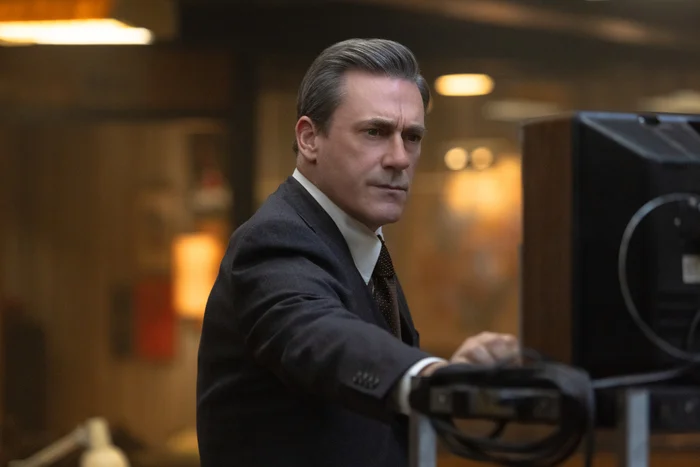
The eight-part limited series American Hostage, streaming on MGM+, plunges viewers into the tense, smoke-filled world of 1977 broadcasting and high-stakes negotiations. Created by seasoned television writers Shawn Ryan and Eileen Myers—known for their work on hit thrillers like The Night Agent—the series is adapted from the first season of the Criminal Content podcast of the same name. Boasting an ensemble cast led by Jon Hamm and Giovanni Ribisi, American Hostage sets out to explore the precarious intersection of the media, institutional corruption, and public grievance. However, despite a compelling premise and standout individual performances, the series ultimately buckles under pacing issues, narrative drift, and unresolved storylines that stretch a tightly wound real-life incident past its natural dramatic breaking point.
Main Facts and Premise
Set against the backdrop of late-1970s Indianapolis, American Hostage chronicles one of the most bizarre and high-profile standoffs in Midwestern history. Jon Hamm stars as Fred Heckman, a local news radio icon widely recognized on transit advertisements as "the most trusted voice in news." After dedicating 22 years to his craft and building a stable life with his supportive wife Barbara, played by Mireille Enos, Heckman finds himself contemplating a lucrative career pivot to CBS Radio in New York City.
His plans are abruptly derailed when a volatile former used car salesman named Tony Kiritsis, portrayed with frantic intensity by Giovanni Ribisi, executes a terrifying scheme. Kiritsis marches into a local mortgage office, takes executive Dick Hall—played by Kristoffer Polaha—hostage, and affixes a shotgun to Hall’s neck using a makeshift "dead man’s switch." Kiritsis’s grievance is rooted in what he perceives as predatory lending practices designed to strip him of a 17-acre plot of land he hoped to develop into a commercial center anchored by a steakhouse.
Rather than communicating directly with law enforcement, Kiritsis demands to negotiate exclusively through Fred Heckman. This forced partnership thrusts Heckman back into the heart of frontline journalism, immediately complicating his professional ethics and drawing sharp warnings from his station colleagues, notably newsroom counterpart Ben Hairston, played by William Jackson Harper. As local police departments and federal authorities grapple with how to resolve the crisis without causing a bloodbath, Kiritsis transforms from a desperate, grievance-driven criminal into a counterculture folk hero, capturing the collective anxieties of an American public deeply disillusioned by the Watergate scandal and institutional overreach.
Historical Chronology and Background Context
The real-life events that inspired American Hostage unfolded over 63 harrowing hours in February 1977, capturing the national spotlight and cementing the story as a legendary chapter in broadcast history. Tony Kiritsis held Dick Hall hostage for nearly three days, using live radio broadcasts as his primary megaphone to air grievances against mortgage companies, financial institutions, and the judicial system.
Historically, the standoff became a watershed moment for live media coverage, blurring the lines between journalism and active participation in criminal negotiations. Fred Heckman’s real-life broadcasts during those grueling three days were essential in maintaining a fragile line of communication that ultimately prevented a catastrophic loss of life. While cinematic adaptations like Gus Van Sant’s 2025 feature Dead Man’s Wire have similarly explored the narrative, Ryan and Myers’ television format affords the story a broader canvas to dissect the mechanics of 1970s journalism, where telephone-transferring, reel-to-reel tape recordings, and radio transmissions served as the primary technological lifelines.
Production and Creative Execution
From a purely technical and aesthetic standpoint, American Hostage begins with immense promise. The series makes clever, stylistic use of 1970s-era split-screens during its early episodes, wordlessly developing characters and ratcheting up tension as the authorities and the media coordinate their responses. Production designer Caroline Hanania deserves significant praise for her meticulous world-building, transforming tight sets—such as the bustling, cigarette-hazy radio station offices and Kiritsis’s claustrophobic apartment—into living, breathing environments that anchor the period piece.
The performances across the board are uniformly strong. Jon Hamm delivers a grounded, understated portrayal of a seasoned newsman hollowed out by the weight of his profession and personal quietude. Giovanni Ribisi leans into the operatic, nervous energy of Tony Kiritsis, avoiding the trap of sanitizing a dangerous criminal while still capturing the universally relatable human desire for dignity, security, and a shot at the American dream.
Supporting players also elevate the material. William Jackson Harper infuses Ben Hairston with a sharp, sarcastic moral compass, while June Laporte portrays Ginny, an ambitious young reporter eager to learn the ropes of investigative journalism. Furthermore, Mireille Enos as Barbara Heckman and Kat Cunning as Ibby Hall—the captive’s wife—form an unexpectedly compelling bond that grounds the emotional stakes of the crisis in domestic reality.
Narrative Missteps and Structural Deficits
Despite these high-caliber elements, American Hostage ultimately stumbles due to structural indecision. The series spends its initial episodes teasing a provocative, modern commentary on systemic economic frustration, subtly drawing parallels to contemporary public anger over rigged corporate systems. However, as the narrative progresses, the writers struggle to sustain this thematic momentum.
Midway through the season, the show loses its narrative focus. After initially positioning the newsroom staff—Ben and Ginny—as the moral compass and emotional heart of the story, the creators appear to experience narrative whovian regret, stranding these characters as the plot abruptly pivots. The focus shifts heavily toward Fred Heckman, only for that arc to stall during a fragmented, flashback-heavy sixth episode that attempts to unpack the characters’ psychological baggage through simplistic tropes.
By the final stretch, the series abandons the stylistic flair that defined its opening hours, dropping the split-screen framing devices and leaving secondary relationships, such as the compelling friendship between Barbara and Ibby, largely unresolved. Directors like Adam Arkin and Nina Lopez-Corrado manage individual scenes with skill, and standouts like Mark McKinney as the weary local police chief and Jonathan Tucker as an emerging FBI profiler add depth, but the fundamental flaw remains: there is simply not enough narrative meat to justify an eight-episode runtime for this specific angle of the story.
Broader Implications and Industry Analysis
The trajectory of American Hostage highlights a recurring challenge in the era of prestige television limited series: the tendency to stretch compact, real-life narratives beyond their natural limits. By padding a tight, high-tension 72-hour standoff into a multi-episode arc, creators often feel compelled to invent subplots and psychological excavations that dilute the raw urgency of the original event.
Nevertheless, the series contributes to a broader cultural conversation regarding how media institutions shape public perception of criminal acts and social grievances. By examining an era when public trust in government and corporations was plummeting, American Hostage mirrors contemporary discussions about systemic inequality and the ways modern media platforms amplify desperate voices.
Ultimately, American Hostage stands as a frustrating paradox in modern television programming. It features a masterclass in period-appropriate production design, a top-tier cast operating at the top of their game, and an inherently fascinating historical premise. Yet, because of disjointed pacing, unresolved subplots, and an inability to maintain its initial thematic focus, the project devolves into a graveyard of squandered potential—proving that even the most trusted voices in drama can occasionally lose their narrative way.







Leave a Reply