
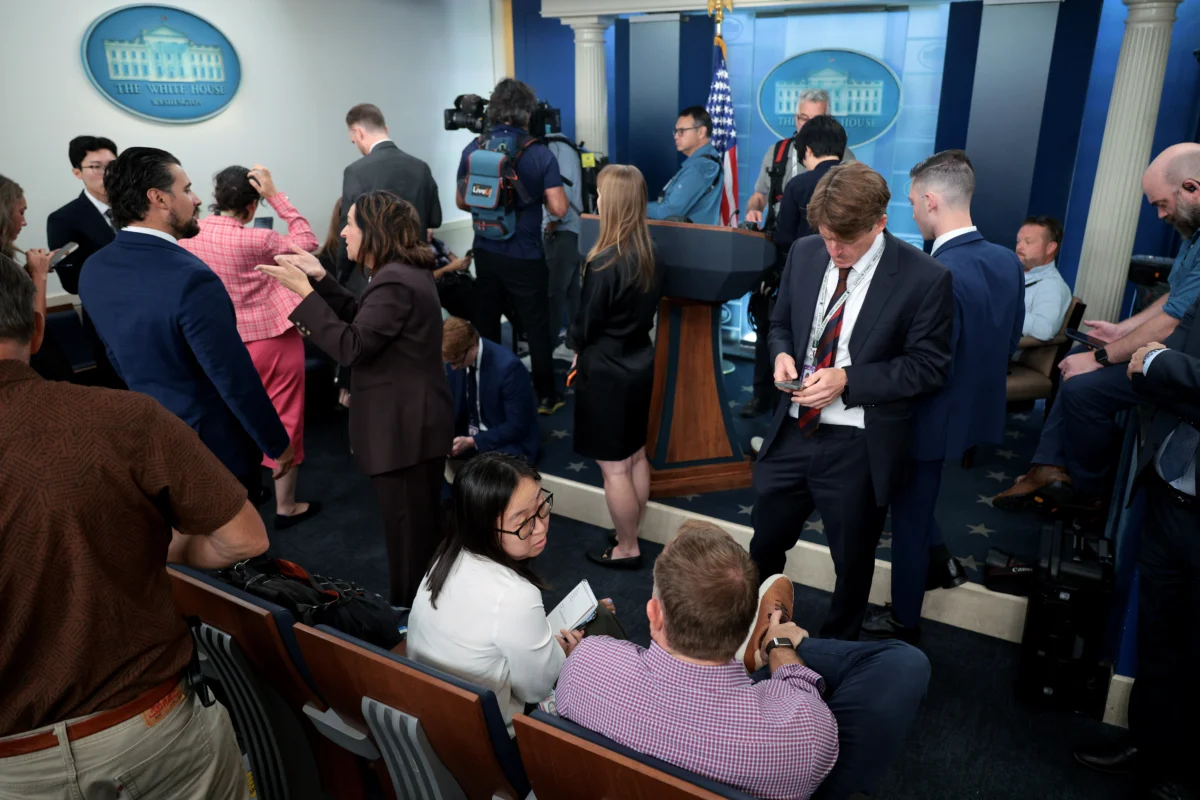
President Donald Trump has officially followed through on his controversial threats to restrict press access to the White House, barring journalists from prominent news outlets including CNN and MS NOW from entering the executive mansion and its surrounding grounds. The decisive action, which unfolded on a Saturday morning, marks a dramatic escalation in tensions between the current administration and the mainstream media, raising profound constitutional questions regarding the First Amendment, freedom of the press, and the historical protocols governing the relationship between the executive branch and independent news organizations.
The enforcement of the ban was swift and caught newsroom personnel off guard. According to reports from the affected networks, reporters and technical staff attempting to cover the administration on Saturday morning found their security credentials abruptly deactivated. The move follows direct threats made by President Trump just a day prior, in which he expressed deep dissatisfaction with the coverage and editorial stances of specific networks, vowing to lock them out of the White House complex.
Chronology of the Incident at the Gates
The morning unfolded with confusion and institutional defiance at the checkpoints surrounding the executive complex. MS NOW correspondent Akayla Gardner detailed the experience of arriving for work, explaining that her standard-issue White House press badge failed to register when scanned at the security entrance.
When I was inside where we have magnetometers, I attempted to scan my badge, which we have to do to get into the White House grounds. It did not work, Gardner said in a broadcast recounting the incident. There was a red beeping light, and so the officer asked me to hand over my badge. He said that it was disabled. I asked why I could not get inside; he said it was above him.
Adding to the chaotic nature of the enforcement, anecdotal discrepancies arose during the initial lockout. While Gardner’s badge and the credentials of the network’s accompanying photographer were immediately rejected and confiscated by security personnel, the badge of the channel’s producer inexplicably worked for a brief period, creating a momentary sense of bewilderment before overarching administrative orders solidified the blockade. Similar reports poured in from CNN correspondents and staff members, whose credentials were likewise invalidated without prior individual notification or administrative justification provided directly to the journalists on the scene.
Historically, credentialed members of the White House press corps have enjoyed routine, protected access to the executive complex. This physical access traditionally encompasses the West Wing press facilities, the James S. Brady Press Briefing Room, and the outdoor working areas colloquially known as Pebble Beach, situated just outside the executive mansion where television networks routinely stage live broadcasts and stand-up reports. The sudden revocation of this access effectively severs these networks’ ability to conduct day-to-day reporting from within the heart of the American executive branch.
Immediate Reactions and Legal Posturing
The affected networks responded with fierce rebukes, framing the executive action not merely as a logistical inconvenience, but as a direct assault on democratic norms and constitutional protections. Representatives from MS NOW issued a robust defense of their newsroom and the broader mandate of independent journalism.
Earlier this morning, MS NOW journalists were denied access to the White House grounds, a network spokesperson stated. The White House belongs to the American people and the decisions made inside are funded by our tax dollars. MS NOW intends to take any and all steps necessary to defend our First Amendment rights and the essential role of independent journalism in our democracy. We stand firmly behind our anchors, our reporters, and our newsroom. We will continue to report on the President, the administration, and the issues that impact the American people.
Concurrently, CNN released a strongly worded statement condemning the administration’s actions and signaling a resolute intention to continue holding public officials accountable, regardless of physical barriers erected at government facilities.
Early today, CNN journalists were denied access to the White House grounds, a CNN spokesperson declared. CNN’s mission to report on the U.S. government will continue regardless of any attempts to restrict physical access to the White House and other government buildings, or any other attempts to impede our journalism. We have a right under the U.S. Constitution to do our reporting without hindrance or interference from the government and this ban is an illegal assault on this fundamental right.
The network further emphasized its unwavering commitment to institutional duty: We will not be deflected from our duty to hold the government and other public bodies to account, and we will continue to report on the actions and processes of this administration without fear or favor. CNN stands fully behind our White House team.
Background Context: The Friction Between the Administration and the Press
This weekend’s escalation is the latest chapter in a long-standing, adversarial relationship between Donald Trump and organizations he frequently characterizes as producing unfavorable or biased coverage. Throughout his political career, the president has maintained a combative stance toward traditional media outlets, regularly utilizing public platforms and social media to disparage specific networks and reporters.
The transition from rhetorical hostility to physical restriction represents a profound intensification of this conflict. While past administrations have occasionally sparred with the press—disputing reporting, lodging formal complaints, or managing access to specific briefings and interviews—the outright revocation of permanent White House press credentials based on editorial content is an extraordinary measure with few modern precedents.
Legal scholars and media watchdogs note that while the White House possesses broad discretion over the management of its physical property and security protocols, those decisions intersect directly with First Amendment jurisprudence. The landmark legal precedent established in the late 1970s—specifically Sherrill v. Knight, stemming from a Secret Service denial of press credentials to a journalist—determined that the White House press facilities constitute a public forum for the exercise of First Amendment rights. Consequently, the government cannot arbitrarily or viewpoint-discriminatorily revoke a journalist’s access without affording due process and demonstrating a compelling, viewpoint-neutral justification.
Broader Implications and Industry Fallout
The decision to bar CNN and MS NOW from the White House complex sends shockwaves through the broader journalism community, raising immediate concerns among press freedom advocacy groups, editorial boards, and rival news organizations.
Professional journalistic associations have long argued that a free and independent press is an indispensable pillar of American democracy, serving as a vital check on executive power. When physical access to the seat of government is conditioned upon editorial compliance or favorable coverage, the fundamental dynamic between the governed and the governing is fundamentally altered.
Furthermore, the restriction of specific outlets creates significant logistical hurdles for news gathering. While reporters can attempt to cover the administration remotely, monitor briefings via official livestreams, and conduct interviews outside the security perimeter, the loss of direct, proximate access to administration officials, press secretaries, and policymakers degrades the depth and immediacy of political reporting. It also creates a two-tiered system where favored outlets retain access while disfavored entities are pushed to the periphery.
As the legal teams for the affected networks explore potential responses—ranging from formal administrative challenges to federal lawsuits asserting constitutional violations—the administration has shown no inclination to reverse its course. President Trump’s prior statements indicated that the bans imposed on CNN and MS NOW could potentially be expanded to include other media organizations whose reporting displeases the executive branch.
The unfolding crisis guarantees that the boundaries of executive power, the legal protections afforded to the press corps, and the future of open journalism within the federal government will remain at the forefront of national discourse. As MS NOW, CNN, and other independent newsrooms vow to press forward with their reporting, the confrontation between the White House and the media enters a tense and highly consequential new era.









Leave a Reply