

The rapid integration of artificial intelligence into the global workplace has triggered a profound paradox: while organizations are scrambling to adopt new technologies to enhance productivity, they are simultaneously witnessing the deterioration of the fundamental human capabilities required to manage those very tools. According to a landmark study by the IBM Institute for Business Value, titled "Designing the Thinking Organization," the rise of AI is fundamentally altering the professional landscape, leaving a significant disconnect between what executives demand from their workforce and the reality of employee skill retention.
The research, which involved comprehensive surveys of 1,500 CHROs and senior executives across 21 geographies and 23 industries, alongside 8,800 full-time employees across 28 countries, highlights a growing tension surrounding critical thinking, professional judgment, and the nuanced oversight of AI-generated output. As AI systems become more autonomous, the human role is shifting from primary creator to supervisor, yet the infrastructure required to support this transition—namely, deliberate workforce redesign—is largely absent.

The Anatomy of the Disconnect
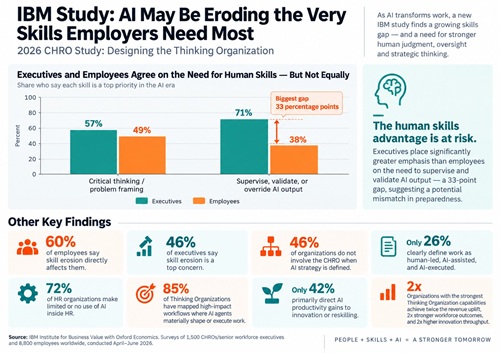
At the heart of the IBM study is a stark divergence in priorities. When asked about the most critical skills required for an AI-enabled work environment, both leadership and staff agree on the surface-level importance of problem framing and critical thinking. Approximately 57% of executives and 49% of employees identify these as top-tier capabilities. However, the alignment disintegrates when the focus shifts to the technical reality of working with AI.
A staggering 33-percentage-point gap exists regarding the necessity of supervising, validating, or overriding AI outputs. While 71% of executives view this oversight capability as a mandatory skill for their employees, only 38% of the workforce shares this perspective. This discrepancy suggests that employees may be underestimating the risks of AI hallucination and bias, or perhaps they have become overly reliant on automated systems, leading to a "check-the-box" mentality that ignores the need for rigorous verification.
Furthermore, the concept of professional judgment—the ability to make informed decisions when data is ambiguous or contradictory—appears to be undervalued by those on the front lines. Only 29% of employees rank judgment as a top priority, a figure that signals a potential cultural shift where human intuition is being sidelined in favor of algorithmic convenience.
The Silent Crisis of Skill Erosion
While the global conversation regarding the "skills gap" has focused on the need for upskilling and reskilling, the IBM report identifies a more insidious phenomenon: skill erosion. Unlike a gap, which implies a lack of knowledge, erosion refers to the degradation of existing competencies that are no longer practiced because AI has subsumed the underlying tasks.
The data indicates that this is not a peripheral concern; 60% of surveyed employees reported that skill erosion is directly impacting their work. Among those who feel the effects of this decline, three out of four report that AI has already begun to diminish at least some of their core professional capabilities. Critical thinking, arguably the most important skill for a knowledge-based economy, was cited as the most frequently eroded asset.
From a historical perspective, this mirrors the transition seen in other industries where automation reduced the reliance on manual craftsmanship. However, in the context of white-collar work, the erosion of cognitive skills presents a unique challenge. If junior employees rely on AI to draft reports, code software, or analyze spreadsheets, they may fail to develop the foundational "muscle memory" required to handle complex, non-standardized problems. When the AI fails or produces an error, these employees may lack the depth of experience necessary to troubleshoot effectively.

Organizational Inertia and Workflow Design
The IBM study reveals that while the technological landscape is moving at breakneck speed, organizational structures remain static. More than half of employees—52%—reported that their day-to-day tasks have shifted significantly over the past year due to AI adoption. Yet, only 26% of organizations have clearly delineated their workflows into human-led, AI-assisted, and AI-executed categories.
This lack of definition creates a vacuum where "day-to-day adaptation" becomes the default strategy. Instead of a deliberate, top-down approach to AI integration, organizations are relying on individual employees to figure out how to use AI on the fly. This ad-hoc approach is a recipe for both inefficiency and the unintentional atrophy of high-level skills.
The report highlights that 80% of enterprises possess a reskilling roadmap. However, these programs are often designed to teach employees how to use new technology rather than how to maintain the human intelligence that the technology is meant to augment. By focusing exclusively on "tool proficiency," companies may be inadvertently accelerating the erosion of the analytical foundations that make their employees valuable.

Broader Economic and Operational Implications
The implications of these findings extend far beyond the walls of individual corporations. If a large segment of the global workforce experiences a decline in critical thinking and judgment, the long-term impact on innovation and organizational resilience could be severe.
Economically, the "reinvestment of productivity gains" remains a point of contention. If the time saved by AI is not being redirected toward professional development or higher-order strategic tasks, the productivity surge promised by AI may be ephemeral. Organizations risk falling into a trap where they optimize for short-term output at the expense of long-term human capital.
For human resources leaders and C-suite executives, the data serves as a wake-up call. The transition to an AI-augmented workplace requires more than just software licenses and cloud infrastructure; it requires a cultural and pedagogical overhaul. Leadership must foster an environment where critical thinking is not just a buzzword, but a core metric of performance—even if that means slower initial adoption cycles to ensure that humans remain in the loop.

A Chronology of the Modern AI Workplace Transition
The current situation is the result of an rapid, unprecedented evolution in corporate strategy:
- Late 2022: The emergence of generative AI tools sparked a "gold rush" in corporate adoption, with many organizations deploying AI without formal governance or training protocols.
- 2023–2024: Companies focused on "AI literacy," prioritizing the ability of staff to prompt and interact with LLMs. This period saw a rise in reliance on AI for routine administrative tasks.
- Early 2025: As AI became deeply embedded in enterprise software suites, the initial novelty faded, and the true impact on employee workflows became apparent. Executives began to observe a lack of oversight in AI-generated deliverables.
- 2026 (April–June): The period of the IBM survey. Data collection confirmed that the "human-in-the-loop" model was being compromised by over-reliance on AI, leading to the identification of the "skill erosion" phenomenon.
Looking Toward a Balanced Future
As the findings from the IBM Institute for Business Value make clear, the future of work will not be defined solely by the power of the models we build, but by the capability of the people who manage them. The "Thinking Organization" of the future must be one that values the "human" in "human-AI collaboration."
Addressing the skill erosion crisis requires a multi-pronged strategy. Organizations should consider implementing "AI-free" periods for critical tasks to ensure that fundamental skills remain sharp. Additionally, performance management systems must be updated to reward the quality of oversight and the ability to challenge AI output, rather than just the volume of output produced.

Ultimately, the goal of an AI-enabled enterprise should be to amplify human intelligence, not replace it. If the current trajectory of skill erosion continues unchecked, corporations risk becoming black boxes of automated output, devoid of the critical oversight required to navigate a complex and unpredictable global market. The task for management today is not just to integrate AI, but to design an organization that treats the preservation of human cognitive skill as a primary, non-negotiable business objective. The challenge is clear: technology can provide the answers, but only human judgment can determine if those answers are the right ones.









Leave a Reply