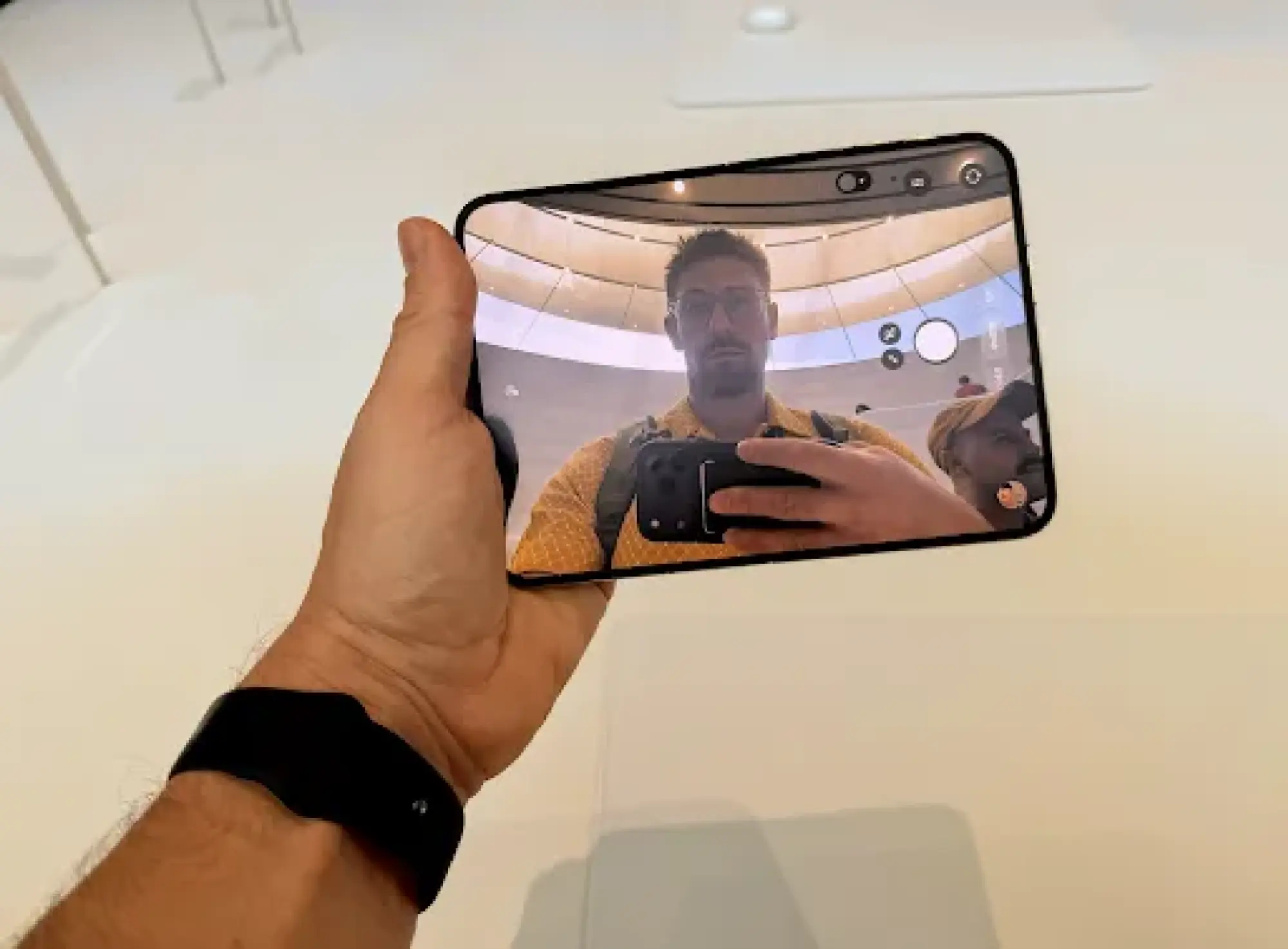
As journalists, tech creators, and industry analysts spent time folding, unfolding, and stress-testing the hardware, a clearer picture has emerged regarding the device’s ergonomics, software fluidity, and the reality of its much-debated folding display.
The Reality of the Hinge and Display
For years, the primary critique leveled against foldable smartphone manufacturers has been the visible crease that develops along the axis of the fold. Apple’s implementation on the iPhone Duo utilizes a proprietary multi-link hinge mechanism designed to minimize tension on the flexible OLED panel.
Initial reports from those on the ground, including Mashable’s senior editorial staff, indicate that Apple has made significant strides in display engineering. When viewed head-on, the 7.6-inch interior display appears remarkably continuous. However, physical reality remains a challenge; when the device is tilted against harsh overhead lighting—such as the bright studio lighting at Apple Park—a faint, subtle vertical crease is discernible. While it is not the "invisible" screen promised in marketing renderings, it represents an industry-leading reduction in physical distortion compared to competing models from Samsung or Google.

Software Fluidity and Responsive UI
Beyond the hardware, the "Surprise and Shine" event highlighted the software optimizations tailored specifically for the Duo. Apple has implemented a "Fluid-State" operating system transition that allows the interface to reconfigure instantly as the device moves between its closed, "phone-like" state and its open, "tablet-like" state.
During live demonstrations, the transition appeared instantaneous. Users can begin composing an email on the outer screen, flip the device open, and find the application automatically expanding into a dual-pane layout without a stutter in the rendering process. This level of software-hardware synergy is widely considered the primary competitive advantage for the iPhone Duo, as it builds upon the existing infrastructure of iOS to provide a consistent experience across form factors.
Chronology of the Development Cycle
The road to the iPhone Duo was paved with years of speculation and internal development cycles that date back to 2021.
- 2021–2022: Apple files a series of patents regarding "flexible display structures" and "self-healing screen coatings."
- 2023: Internal reports suggest Apple is testing three different foldable prototypes, including a "clamshell" design and a "book-style" device.
- 2024: The company commits to the "Duo" form factor, prioritizing the "book-style" design to maximize productivity.
- 2025: Supply chain leaks confirm mass production of specialized hinges and ultra-thin glass components.
- September 2026: Official public reveal at Apple Park, followed by immediate hands-on demonstrations.
Industry Reactions and Expert Analysis
The reception from the tech community has been largely enthusiastic, though tempered by the reality of the $1,999 price point. Max Weinbach, a prominent tech creator, noted that the integration of an under-display camera on the interior screen was particularly impressive, describing the execution as "wildly ahead of expectations."

Justine Ezarik, known professionally as iJustine, highlighted the device’s utility for media consumption. Her demonstrations showcased the ability to run high-definition video content on one half of the screen while navigating a feed or multitasking on the other. This capability, she noted, fundamentally changes how users interact with mobile entertainment.
Conversely, some observers have drawn comparisons to legacy dual-screen devices like the Microsoft Surface Duo or the dual-screen interface of the Nintendo DS. While these comparisons acknowledge the form factor, the consensus is that the iPhone Duo is a more cohesive integration of hardware and software than its predecessors. Gizmodo’s Ray Wong provided a more critical view, focusing on the inevitable nature of the crease, noting that while Apple’s engineering is superior, the laws of physics still dictate that a moving screen will show some sign of wear over time.
Market Implications and Economic Outlook
The $1,999 price tag places the iPhone Duo firmly in the "ultra-premium" category. Analysts suggest that Apple is not initially targeting the mass market with this device. Instead, the strategy appears to be a "halo product" approach, designed to showcase the company’s technical prowess while appealing to early adopters, power users, and enterprise clients who require tablet-like functionality in a pocketable device.
From an economic perspective, the success of the iPhone Duo will be measured by its impact on the average selling price (ASP) of Apple’s mobile portfolio. By introducing a device at this price point, Apple is effectively testing the upper limits of consumer willingness to spend on mobile technology. If the device proves durable over the coming months, it could normalize the transition from traditional slate smartphones to foldable devices as the new standard for the high-end market.

Technical Specifications and Usability
The hardware features a 7.6-inch Super Retina XDR interior display with a 120Hz ProMotion refresh rate. When folded, the exterior display functions as a standard 6.2-inch iPhone interface. The device is powered by the latest A-series chip, optimized for the power demands of driving two display states simultaneously.
The hinge, which has been the subject of intensive testing, is rated for over 300,000 folds. This suggests that even for "power users" who fold their device hundreds of times a day, the hinge should theoretically last for several years of heavy use.
The Path Forward
As the industry turns its attention toward the official retail launch on October 23, 2026, the conversation is shifting from "can Apple do it" to "is it worth it." For the average consumer, the choice between a traditional, thinner, and potentially more durable standard iPhone and the expansive, multitasking-heavy iPhone Duo will be the defining decision of the 2026 fiscal year.
The "Surprise and Shine" event confirmed that the iPhone Duo is not just a concept or a prototype; it is a fully realized consumer product. Its ability to handle complex workflows, such as streaming video while simultaneously managing social media feeds or professional applications, positions it as a bridge between the phone and the laptop.

While the crease remains a topic of debate and the price tag is undeniably steep, the initial hands-on reports suggest that Apple has delivered on its promise of a premium, functional, and highly polished folding experience. Whether this device will lead to a total paradigm shift in the smartphone market or remain a luxury niche will become clear once the device moves from the controlled environment of Apple Park into the hands of the general public.
For now, the message from the first wave of users is clear: the folding era has officially arrived, and it is more seamless than many critics anticipated. The true test will come in the weeks following the October 23 release, as real-world durability, battery performance, and software longevity are subjected to the rigors of daily life. As of today, the iPhone Duo stands as a testament to the maturation of foldable technology, proving that what was once considered a fragile curiosity is now a viable, daily-use tool for the modern digital professional.