In an era dominated by atomic clocks, digital notifications, and microsecond-precision computing, modern society often views timekeeping technology as an inescapable taskmaster. Yet, long before the advent of mechanical gears and electrical circuits, early civilizations grappled with the same fundamental human desire: the need to measure and master the passage of time. Among the most remarkable innovations of antiquity was the Greek clepsydra, or "water thief," a hydraulic device that evolved from a simple leaking vessel into a marvel of automation. Recent educational deep-dives and historical analyses, including the popular animated Deconstructed video series, have brought renewed attention to this ancient engineering masterpiece—specifically the sophisticated automatic water clock designed by the third-century BC Greek inventor Ctesibius, which maintained unmatched precision for an astounding 1,800 years.
The Evolution of Hydraulic Timekeeping
The roots of the clepsydra stretch deep into antiquity, with historical and archaeological evidence suggesting that rudimentary water clocks were utilized as early as the sixteenth century BC. Early iterations of these devices have been discovered in regions corresponding to modern-day Iraq, Iran, and Egypt, with more ambiguous artifacts unearthed in ancient South Asian and East Asian contexts.
In its most primitive form, a clepsydra required little more than a bowl or vessel pierced with a small hole at the bottom, allowing water to escape at a controlled rate. However, these early designs suffered from a persistent and natural physical impediment: hydraulic pressure. As the water level inside the vessel decreased, the hydrostatic pressure dropped, causing the flow rate to slow down progressively. Consequently, measuring equal intervals of time proved notoriously inaccurate.
This fundamental flaw remained uncorrected for centuries until the third century BC, when the brilliant Alexandrian inventor and mathematician Ctesibius revolutionized hydraulic engineering. Ctesibius, often regarded as the father of pneumatics and hydraulics, recognized that maintaining a constant water pressure was the key to achieving steady, reliable timekeeping.
Engineering Brilliance: Ctesibius’s Automatic System
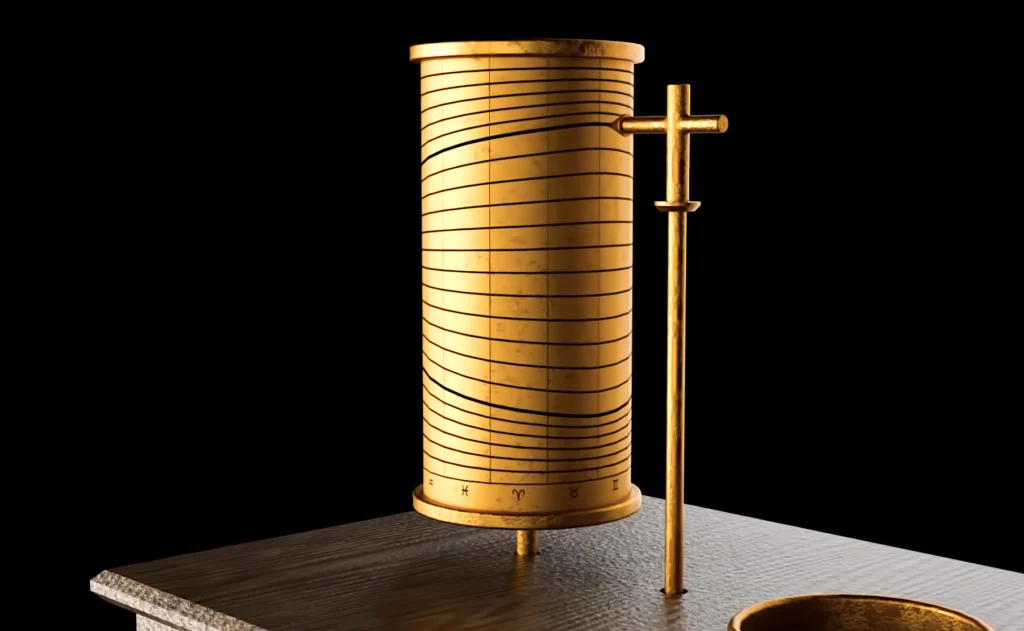
Ctesibius’s automated water clock addressed the pressure drop problem through an ingenious multi-stage delivery system. The apparatus centered on a vertical cylinder that rotated once every solar year. This cylinder was meticulously inscribed with straight vertical lines representing the months of the year, alongside curved horizontal lines corresponding to the varying hours of the day. A pointer, resting adjacent to the cylinder, indicated the exact current hour. The position of this pointer was dynamically altered by the fluctuating water level of the internal cylinder in which it floated.
To ensure that the water level rose at a perfectly consistent and uninterrupted rate, Ctesibius introduced a constant-supply mechanism. The primary cylinder was continuously fed by a secondary reservoir, which itself was maintained at a constant volume through a steady inflow of water.
Furthermore, the inventor solved the challenge of resetting the daily cycle without requiring constant human intervention. By incorporating an integrated siphon system, Ctesibius ensured that accumulated water was automatically drained every twenty-four hours, resetting the clock’s daily operational cycle. To accommodate the seasonal shifts in the length of daylight hours characteristic of the ancient Greek timekeeping system—where daylight was divided into twelve equal hours regardless of the season—a water wheel attached to a simple system of gears kept the cylinder turning at a variable rate, ensuring the display seamlessly adapted to the changing cosmos.
Historical Chronology of Horological Milestones
To understand the monumental achievement of Ctesibius’s clepsydra, historians view its development within a broader chronological framework of human timekeeping:
- 16th Century BC: Earliest archaeological evidence of primitive outflow water clocks in Egypt, Mesopotamia, and neighboring regions.
- 3rd Century BC: Ctesibius of Alexandria invents the advanced automatic water clock, integrating constant-flow reservoirs, siphons, and gear-driven seasonal adjustments.
- 1st Century BC – 17th Century AD: Hydraulic timekeeping devices, building upon the principles laid by Ctesibius and later refined by Islamic and European engineers, dominate navigation, astronomy, and civic life.
- 1656 AD: Dutch scientist Christiaan Huygens invents the pendulum clock, providing a mechanical alternative that finally surpasses the long-standing accuracy of advanced water clocks.
Academic and Engineering Perspectives
Modern historians of science and mechanical engineers frequently laud the work of Ctesibius as a foundational stepping stone toward the modern industrial age. Commentators note that in an era completely devoid of electricity, digital logic, and modern metallurgy, ancient inventors managed to solve complex control-system problems using purely physical forces.
"In a world without electricity, digital logic, or even mechanical clocks, this ancient invention laid the foundation for automation and timekeeping as we know them today," narrators of historical engineering analyses observe.
Scholars emphasize that the clepsydra designed by Ctesibius was not merely a novelty; it held the title of the most accurate timekeeping device on Earth for roughly 1,800 years. Its reign was only brought to an end in 1656 when Christiaan Huygens developed the pendulum clock, introducing a new standard of harmonic oscillation that eventually transitioned society into the mechanical age.
Broader Impact and Societal Implications
The legacy of the water clock extends far beyond the realm of horology; it marks the dawn of true automation. The principles utilized by Ctesibius—such as feedback loops, constant-level regulation, and geared mechanical movement—foreshadowed the industrial innovations that would emerge millennia later.
From a psychological and sociological standpoint, the transition from water-based time measurement to pendulum- and spring-driven clocks fundamentally altered human interaction with time. While hourglasses and clepsydras presented time as a fluid, continuous phenomenon mirroring the natural flow of rivers and rain, mechanical clocks introduced a rigid, segmented view of the day. Yet, the primal connection between the flow of water and the relentless march of time remains deeply embedded in human culture and metaphor.
As modern researchers continue to decode ancient artifacts—ranging from the intricate gears of the Antikythera mechanism to the hydraulic wonders of Alexandria—the ingenuity of ancient engineers like Ctesibius serves as a powerful reminder that the intellectual drive to measure, organize, and understand the universe is as old as civilization itself.