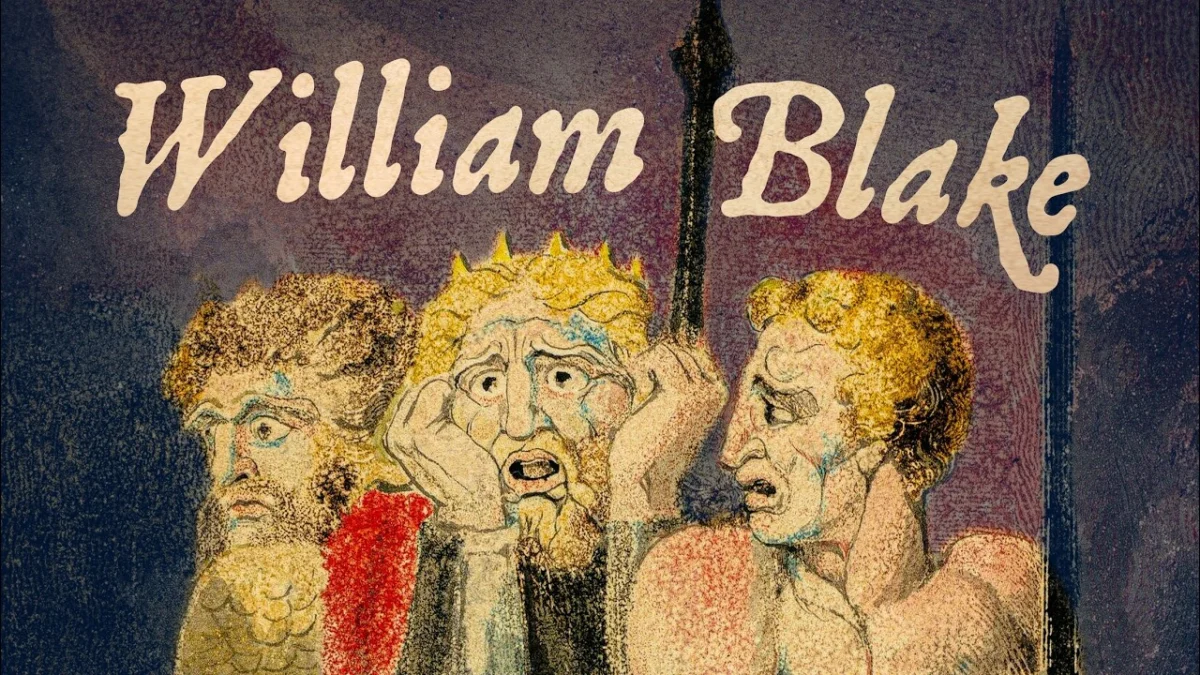
William Blake remains one of the most enigmatic figures in the history of Western art and literature, a man whose work continues to defy the neat categorizations of academic study. Often described as a poet, a painter, and a printmaker, Blake was in reality a visionary who refused to see these disciplines as separate entities. Instead, he treated the creation of art as a unified act, producing "illuminated books" that integrated text and image in a manner that had no precedent in the late eighteenth century and has seen few equals since. This refusal to specialize—to stay within the "neighborhoods of meaning" prescribed by the artistic establishment of his day—made him a radical in his own time and a "patron saint of unclassifiable artists" in the modern era.
Recent analysis by cultural commentators, including Evan Puschak of the Nerdwriter series, has brought renewed attention to Blake’s refusal to conform to the burgeoning principle of specialization that defined the Enlightenment and the Industrial Revolution. While his contemporaries were increasingly separating the roles of the writer, the illustrator, and the printer, Blake sought to consolidate them. He was a craftsman who controlled every stage of production, from the initial poetic composition to the physical etching of copper plates and the hand-coloring of the final prints. This holistic approach was not merely a matter of artistic preference; it was a philosophical stance against a world he saw as increasingly fragmented and soul-destroying.
The Historical Context of Blake’s Rebellion
To understand the radical nature of Blake’s work, one must look at the rigid structures of the London art world during his lifetime. Born in 1757, Blake lived through a period of intense social and intellectual upheaval. The Royal Academy of Arts, founded in 1768 when Blake was a young boy, sought to professionalize and standardize British art. Under the leadership of Sir Joshua Reynolds, the Academy promoted a "Grand Style" that emphasized classical hierarchies, formal training, and a strict separation of genres.
Blake, who was apprenticed to an engraver at the age of 14, found himself at the bottom of this hierarchy. In the eyes of the Academy, an engraver was a mere copyist—a technician rather than a "fine artist." Blake’s rejection of this status was total. He viewed the Academy’s standards as a form of intellectual tyranny, famously scrawling "This Man was Hired to Depress Art" in the margins of his copy of Reynolds’s Discourses.
By choosing to work as a "cross-breeder" of words and images, Blake essentially opted out of the professional art market of the 1800s. He did not paint for the wealthy patrons of the Academy; instead, he produced small-scale, idiosyncratic books that the public of his time largely ignored or found incomprehensible. His decision to live in what scholar Morris Eaves calls "incommensurable neighborhoods of meaning" meant that he lived much of his life in relative poverty, supported by a tiny circle of friends and patrons who recognized his genius.
The Technical Innovation of Relief Etching
A central component of Blake’s unclassifiable nature was his invention of "relief etching," a printing process he called "illuminated printing." In standard intaglio engraving, the lines to be printed are incised into the metal plate. Blake reversed this: he wrote and drew on copper plates using an acid-resistant liquid. When the plate was placed in an acid bath, the background was eaten away, leaving the text and illustrations standing in relief, like a rubber stamp.
This technical breakthrough allowed Blake to print both text and image simultaneously, treating the page as a single, organic composition. It also allowed him to maintain the "firm and determinate line" that he believed was the hallmark of true art. Once the plates were printed in a single color, Blake and his wife, Catherine, would hand-color each page with watercolors, ensuring that no two copies of his books were ever exactly alike.
This process was more than a labor-saving device; it was a manifestation of his belief that the "Body" and "Soul" of a work of art—its physical form and its poetic meaning—could not be separated. In works like Songs of Innocence and of Experience (1794), the relationship between the words and the surrounding vines, figures, and colors is symbiotic. To read the poem without seeing the image, or vice-versa, is to miss the fundamental tension Blake intended to convey.
Chronology of a Visionary Career
The trajectory of Blake’s career reveals a steady progression toward increasingly complex and personal mythologies.
- 1772–1779: Blake serves his apprenticeship under James Basire, where he spends much of his time sketching the Gothic monuments of Westminster Abbey. This experience deeply influenced his preference for linear, "Gothic" forms over the shaded, "sloshy" techniques of his contemporaries.
- 1788: Blake begins experimenting with relief etching. His first known attempts are the small tracts There is No Natural Religion and All Religions are One, which set the stage for his lifelong critique of Enlightenment rationalism.
- 1789–1794: Blake produces his most famous works, Songs of Innocence and Songs of Experience. These poems explore "the two contrary states of the human soul," moving from the pastoral simplicity of childhood to the "dark satanic mills" of an industrializing London.
- 1793–1804: This period marks the creation of his "Prophetic Books," including America a Prophecy, Europe a Prophecy, and The Book of Urizen. In these works, Blake developed a private mythology involving characters like Urizen (representing cold reason and law) and Orc (representing revolution and passion).
- 1804–1820: Blake works on his most ambitious illuminated poems, Milton and Jerusalem: The Emanation of the Giant Albion. These are sprawling, difficult works that attempt to map the spiritual history of humanity.
- 1821–1827: In his final years, Blake turned to illustrating the works of others, including the Book of Job and Dante’s Divine Comedy. Even in these commissions, his idiosyncratic vision remained dominant; his illustrations for Job, for instance, reinterpreted the biblical story as a psychological struggle for self-knowledge rather than a test of blind obedience.
Supporting Data and Modern Reception
While Blake was marginalized during his lifetime—his only solo exhibition in 1809 was a critical and financial failure—his status in the 21st century is that of a cultural titan. The scale of this shift is reflected in both academic interest and the commercial value of his work.
In 2019, the Tate Britain held the largest exhibition of Blake’s work in over 20 years, featuring more than 300 originals. The exhibition highlighted how Blake’s "unclassifiable" nature has made him a precursor to modern graphic novels and multimedia art. Furthermore, the "William Blake Archive," a digital project supported by the Library of Congress and the University of North Carolina, has digitized thousands of his works, allowing global access to materials that were once locked in private collections.
From a market perspective, Blake’s rarity and unique process have made his works among the most valuable in British history. In 1999, a copy of The First Book of Urizen sold at Sotheby’s for $2.5 million, a record for a single work by the artist. This commercial valuation stands in stark contrast to Blake’s own life, where he often struggled to pay for the copper plates he used for his etchings.
Broader Impact and Philosophical Implications
Blake’s legacy extends far beyond the art gallery or the literature classroom. He is often cited as a foundational figure for the 1960s counterculture, influencing figures such as Allen Ginsberg, Aldous Huxley, and Jim Morrison (whose band, The Doors, took its name from Blake’s line: "If the doors of perception were cleansed every thing would appear to man as it is, Infinite").
The core of Blake’s radicalism lies in his resistance to the "Single Vision" of Newtonian science and industrial capitalism. He believed that the human imagination was the "Divine Body" and that the act of creation was a sacred duty. By refusing to specialize, Blake asserted that the human experience cannot be compartmentalized. In his view, the scientist, the poet, and the artisan should be one and the same.
In the contemporary era, where hyper-specialization is the norm in both academia and the workforce, Blake’s "unclassifiable" art serves as a potent reminder of the power of integration. He viewed the divisions created by society—between class, between reason and emotion, and between different modes of art—as "mind-forg’d manacles." His life’s work was an attempt to break those manacles and present a vision of reality that was whole, vibrant, and profoundly human.
As modern audiences engage with his work through digital archives or high-definition video essays, the relevance of his message remains undiminished. Blake’s art suggests that salvation does not lie in "slavish obedience" to the rules of others, but in the radical act of seeing the world through one’s own imaginative lens. He remains, nearly two centuries after his death, the definitive example of an artist who refused to be categorized, choosing instead to create a world entirely of his own making.