Stephen King’s literary career has long been defined by an exceptional, highly lucrative ability to immerse readers in meticulously constructed worlds and compel them to turn pages at a relentless pace. Once a reader is hooked, King’s prose possesses an uncanny, cinematic quality, unspooling naturally as a fully realized film inside the imagination. It is hardly surprising, therefore, that his vast bibliography has been extensively adapted for the silver screen over the decades. While some of these cinematic translations have achieved masterpiece status, others have famously fallen short. Yet, the global appeal of King’s storytelling craftsmanship has historically transcended geopolitical boundaries, reaching audiences and creators far beyond the traditional Western studio system.
A striking testament to this cross-cultural resonance occurred during the mid-1980s, when Soviet animator Mikhail Titov adapted King’s 1972 short story “Battleground” into an animated short film simply titled Battle (or Сражение). Released in 1986, this rarely discussed adaptation reimagined King’s pulp-horror narrative through a unique Eastern Bloc artistic lens, blending American noir tropes with the distinct aesthetic traditions of Soviet animation.
Main Facts of the Production
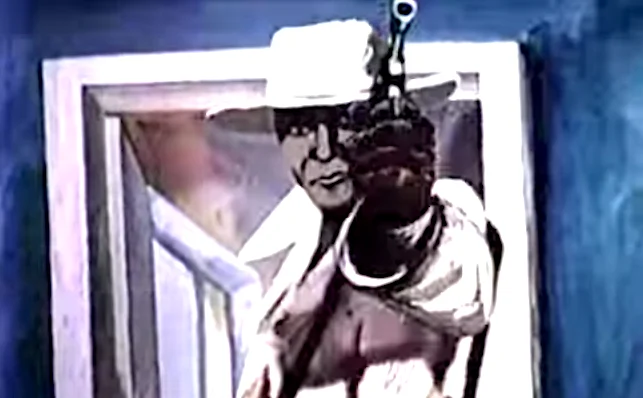
The 1986 animated short Battle runs for roughly ten minutes and features virtually no dialogue, relying instead on heavy atmospheric tension, dynamic action sequences, and a pronounced auditory landscape. The plot mirrors King’s original short story, centering on a cynical, trench-coat-and-fedora-wearing professional assassin who successfully completes a high-profile contract to eliminate a toy manufacturer. Upon returning to his high-rise apartment, the hitman discovers an unmarked package waiting on his doorstep.
Displaying a fatal lack of caution, he brings the box inside and unwraps it, only to find a military-themed playset manufactured by the very man he was hired to kill. Moments later, the miniature toys spring to life. Armed with live ammunition, rocket launchers, and miniature rotary aircraft, the plastic platoon initiates a calculated, single-minded military assault on the assassin. Trapped in his own home and heavily outgunned by miniaturized artillery, the seasoned killer finds himself pinned down in his bathroom, fighting desperately for survival against an unyielding toy army.
Director Mikhail Titov approached the project with a distinct visual strategy, utilizing rotoscoping—an animation technique where artists trace over motion picture footage frame by frame. This method yielded remarkably fluid and realistic human movements for the assassin, contrasting sharply with a surreal, distorted environment that appeared to bulge and warp as if viewed through a fish-eye lens. To complement the disorienting visuals, the production featured a synthesizer- and saxophone-heavy soundtrack that encapsulated the distinctive sonic textures of the mid-1980s.
Chronology and Historical Context
The trajectory leading to the creation of Battle spans several decades of literary publication, geopolitical separation, and the evolution of international animation practices.
In 1972, Stephen King published “Battleground” in the September issue of Cavalier magazine. The story was later collected in King’s acclaimed 1978 anthology Night Shift, which significantly broadened his international readership. Despite the strict cultural controls of the Iron Curtain, Western horror and speculative fiction frequently found ways to circulate among artists, filmmakers, and intellectuals in the Soviet Union.
By the mid-1980s, the political climate under Mikhail Gorbachev began to experience the early phases of Glasnost (openness) and Perestroika (restructuring), which fostered a subtle thaw in cultural exchanges and permitted Soviet artists to explore unconventional narrative material. It was within this evolving creative atmosphere that Mikhail Titov, an established animator with Kyivnaukfilm—the prominent Ukrainian animation studio famed for works like How the Cossacks Played Football (1970)—undertook the adaptation of King’s work.
Released in 1986, Battle emerged during a vibrant era for Soviet animation, which frequently experimented with avant-garde techniques, adult-oriented themes, and dark allegories. Although copyright enforcement between Western authors and Soviet state-run studios was virtually nonexistent at the time due to the Soviet Union’s non-signatory status regarding international copyright treaties like the Universal Copyright Convention, the film stood as an artistic homage rather than a commercial venture.
Supporting Data and Technical Execution
Examining the production details of Battle reveals the meticulous craftsmanship applied by Soviet animators working under state-sponsored studio systems. Kyivnaukfilm, where Titov spent a significant portion of his career, was one of the largest and most prolific animation houses in the USSR, producing hundreds of shorts ranging from children’s educational cartoons to sophisticated adult animation.
The technical choice of rotoscoping was relatively uncommon in mainstream Soviet animation of that era, which more frequently favored traditional hand-drawn cel animation, stop-motion puppet animation, or experimental pin-screen techniques. By tracing real human motion for the assassin, Titov achieved a heightened sense of physical vulnerability and weight, making the surreal threat of the plastic soldiers appear all the more jarring.
| Production Element | Detail |
|---|---|
| Original Author | Stephen King |
| Source Material | "Battleground" (Short Story, 1972) |
| Director | Mikhail Titov |
| Studio | Kyivnaukfilm |
| Release Year | 1986 |
| Primary Animation Technique | Rotoscoping |
| Audio Profile | Minimal dialogue, synth-pop/saxophone soundtrack |
The sound design played an equally vital role in shaping the film’s atmosphere. The aggressive integration of 1980s electronic synthesizers and smooth jazz saxophone functioned not only as a stylistic nod to contemporary Western action cinema—such as the gritty detective thrillers and neo-noir films popular during the decade—but also as an intensifying mechanism for the relentless pacing of the miniature warfare unfolding on screen.
Industry Perspectives and Creator Backgrounds
While Stephen King has frequently commented on adaptations of his work—ranging from enthusiastic praise for Stanley Kubrick’s The Shining (despite initial reservations) to public disavowals of various television miniseries—there is no public record of King officially commenting on the 1986 Soviet short. Given the informal nature of cultural distribution across the Iron Curtain during the Cold War, it remains historically uncertain whether King was even aware of Battle during its initial release.
Director Mikhail Titov, however, was an established figure within the Soviet animation community. Born in 1944, Titov dedicated decades to his craft, contributing as an animator and director to numerous notable projects. His earlier work on the popular Cossacks series demonstrated a mastery of broad comedic timing and character animation, whereas Battle allowed him to pivot successfully into suspense, action, and psychological tension. Animation historians have often noted that Titov’s ability to translate a prose-heavy, fast-paced American pulp story into a nearly silent, visually driven short film highlights his sophisticated understanding of visual grammar.
Broader Impact and Cultural Implications
The existence of Battle offers significant analytical value for film historians, literary scholars, and pop culture enthusiasts examining the global footprint of American popular culture during the Cold War. It demonstrates that despite profound ideological divides and restricted diplomatic channels, creative works produced by Western authors managed to penetrate Soviet artistic circles, inspiring local creators to reinterpret them through entirely distinct cultural and aesthetic frameworks.
Furthermore, Battle serves as a fascinating historical precursor to later official adaptations of the same material. Decades after Titov’s short film, TNT adapted “Battleground” as the pilot episode of its 2006 television anthology series Nightmares & Dreamscapes: From the Stories of Stephen King, starring William Hurt as the beleaguered assassin. Comparing the 2006 American live-action adaptation—which leaned heavily into CGI and overt dialogue—with Titov’s 1986 animated, virtually silent interpretation provides a compelling study in comparative adaptation theory.
Ultimately, Mikhail Titov’s Battle remains a fascinating footnote in the cinematic history of Stephen King adaptations. By stripping away dialogue and focusing purely on movement, sound, and spatial tension, the Soviet animator crafted a memorable, highly stylized siege thriller that continues to captivate modern audiences discovering it decades later via digital preservation archives.