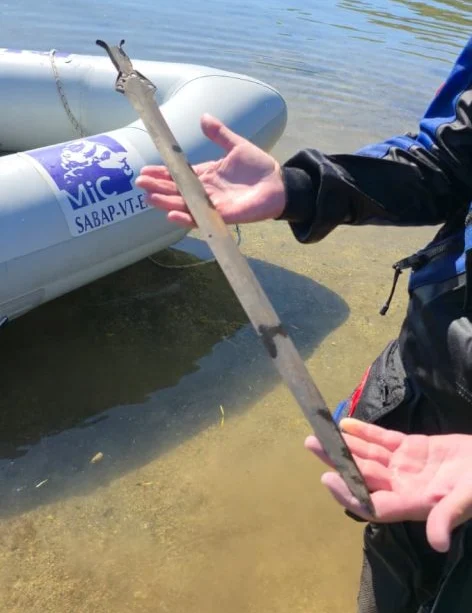
Archaeologists working beneath the waters of an undisclosed Italian lake have made a remarkable and exceptionally well-preserved discovery: a fully intact Bronze Age sword that has survived for over three millennia. Announced by the Superintendence of Archaeology, Fine Arts and Landscape for the Province of Viterbo and Southern Etruria, this extraordinary find provides unprecedented insight into the weapon-making technology, ritual practices, and daily lives of ancient European civilizations. While underwater archaeology frequently yields fragmented pottery, sunken wooden structures, or corroded metallic scraps, the recovery of a pristine metal blade from this era remains an exceedingly rare event, capturing the attention of historians and scientists worldwide.
The discovery highlights the rich archaeological tapestry hidden beneath Italy’s inland waterways. Viterbo and Southern Etruria, regions historically renowned for their Etruscan heritage, are proving to be repositories of even older human histories that predate classical antiquity by centuries. As marine archaeologists continue to survey these submerged environments using advanced sonar, diving equipment, and meticulous excavation protocols, lakes and rivers are increasingly recognized as primary archives for understanding prehistoric ritual behavior and settlement patterns.
The Chronology and Context of Bronze Age Weaponry
The Bronze Age in Italy generally spans from approximately 2300 BCE to 900 BCE, a transformative era marked by the widespread adoption of metallurgy, the development of complex trade networks, and the rise of stratified societies. During this long epoch, copper-tin alloy metallurgy revolutionized both agriculture and warfare, transitioning communities away from simpler stone tools toward durable, sophisticated metallic implements.
Swords from the early and middle Bronze Age were rarely standard military equipment; instead, they served as prestigious status symbols, ceremonial objects, and items of high value that reflected the wealth and power of chieftains or warriors. The newly recovered sword exhibits the distinct metallurgical characteristics of the period, featuring a carefully cast hilt and blade designed for both thrusting and cutting.
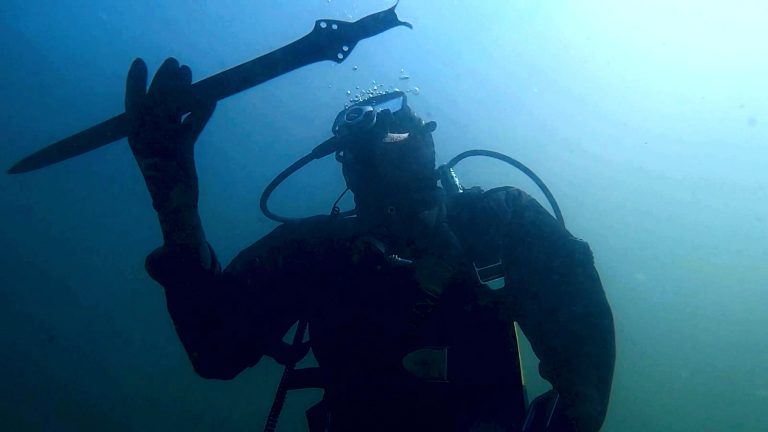
The preservation of such an artifact in an aquatic environment is largely due to the unique chemical properties of lake sediments. Submerged in oxygen-deprived (anoxic) mud, organic and metallic objects are often shielded from the rapid oxidation and bacterial decay that typically destroy artifacts exposed to air and soil. Consequently, the metal has retained much of its original contour, offering modern metallurgists an exceptional template for analyzing ancient casting techniques, alloy compositions, and post-production finishing.
Methodology and Underwater Excavation Challenges
Recovering fragile antiquities from underwater sites requires a delicate balance of marine engineering, historical expertise, and conservation science. The excavation team from the Superintendence of Archaeology utilized non-invasive mapping techniques before deploying certified scientific divers to retrieve the artifact.
When conducting underwater archaeology, the primary objective is not merely extraction, but the meticulous recording of the artifact’s exact provenance. Every centimeter of surrounding sediment is mapped to determine whether the sword was part of a larger structured deposit, such as a shipwreck, a lakeside settlement, or a deliberate ritual offering. Throughout European prehistory, it was a common cultural practice to submerge high-value items—such as weapons, jewelry, and bronze vessels—into lakes, bogs, and rivers as votive offerings to deities. Determining whether this specific sword was lost in combat, abandoned during a settlement relocation, or intentionally sacrificed to the waters remains a core focus of the ongoing investigation.
Official Responses and Expert Analysis
Representatives from the Superintendence of Archaeology, Fine Arts and Landscape for the Province of Viterbo and Southern Etruria have emphasized the immense scientific value of the find. In preliminary statements released following the recovery, heritage officials noted that the sword will undergo an extensive conservation process in specialized restoration laboratories.
Conservationists face the intricate challenge of stabilizing the bronze artifact. Metals retrieved from freshwater environments can suffer from "bronze disease"—a destructive chemical reaction caused by residual chlorides interacting with oxygen once the object is removed from the water. Specialized desalination and chemical consolidation treatments will be required over several months, or even years, to ensure the long-term preservation of the blade before it can be cleared for public exhibition.
Independent archaeological experts not directly affiliated with the excavation have praised the precision of the recovery operation. Historians specializing in prehistoric European warfare observe that weapons of this caliber and condition offer concrete data to test existing theories regarding Bronze Age trade routes. Because the tin required to create bronze was scarce in the Italian peninsula, ancient smiths relied on long-distance commerce that connected the Mediterranean with distant sources in Central Europe or the British Isles. Analyzing the trace chemical signatures within the metal alloy of the newly discovered sword may eventually reveal the geographic origin of the raw materials used to forge it.
Broader Implications for Prehistoric Research
The discovery of the Viterbo region sword reinforces the vital importance of protecting inland aquatic zones from illicit treasure hunting and unauthorized artifact looting. Underwater cultural heritage is protected under international conventions, yet freshwater sites remain vulnerable to illegal diving and commercial exploitation. By highlighting the profound historical dividends yielded by professional, scientific excavation, heritage authorities hope to foster greater public appreciation for legal preservation efforts.
Furthermore, this find contributes to a growing body of research that challenges traditional narratives of prehistoric isolation. The sophisticated craftsmanship evident in the sword demonstrates that Italian Bronze Age communities were part of an interconnected network of artisans and metallurgists who shared technological innovations across vast geographic distances.
As conservation work proceeds and academic publications detailing the metallurgical analysis are released in the coming months, the sword is expected to become a centerpiece for future exhibitions dedicated to ancient Italian heritage. By bridging the gap between myth and material reality, this submerged artifact provides a tangible link to the individuals who shaped the foundations of European civilization over three millennia ago.