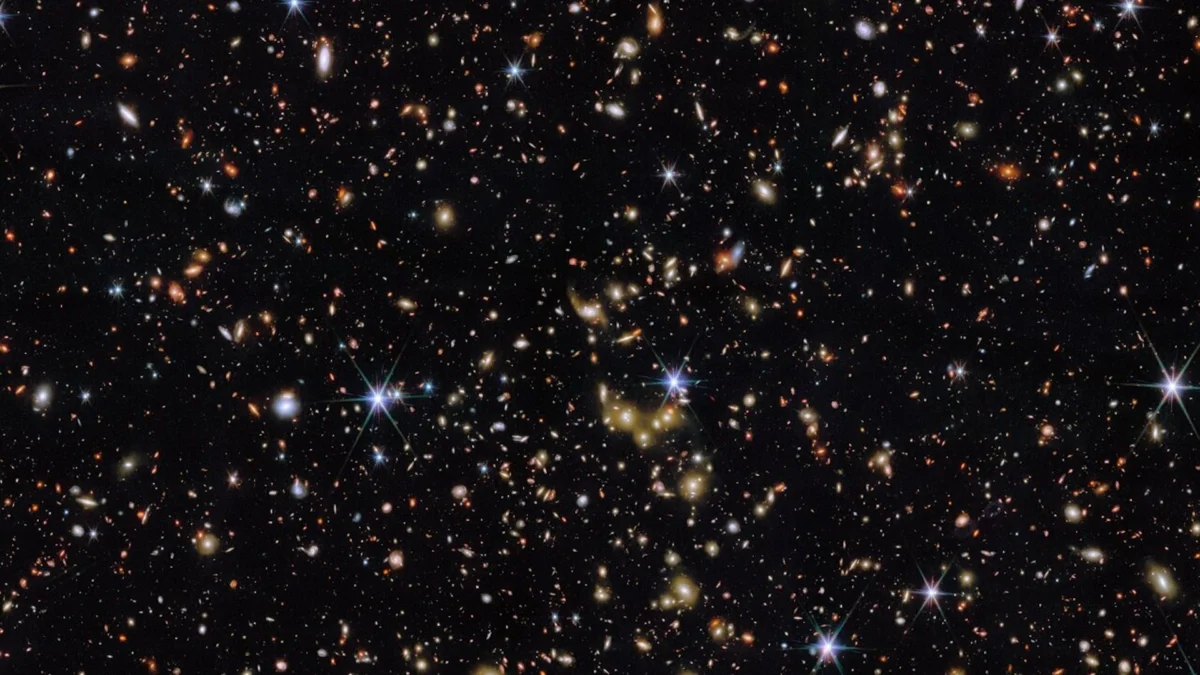
The James Webb Space Telescope (JWST) has once again pushed the boundaries of human observation, returning a stunning deep field image that captures some of the most distant galaxies ever identified in the universe. Released through a collaborative effort involving the European Space Agency (ESA), NASA, and the Canadian Space Agency (CSA)—alongside contributions from researchers such as G. Gozaliasl, A. Koekemoer, M. Franco, and the COSMOS-Web team—this breathtaking snapshot offers astronomers a clearer window than ever before into a pivotal epoch of cosmic history: the period immediately following the end of the Cosmic Dark Age.
By peering billions of light-years into the past, JWST is allowing scientists to reconstruct how the very first stars, black holes, and galaxies assembled from primordial gas. This latest deep field image not only showcases the technological prowess of humanity’s premier space-based observatory but also reignites fundamental questions regarding the timeline of cosmic reionization and the evolutionary trajectory of the universe.
Unlocking the Secrets of the Early Universe
To understand the significance of the JWST deep field image, one must examine the state of the universe during its infancy. Following the Big Bang roughly 13.8 billion years ago, the universe was an intensely hot, dense soup of elementary particles. As it expanded, it cooled, allowing protons and electrons to combine into neutral hydrogen atoms around 380,000 years later. This event, known as recombination, rendered the universe transparent to light for the first time, releasing the Cosmic Microwave Background (CMB).
However, this era ushered in the Cosmic Dark Age—a sprawling, hundreds-of-millions-of-years stretch during which no stars existed. The universe was filled with cold, opaque neutral hydrogen gas that blocked optical light, plunging the cosmos into literal and figurative darkness.
The Cosmic Dark Age finally drew to a close roughly 400 million to one billion years after the Big Bang during an epoch known as Cosmic Reionization. During this transformative phase, intense ultraviolet radiation emitted by the universe’s very first generation of stars and massive black holes ionized the surrounding neutral hydrogen gas. The JWST deep field image captures the glowing remnants and newly formed structures emerging precisely from this transitional threshold, providing direct observational data on an era that was previously obscured from view.
The Technological Leap of the James Webb Space Telescope
The ability to capture ancient, redshifted light from the edge of the observable universe requires unprecedented technological capabilities. Unlike its predecessor, the Hubble Space Telescope, which primarily observes in the optical and ultraviolet spectrums, JWST is optimized for infrared astronomy.
Because the universe is expanding, light emitted by the earliest galaxies has traveled across space for billions of years. During this journey, the wavelength of that light has been stretched—or redshifted—from ultraviolet and visible light into the infrared spectrum. JWST’s massive 6.5-meter primary mirror, coated in a microscopic layer of gold to optimize the reflection of infrared light, combined with its suite of highly sensitive instruments like Near-Infrared Camera (NIRCam) and Near-Infrared Spectrograph (NIRSpec), makes it uniquely qualified to detect these faint, ancient heat signatures.
Operating from its station at the second Lagrange point (L2), roughly 1.5 million kilometers (1 million miles) away from Earth, the observatory remains shielded from the thermal interference of both the Earth and the sun. This ultra-cold environment allows its instruments to detect infrared light with a clarity and depth that ground-based telescopes simply cannot achieve due to atmospheric distortion and thermal glow.

Chronology of Deep Field Observations
Deep field imaging has a storied history in modern astronomy, serving as a measure of humanity’s technological progress over the past three decades:
- 1995 (The Hubble Deep Field): Pointed at what appeared to be an empty patch of sky in the constellation Ursa Major, the Hubble Space Telescope revealed thousands of previously unknown galaxies, proving that the universe was densely populated with galactic structures even in deep antiquity.
- 2003–2004 (The Hubble Ultra Deep Field): Looking even deeper into the southern constellation Fornax, Hubble captured light from galaxies that existed fewer than 800 million years after the Big Bang.
- 2012 (The Hubble eXtreme Deep Field – XDF): Combining a decade of imaging data, Hubble pushed the horizon back further, revealing faint galaxies born just 450 million years after the Big Bang.
- 2022 (JWST’s First Deep Field – SMACS 0723): Shortly after entering scientific operations, JWST shattered previous records by capturing the galaxy cluster SMACS 0723, displaying gravitationally magnified background galaxies dating back to within 300 to 400 million years of the Big Bang.
- Present Day (COSMOS-Web and Advanced Deep Fields): Ongoing surveys like COSMOS-Web leverage JWST’s wide-field infrared imaging capabilities to map large swathes of the early universe, yielding unprecedented statistical samples of primordial galaxies.
Scientific Analysis and Implications
The release of deep field imagery from collaborations involving the COSMOS-Web team and international space agencies is far more than an aesthetic achievement; it represents a goldmine of empirical data.
One of the most pressing questions in contemporary astrophysics is how galaxies formed so quickly in the early universe. Standard cosmological models previously suggested that galaxies required a billion years or more to grow to the massive sizes now being routinely discovered by JWST. The presence of bright, well-developed galaxies existing merely a few hundred million years after the Big Bang challenges existing paradigms of galaxy formation and stellar evolution.
Astronomers analyzing these deep field datasets are utilizing spectroscopic instruments to break down the light from these distant objects into their constituent wavelengths. This allows researchers to measure the precise chemical composition (metallicity) of early stars. Because the first stars were forged almost entirely from primordial hydrogen and helium, finding traces of heavier elements—such as carbon, oxygen, and iron—provides critical clues about how quickly subsequent generations of massive stars lived, died, and seeded the interstellar medium with heavier elements.
Furthermore, these observations shed light on supermassive black holes. JWST data frequently reveals the presence of active galactic nuclei powered by black holes that are vastly more massive than theoretical models predicted should exist at such early cosmic epochs. Understanding the symbiotic growth relationship between these early black holes and their host galaxies remains one of the frontier challenges of theoretical physics.
Broader Impact on Astrophysics and Public Engagement
Beyond the realm of academic research, JWST’s deep field imagery continues to capture the global public imagination. In an era often dominated by terrestrial conflicts and digital polarization, images of thousands of distant galaxies—each containing billions of stars, planets, and potential worlds—serve as a humbling reminder of humanity’s place within the vast cosmic expanse.
Educational institutions, science communicators, and museums worldwide utilize these high-resolution datasets to inspire the next generation of scientists, engineers, and astronomers. The collaborative nature of missions like JWST—bridging NASA, ESA, CSA, and international research consortiums—also demonstrates the profound achievements possible through coordinated global scientific enterprise.
As the James Webb Space Telescope continues its multi-year mission, astronomers anticipate even deeper and more comprehensive surveys of the cosmos. Each exposure brings humanity closer to answering the ultimate chronological question: how the lights first turned on in a dark universe, setting into motion the complex chain of events that eventually led to the formation of our solar system, our planet, and life itself.