
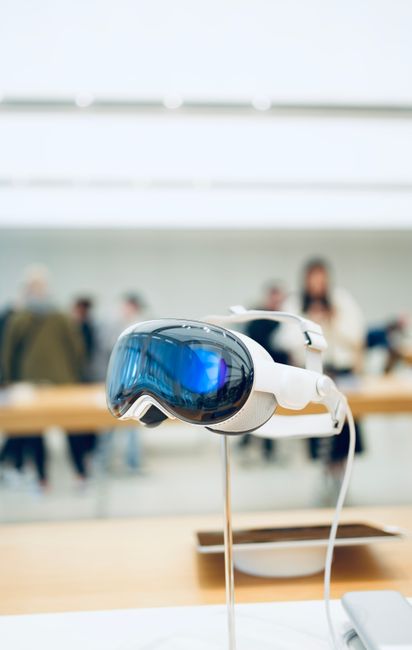
Apple Vision Pro: Spatial Computing Redefined
The Apple Vision Pro, a revolutionary spatial computing device, heralds a new era of human-computer interaction. Unlike traditional VR or AR headsets, the Vision Pro seamlessly blends digital content with the physical world, creating an immersive experience that transcends the limitations of flat screens. This groundbreaking technology leverages a sophisticated array of sensors, high-resolution displays, and powerful custom silicon to deliver a user interface that is both intuitive and incredibly powerful. At its core, spatial computing with the Vision Pro is about augmenting reality, allowing users to interact with digital information in a three-dimensional space. This means applications can be placed anywhere in the room, resized at will, and manipulated with natural gestures and eye movements. The device’s advanced eye-tracking technology, combined with precise hand-tracking, allows for effortless navigation and interaction. Users can simply look at an element to select it and then use subtle hand gestures, like pinching and flicking, to control applications and menus. This level of intuitive control eliminates the need for cumbersome controllers, further blurring the lines between the digital and physical.
The hardware underpinning the Apple Vision Pro is nothing short of extraordinary. Two micro-OLED displays, each boasting more pixels than a 4K TV for each eye, provide unparalleled visual fidelity. This meticulous attention to detail ensures that text is crisp, images are vibrant, and the sense of presence is profoundly convincing. The displays are powered by the M2 chip, familiar from Apple’s Mac lineup, providing robust processing power. Complementing this is the all-new R1 chip, specifically designed to process input from the device’s 12 cameras, five sensors, and six microphones in real-time. This low-latency processing is crucial for maintaining the illusion of seamless integration and preventing motion sickness. The external battery pack, while a departure from fully integrated designs, is a pragmatic choice, allowing for extended use without the bulk of a large battery within the headset itself. This battery connects via a braided cable, designed for comfort and durability. The design of the Vision Pro prioritizes comfort and fit, with a modular system that allows users to customize the light seal and head band for a personalized and secure experience, even during prolonged use. The use of premium materials, such as aluminum and glass, further reinforces the device’s premium positioning and durable construction.
The operating system, visionOS, is the bedrock of the Vision Pro’s spatial computing capabilities. Built from the ground up for this new paradigm, visionOS introduces a unique interface that allows users to interact with apps in a three-dimensional environment. Apps are no longer confined to a screen; they can be anchored to walls, placed on desks, or even floated in mid-air. This spatial organization allows for a more natural and less cluttered workflow, especially when multitasking. Users can open multiple app windows, arrange them around their physical space, and switch between them with simple glances and gestures. The system’s ability to understand and react to the user’s environment is paramount. The Vision Pro’s passthrough technology, powered by high-resolution cameras, provides a remarkably clear and natural view of the real world, allowing users to remain aware of their surroundings while immersed in digital content. This is a key differentiator from fully immersive VR headsets, making the Vision Pro suitable for a wider range of everyday tasks. The system’s integration with the Apple ecosystem is another significant advantage, allowing for seamless continuation of work and entertainment across Apple devices.
The applications and use cases for the Apple Vision Pro are vast and continue to expand. In the realm of productivity, the Vision Pro transforms workspaces. Imagine having multiple virtual monitors for coding, design, or data analysis, all arranged in your physical office space without the need for actual monitors. This unlocks unprecedented multitasking capabilities and can significantly boost efficiency. For creative professionals, the ability to manipulate 3D models in real-world scale, sculpt digital art in a spatial environment, or visualize architectural designs with true-to-life dimensions opens up entirely new creative workflows. The entertainment experience is also fundamentally changed. Watching movies on a massive virtual screen that can be adjusted to any size and placed anywhere in a room offers an unparalleled cinematic experience. Gaming takes on a new dimension, with immersive environments and interactive gameplay that leverages the spatial computing capabilities. Beyond work and entertainment, the Vision Pro has the potential to revolutionize education. Students could explore historical sites in 3D, dissect virtual anatomy models, or engage with complex scientific concepts in an interactive, spatial manner.
The interaction model of the Apple Vision Pro is a significant departure from conventional interfaces. It emphasizes natural human behaviors, primarily eye movement and hand gestures. The EyeSight feature, a unique aspect of the Vision Pro, displays an outward-facing representation of the user’s eyes when someone is approaching, signaling that the user is not fully immersed and is aware of their surroundings. This is a crucial social cue, addressing a common concern with immersive technologies. The core interaction loop involves looking at an element to bring it into focus, followed by a simple pinch gesture to select or activate it. More complex manipulations, such as resizing or rotating objects, are achieved through intuitive multi-finger gestures. This gestural language is designed to be learned quickly and feel natural. Voice commands, powered by Siri, further enhance the interaction, allowing users to dictate text, search for information, or control applications hands-free. The precision of the eye-tracking is remarkable, enabling the system to accurately determine which element the user is focusing on, even when surrounded by multiple virtual objects.
The potential impact of Apple Vision Pro on various industries is profound. In healthcare, surgeons could practice complex procedures in a virtual environment, or visualize patient data in 3D during surgery. Architects and engineers can collaborate on designs in a shared virtual space, walking through their creations before they are built. The retail sector could offer immersive shopping experiences, allowing customers to virtually try on clothes or visualize furniture in their homes. The training and simulation market stands to benefit immensely, providing realistic and safe environments for learning complex skills across various professions. The development of the Vision Pro also signifies a commitment from Apple to nurture a robust ecosystem. The availability of the Software Development Kit (SDK) for visionOS encourages developers to create innovative applications tailored for spatial computing. As developers explore the possibilities of this new platform, the range and sophistication of applications are expected to grow exponentially, further cementing the Vision Pro’s position as a transformative technology. The company’s track record with previous product launches suggests a long-term vision for the platform, with ongoing software updates and hardware iterations anticipated to enhance its capabilities and expand its reach.
Privacy and security are paramount considerations for any new computing platform, and Apple has integrated robust measures into the Vision Pro. The device’s processing is largely done on-device, minimizing the transmission of sensitive personal data. Eye-tracking data, for instance, is processed locally and not shared with Apple or third parties unless explicitly permitted by the user. The passthrough cameras are designed to capture only what is necessary for the spatial computing experience and are not used for continuous surveillance. Furthermore, the user has granular control over app permissions, dictating what data apps can access. The secure enclave within the M2 chip protects sensitive information, and the entire system is built with Apple’s commitment to user privacy at its forefront. The company’s established reputation for strong privacy practices provides a level of assurance for consumers adopting this new technology. This focus on user trust is critical for widespread adoption, especially given the intimate nature of a head-worn device.
The future roadmap for spatial computing, with the Apple Vision Pro at its vanguard, is incredibly promising. As the technology matures and becomes more accessible, we can expect to see further advancements in display resolution, processing power, battery life, and the overall form factor of these devices. The integration of AI will undoubtedly play a significant role, enabling more intelligent and context-aware spatial computing experiences. Imagine an AI assistant that can proactively offer relevant information based on your physical environment and current task. The development of more sophisticated haptic feedback technologies could further enhance immersion, allowing users to "feel" virtual objects. The long-term vision for spatial computing is not about replacing physical reality but about augmenting it, creating a more seamless and intuitive way to interact with information and digital content. The Apple Vision Pro is positioned as the initial, high-fidelity exploration of this future, setting a precedent for what is to come in the evolving landscape of personal technology. The device’s success will be measured not just by its initial sales figures but by its ability to inspire a new generation of applications and fundamentally alter how we work, play, and connect with the digital world.




Leave a Reply