
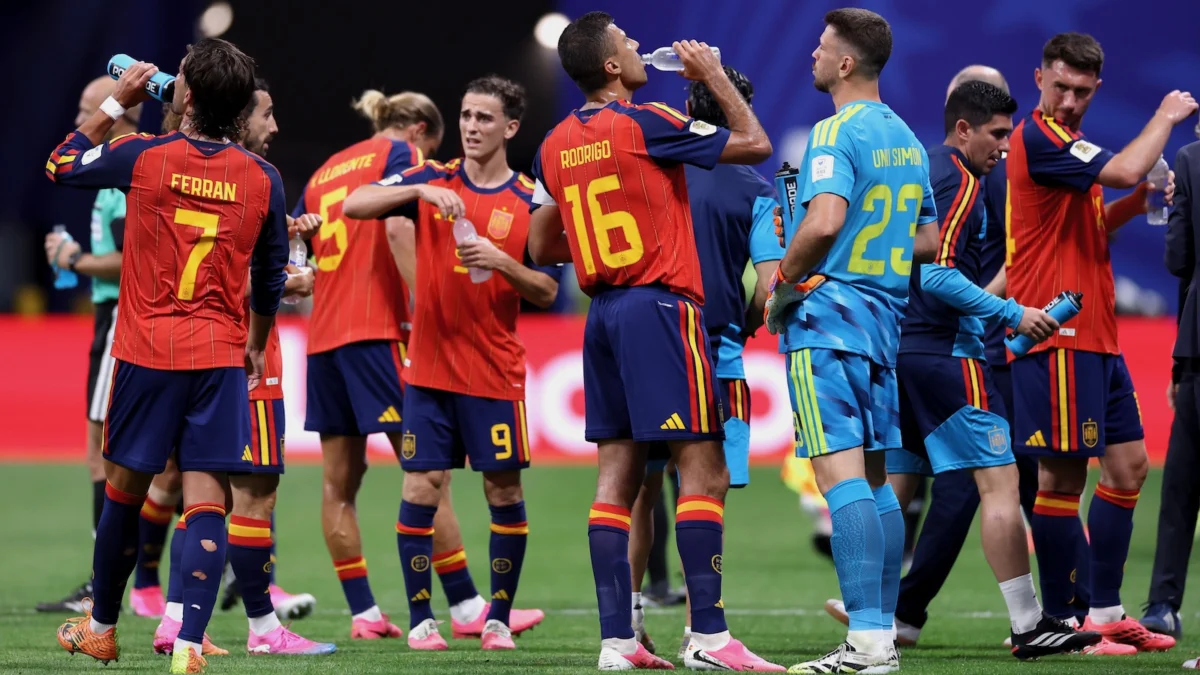
As the United States national team prepares to take the pitch against Australia this afternoon, the global sporting community finds itself embroiled in a debate that transcends the boundaries of tactical formations and goal-scoring prowess. Millions of spectators, many of whom have not engaged with international soccer since the previous World Cup cycle, will witness a structural transformation of the "beautiful game." For the first time in the tournament’s history, mandatory three-minute hydration breaks are being implemented midway through each half, regardless of the local climate or stadium conditions. While FIFA, the sport’s global governing body, defends the measure as a critical evolution in player safety amid a warming planet, critics, broadcasters, and fans have labeled the move a "momentum killer" and a thinly veiled attempt to maximize advertising revenue.
The introduction of these breaks has sparked what international media outlets are calling "Water-gate." The controversy highlights a growing tension between the physical demands of elite athleticism in an era of climate instability and the commercial imperatives of the world’s most-watched sporting event. As the tournament progresses across 16 host cities in the United States, Canada, and Mexico, the mandatory pauses have shifted the spotlight from the players’ skill to the organization’s motives.
The Evolution of Hydration Protocols
To understand the current friction, it is necessary to examine the chronology of FIFA’s cooling policies. Historically, soccer has been a game of continuous play, with the clock running for 45 minutes plus "stoppage time" in each half. The concept of a formal "cooling break" was first introduced during the 2014 World Cup in Brazil, specifically for matches where the Wet Bulb Globe Temperature (WBGT) exceeded 32 degrees Celsius (approximately 90 degrees Fahrenheit). The WBGT is a composite temperature used to estimate the effect of temperature, humidity, wind speed, and solar radiation on humans.
Under the previous regulations, the decision to implement a break was made on a match-by-match basis by the referee and the FIFA medical delegate. This protocol was utilized sparingly, most notably during the Netherlands versus Mexico Round of 16 match in Fortaleza, where temperatures soared. However, following the 2025 summer season—which saw record-breaking heatwaves across North America and prompted the players’ union, FIFPRO, to demand more rigorous protections—FIFA opted for a radical policy shift.
In December 2025, FIFA announced that for the 2026 World Cup, hydration breaks would become mandatory for every match. The governing body stated that this "focused attempt to ensure the best possible conditions for players" was necessary to standardize player welfare across a continent-wide tournament featuring vastly different microclimates. Crucially, the rule now applies to matches held in climate-controlled indoor stadiums, such as those in Houston and Arlington, as well as evening matches in more temperate cities like Vancouver or Seattle.
Scientific Rationale vs. Sporting Integrity
The medical community generally supports the proactive management of heat stress. Modern elite soccer requires players to cover between 10 and 13 kilometers per match, often involving high-intensity sprints that cause core body temperatures to spike. Research conducted by FIFPRO and various sports science institutes suggests that even mild dehydration can impair cognitive function, increase the risk of soft-tissue injuries, and lead to heat exhaustion.
"It has never been more important to give space to scientific knowledge and find mitigation strategies that protect the health and wellbeing of our players," FIFPRO stated in a recent press release. The organization argues that the traditional 15-minute halftime interval is insufficient for recovery when ambient temperatures are extreme.
However, the "one-size-fits-all" application of the rule has drawn the ire of players and coaches who value the flow of the game. Virgil van Dijk, the veteran captain of the Netherlands, expressed a sentiment shared by many professionals: "If it’s really hot, obviously it will be good to put them in. But I think you have to look at it in every game separately." The concern among purists is that these breaks disrupt tactical momentum. A team that has its opponent "on the ropes" during a period of sustained pressure may find its rhythm severed by a mandatory whistle, allowing the defending team to regroup and rehydrate.
The Commercial Conflict and "Water-gate"
The most cynical critiques of the new policy focus on the financial windfall generated by these three-minute windows. While FIFA maintains that the breaks are strictly for hydration, the logistical reality of modern broadcasting has created a lucrative new asset.
According to reports from The Wall Street Journal, the mandatory breaks have essentially divided the 90-minute match into four quarters, creating premium "ad pods" that did not previously exist in soccer broadcasting. In the United States, where the domestic market is a primary target for FIFA’s growth strategy, the value of these breaks is immense. A 30-second advertisement during an early-round match is estimated to cost approximately $200,000. For high-stakes matches involving the U.S. National Team, that figure can climb to $750,000 or more.
With two breaks per match (one in each half), broadcasters have roughly four minutes and twenty seconds of additional commercial time to sell. Across an 80-match tournament, this represents hundreds of millions of dollars in potential incremental revenue. John Kosner, a former ESPN executive, noted that FIFA has "made enormously valuable breaks" out of a player safety initiative.
The tension reached a boiling point during the opening match of the tournament. The American broadcaster Fox Sports cut to a commercial break at the 67-minute mark. However, the advertisements ran longer than the hydration pause. By the time the broadcast returned to the pitch, the match had already resumed, leaving viewers to miss several minutes of live action. While FIFA declined to sanction the network, citing the fact that the break began during a replay sequence, the incident solidified public perception that the breaks are designed for sponsors rather than athletes—especially since the kickoff temperature for that specific match was a mild 74 degrees Fahrenheit.
Public Outcry and Fan Reaction
The reaction from the stands and social media has been overwhelmingly negative. During the England versus Croatia fixture, a chorus of boos erupted from the stadium when the referee signaled for the mid-half stoppage. On platforms like Reddit, fans have accused FIFA of "ruining the beautiful game" and "monetizing every second of the broadcast."
The frustration stems from a perceived lack of transparency. Fans argue that if the goal is truly player safety, the breaks should be contingent on the actual environmental conditions of the day. The requirement for hydration breaks in air-conditioned stadiums, where the temperature is maintained at a constant 70 degrees, is cited as the "smoking gun" for those who believe the policy is profit-driven.
Chris Taylor, the head coach of Vermont Green FC—a club known for its focus on climate justice—offered a nuanced perspective. While he acknowledges the very real dangers of extreme heat, he questioned the implementation at the World Cup level. "I don’t think the health of the players is their primary concern," Taylor remarked, suggesting that the tournament feels as though "every angle has been monetized."
Logistical Challenges of a Multi-National Tournament
FIFA’s defense of the mandatory nature of the breaks centers on the concept of competitive equity. The 2026 World Cup is a logistical behemoth, spanning three countries and multiple time zones. Teams playing in Monterrey or Miami may face humidity levels exceeding 80%, while teams in Mexico City must contend with both heat and high altitude.
FIFA officials argue that making the breaks mandatory for all matches prevents teams in cooler climates from having an unfair physical advantage over those playing in tropical conditions. By standardizing the breaks, FIFA claims it is ensuring that every player, regardless of their venue, follows the same physiological recovery protocol.
Critics like Taylor, however, find this argument lacking. Soccer is inherently a game of variables; pitch dimensions, grass types, and travel schedules are rarely perfectly equal. Adding a mandatory stoppage to "standardize" the experience is seen by many as an unnecessary intervention into the sport’s natural unpredictability.
Broader Implications for the Future of Global Sports
The "Water-gate" controversy is a harbinger of the challenges facing global sports in the 21st century. As climate change increases the frequency of extreme weather events, governing bodies will be forced to choose between traditional game structures and radical safety interventions.
If the 2026 World Cup’s hydration breaks become a permanent fixture, they may pave the way for further "Americanization" of the sport, including more frequent stoppages for video reviews (VAR) or even designated "media timeouts," similar to those found in the NFL or NBA.
For now, as the U.S. and Australia take the field, the three-minute whistle will remain a point of contention. Whether it is viewed as a necessary evolution for a warming world or a "money-grabbing disgrace," the mandatory hydration break has fundamentally altered the rhythm of the World Cup. As the tournament continues, the pressure will remain on FIFA to prove that its commitment to player welfare is as robust as its commitment to its commercial partners. For the millions watching at home, the hope remains that the game—and not the commercials—remains the primary focus.










Leave a Reply