
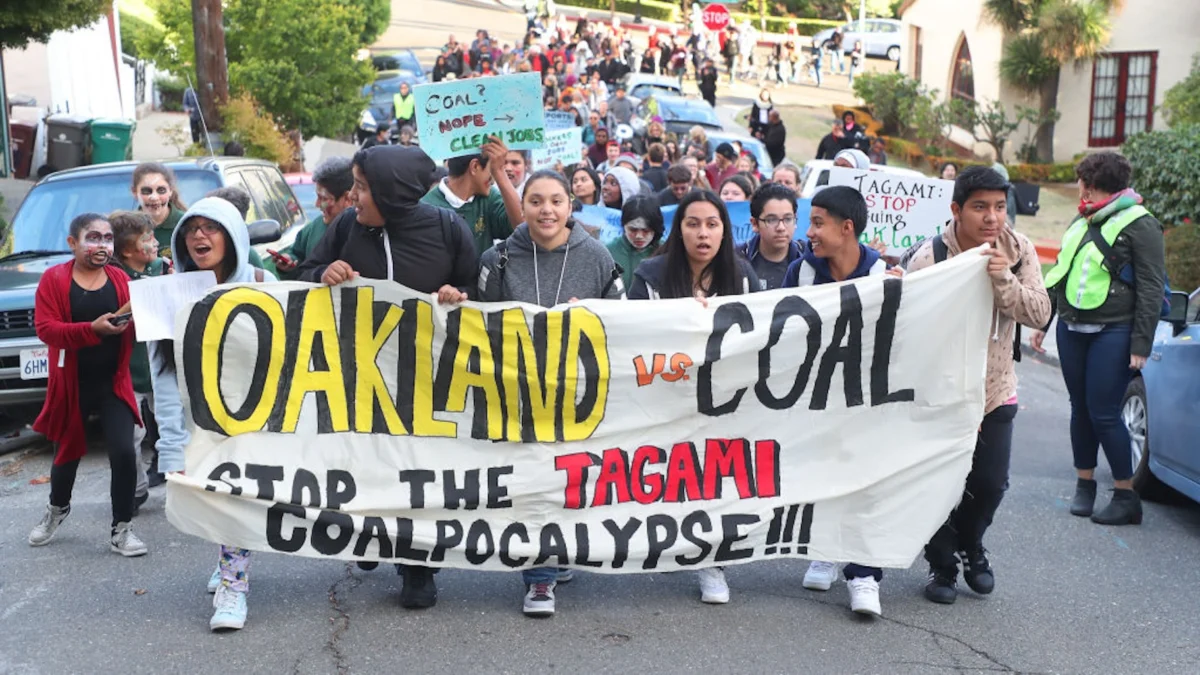
The U.S. Department of Energy has announced a commitment of up to $75 million in federal funding to support the construction of a controversial export terminal in Oakland, California, marking a significant intervention by the Trump administration in a local land-use conflict that has spanned more than a decade. The injection of capital, sourced through the Defense Production Act, aims to revitalize a project that has been stalled by a labyrinth of litigation, environmental opposition, and financial instability. This move is part of a broader federal strategy to bolster the domestic coal industry, even as the fuel’s role in the American power grid continues to diminish in the face of cheaper renewable energy and natural gas.
The funding for the Oakland Global Trade and Logistics Center—the formal name for the terminal project—was included in a sweeping $400 million package aimed at supporting coal-fired power plants and expanding export infrastructure across the United States. Energy Secretary Chris Wright characterized the investment as a necessary step toward achieving "American energy dominance," arguing that the lack of export capacity on the West Coast has long acted as a bottleneck for American energy resources seeking access to global markets, particularly in Asia.
A Decade of Discord: From Army Base to Coal Hub
The saga of the Oakland terminal began in 2013 when the City of Oakland entered into a development agreement with California Capital & Investment Group (CCIG), led by prominent local developer Phil Tagami. The project was centered on the redevelopment of the decommissioned Oakland Army Base, a sprawling site on the city’s western waterfront. At the time, the project was marketed as a multi-commodity bulk terminal that would revitalize the local economy, create jobs, and help Oakland regain shipping traffic lost to competing ports like Long Beach and Savannah.
During the initial planning phases, rumors circulated that the terminal would be used to export coal from mines in the Intermountain West. Tagami initially dismissed these concerns, labeling critics as "misinformed" in a December 2013 newsletter. However, the political landscape shifted dramatically in 2015 when a report by the Salt Lake Tribune revealed that the developers had secretly secured a $53 million investment from four coal-producing counties in Utah. The deal was designed to guarantee the terminal would be used to ship millions of tons of Utah coal to overseas buyers.
The revelation sparked an immediate and intense backlash in Oakland, a city with a long history of environmental activism and a population already burdened by high rates of asthma and industrial pollution in the West Oakland neighborhood. Residents and environmental groups argued that the transport of coal via rail and its storage at the waterfront would release harmful coal dust into the air, posing a direct threat to public health.
The Legal Stalemate and the "Regulatory Certainty" Clause
In response to public outcry, the Oakland City Council held a series of high-profile hearings in 2016. Following testimony from health experts and community members, the city passed an ordinance and adopted a resolution prohibiting the storage and handling of coal within city limits. This legislative move set the stage for a protracted legal battle that would eventually reach the federal appellate level.
The developers sued the city, arguing that the coal ban violated the terms of the 2013 development agreement. A central pillar of the developers’ argument was a "regulatory certainty" clause, which effectively froze the city’s land-use regulations at the time the agreement was signed. Under this contract, the city was prohibited from applying new regulations to the project unless it could prove that failing to do so would result in a "substantial danger" to the health and safety of Oakland residents.
In 2018, a federal judge ruled in favor of the developers, concluding that the city had failed to provide sufficient evidence that coal dust from the terminal would pose such a substantial danger. The judge’s ruling noted that the record compiled by the city was "riddled with inaccuracies" and "faulty analyses." While the court did not rule that coal was safe, it determined that the city’s specific evidentiary basis for the ban did not meet the high threshold required to override the development agreement. This decision was later upheld by the 9th U.S. Circuit Court of Appeals.
Financial Turmoil and Bankruptcy Proceedings
Despite their legal victories regarding the coal ban, the developers faced mounting financial hurdles. As the litigation dragged on, construction milestones required by the city lease were missed. In 2018, the City of Oakland moved to terminate the ground lease for the terminal site, citing the lack of progress. This triggered a second wave of litigation in state court, where developers argued that the city’s own opposition and legal maneuvers had made it impossible to meet the construction deadlines.
The project’s financial viability was further called into question when Insight Terminal Solutions (ITS), the company slated to operate the facility, filed for Chapter 11 bankruptcy in Kentucky. During these proceedings, ITS sought more than $650 million in damages from the City of Oakland, claiming the city’s "bad faith" opposition had destroyed the project’s value. While a bankruptcy judge initially sided with the firm, a federal district court vacated that ruling late last year, providing a temporary reprieve for the city’s strained municipal budget.
Environmental advocates have long argued that the project was a "zombie" development—economically unfeasible without massive subsidies and legally fraught. Ben Eichenberg, an attorney for San Francisco Baykeeper, noted that the terminal had essentially run out of private funding options. "The project was drowning," Eichenberg said, "and the federal government has just thrown it a $75 million life preserver."
Federal Strategy and the Defense Production Act
The Department of Energy’s decision to use the Defense Production Act (DPA) to fund a coal terminal is a notable shift in federal energy policy. Traditionally used to ensure the production of critical materials for national defense, the DPA has been increasingly utilized by recent administrations to steer the energy economy. While the Biden administration used the DPA to boost heat pump production and solar components, the current administration is leveraging it to shore up fossil fuel infrastructure.
Secretary Chris Wright’s assertion of "energy dominance" reflects a geopolitical strategy aimed at making the United States a primary energy supplier to the Indo-Pacific region. By expanding West Coast export capacity, the administration hopes to provide an outlet for coal from states like Utah and Wyoming, where domestic demand is cratering as utilities transition to cleaner energy sources.
According to data from the U.S. Energy Information Administration (EIA), coal’s share of U.S. electricity generation has fallen from approximately 50% in 2005 to less than 17% in 2023. In contrast, utility-scale solar and wind generation have seen record growth. For the coal industry, survival increasingly depends on the ability to reach international markets where coal demand remains higher, particularly in developing economies.
Environmental and Public Health Concerns
The prospect of a coal terminal in West Oakland remains a flashpoint for environmental justice. West Oakland is surrounded by three major freeways and the Port of Oakland, resulting in some of the highest levels of diesel particulate matter in the state. According to the Alameda County Public Health Department, residents of West Oakland have historically faced a life expectancy several years lower than those in the more affluent Oakland hills.
Coal dust contains fine particulate matter (PM2.5 and PM10), which can penetrate deep into the lungs and enter the bloodstream. Exposure is linked to respiratory illnesses, cardiovascular disease, and increased mortality. Environmental groups argue that even with modern mitigation technologies, the volume of coal intended for the terminal—up to 10 million tons per year—would inevitably lead to significant fugitive dust emissions during rail transport and loading.
"We are going to do everything in our power to protect the community," Eichenberg said. "This is not just about a contract; it’s about the air people breathe in a community that has already been treated as a sacrifice zone for industrial pollution."
The Permitting Roadblock Ahead
While the $75 million federal grant provides a significant financial boost, it does not clear the project’s regulatory path. The terminal must still secure a variety of permits from regional and state agencies. The most significant hurdle is the Bay Area Air Quality Management District (BAAQMD), which has the authority to impose stringent regulations on facilities that emit air pollutants.
Local advocates have already begun a campaign to pressure the air district to deny the necessary permits or to impose conditions so rigorous that the project becomes functionally or economically impossible to operate as a coal hub. Furthermore, the State of California has historically been at odds with federal efforts to expand fossil fuel infrastructure, and state agencies may exercise their own oversight authorities to challenge the project.
Colin O’Brien, an attorney with Earthjustice, emphasized that the legal battle is far from over. "The federal government can provide the money, but they cannot bypass the local and state environmental laws that protect our air and water," O’Brien said. "The developers still have to prove they can operate this facility without harming the public."
Broader Implications for Urban Development
The Oakland coal terminal case serves as a cautionary tale for municipalities entering into long-term development agreements. The "regulatory certainty" clauses that are often used to attract private investment can limit a city’s ability to respond to new environmental data or shifting public health priorities.
As the $75 million in federal funds begins to flow, the eyes of the nation will remain on Oakland. The outcome of this conflict will likely set a precedent for how other coastal cities handle the tension between federal energy mandates and local environmental protections. For now, the "life preserver" provided by the Department of Energy ensures that the saga of the Oakland coal terminal will continue into its second decade, with no clear resolution in sight.








Leave a Reply