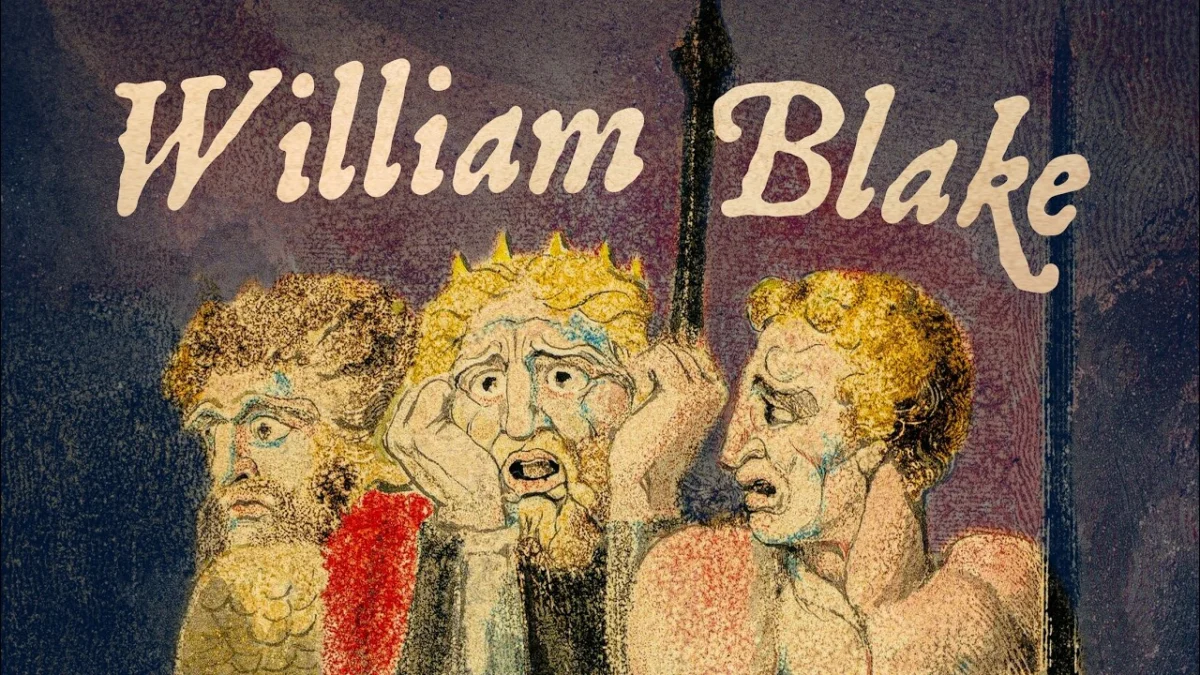
William Blake remains one of the most enigmatic figures in the history of Western art and literature, a man whose legacy defies the neat categorizations that scholars and critics typically use to organize the creative world. While he is frequently identified as a poet, a painter, and a printmaker, these labels often fail to capture the essence of his contribution. Blake did not merely practice three different disciplines; rather, he engaged in a singular, unified act of creation where text and image were inseparable. This holistic approach placed him at odds with the institutional standards of his time and has led modern commentators, including Evan Puschak of the Nerdwriter series, to describe him as the "patron saint of unclassifiable artists."
Born in London in 1757, Blake lived through a period of profound social and intellectual upheaval. His work was a direct reaction against the Enlightenment’s burgeoning focus on rationalism and the Industrial Revolution’s tendency toward human specialization. To understand Blake is to understand a man who viewed the division of art into separate categories as a symptom of a fractured human psyche. Through his "illuminated books," Blake sought to heal this rift, creating works that synthesized poetry and visual art into a visionary whole that the 18th-century art establishment was ill-equipped to comprehend.
The Formative Years and the Craft of Engraving
Blake’s path toward his radical artistic style began with his early education. Unlike many of his contemporaries who sought the prestige of the Royal Academy of Arts, Blake’s training was rooted in the manual labor of the artisan. At the age of 14, he was apprenticed to James Basire, an engraver to the Society of Antiquaries. This seven-year apprenticeship was foundational. It was here that Blake mastered the technical precision required for copperplate engraving, a skill that would eventually allow him to bypass the traditional publishing industry and produce his own books from start to finish.
During his apprenticeship, Blake was often sent to Westminster Abbey to sketch the gothic monuments. This exposure to medieval art left a lasting impression, instilling in him a preference for clear, bold outlines and a rejection of the "sfumato" or blurred edges popular in the oil paintings of the era. By the time he completed his apprenticeship in 1779 and entered the Royal Academy as a student, his aesthetic preferences were already firmly established—and they were diametrically opposed to those of the Academy’s president, Sir Joshua Reynolds.
Conflict with the Royal Academy and the Rise of Specialization
The late 18th century saw the formalization of artistic standards through institutions like the Royal Academy of Arts, founded in 1768. Under Reynolds, the Academy promoted the "Grand Style," which emphasized generalization, classical proportions, and a hierarchy of genres that placed history painting at the top and engraving near the bottom. For Blake, this institutionalized approach was a "straitjacket" on the imagination.
The Academy’s insistence on specialization—separating the "fine arts" of painting and sculpture from the "mechanical arts" of engraving and printing—represented everything Blake loathed. He believed that the true artist should be a "maker" in the most comprehensive sense. This defiance led to a career spent largely in poverty and obscurity. To the official art world of the 1790s, Blake was an eccentric at best and a madman at worst. His insistence on controlling every aspect of his production—writing the text, designing the layout, etching the plates, and hand-coloring the final prints—was an act of professional rebellion against a society that was increasingly valuing the assembly line over the individual vision.
The Innovation of Relief Etching: The Infernal Method
In 1788, Blake claimed to have received a vision from his deceased brother, Robert, revealing a new method of printing. This technique, which Blake called "relief etching," became the vehicle for his most famous works, including Songs of Innocence and of Experience.
Traditional engraving (intaglio) involves cutting lines into a metal plate, where the ink sits in the grooves. In contrast, Blake’s relief etching involved writing and drawing on the copper plate with an acid-resistant liquid. When the plate was submerged in acid, the unprotected metal was eaten away, leaving the text and images raised in relief, much like a rubber stamp.
This technical breakthrough was revolutionary for several reasons:
- Integration: It allowed Blake to print text and images simultaneously on the same page, ensuring they were aesthetically and conceptually unified.
- Autonomy: It removed the need for a typesetter or a commercial publisher, giving Blake total creative sovereignty.
- Fluidity: The process allowed for a more "painterly" and spontaneous style of writing and drawing compared to the rigid labor of traditional engraving.
Blake referred to this as the "Infernal Method," a term he used in The Marriage of Heaven and Hell to describe the process of "melting apparent surfaces away, and displaying the infinite which was hid."
Chronology of Major Works and Visionary Books
Blake’s career can be mapped through a series of "illuminated books" that grew increasingly complex in their mythology and visual density:
- 1789: Songs of Innocence: A collection of poems that captured the "child-like" state of the human soul, characterized by joy and a sense of divine presence in nature.
- 1790–1793: The Marriage of Heaven and Hell: A radical philosophical work that attacked the dualisms of religious morality, famously stating that "Energy is Eternal Delight."
- 1794: Songs of Experience: Published as a companion to Innocence, this volume explored the "contrary state of the human soul," dealing with themes of social oppression, industrial cruelty, and the loss of wonder.
- 1793–1795: The Prophetic Books: Works like America a Prophecy and Europe a Prophecy began to outline Blake’s private mythology, featuring characters like Urizen (the personification of cold reason and law) and Orc (the spirit of revolution).
- 1804–1820: Jerusalem: The Emanation of the Giant Albion: His longest and most ambitious illuminated book, representing the culmination of his mythological and artistic efforts.
In his later years, Blake turned his attention to illustrating the works of others, bringing his unique visionary perspective to classics such as John Milton’s Paradise Lost, Dante Alighieri’s Divine Comedy, and the Biblical Book of Job. His illustrations for the Book of Job are particularly noted for their psychological depth, portraying Job’s suffering not as a test of blind obedience, but as a journey toward true spiritual understanding.
Analysis: The Philosophy of Wholeness
The core of Blake’s radicalism lay in his rejection of "Single Vision," a term he used to describe the narrow, materialistic worldview championed by figures like Isaac Newton and John Locke. Blake believed that the Enlightenment’s focus on empirical data and mathematical laws had "unwoven the rainbow," stripping the world of its spiritual and imaginative dimensions.
By refusing to specialize, Blake was practicing a form of "intellectual rebellion." In the eyes of his contemporaries, a poet should write and an engraver should engrave. By doing both—and by insisting that the visual and the verbal were two sides of the same coin—Blake was asserting that reality itself is a unified whole. As Morris Eaves, author of The Cambridge Companion to William Blake, notes, Blake’s decision to live in "incommensurable neighborhoods of meaning" was a deliberate attempt to subvert the principle of specialization that had become the bedrock of modern human understanding.
Modern Implications and the "Nerdwriter" Perspective
In the contemporary digital age, Blake’s work has seen a resurgence of interest, partly because the modern world has become a place of extreme "cross-breeding" of media. Evan Puschak (The Nerdwriter) argues that Blake is more relevant today than ever because we live in an era where the boundaries between different forms of content—video, text, image, and sound—are constantly blurring.
Blake’s "unclassifiable" nature is no longer seen as a failure of focus, but as a precursor to the modern multi-media artist. His work challenges the viewer to move beyond the "slavish obedience to words written in a book" and to engage with art as an immersive, transformative experience.
Furthermore, Blake’s critique of the "dark satanic mills" of the Industrial Revolution continues to resonate in discussions about the dehumanizing effects of technology and the loss of individual agency in a globalized economy. He remains a symbol of the artist as an independent visionary, one who refuses to compromise their internal truth for the sake of institutional approval or commercial success.
Legacy and Conclusion
William Blake died in 1827, largely uncelebrated by the general public. It was not until the mid-19th century, with the publication of Alexander Gilchrist’s biography, that he began to be recognized as a titan of British art and literature. Since then, he has influenced a diverse array of thinkers and creators, from the Pre-Raphaelite painters to the Beat poets of the 1950s and modern musicians like Bob Dylan and Patti Smith.
The radical, unclassifiable nature of Blake’s art serves as a permanent reminder of the power of the integrated imagination. By refusing to let the world cut reality into separate categories, Blake created a body of work that remains as vibrant and challenging today as it was two centuries ago. He did not merely record visions; he built an entire universe, proving that when the doors of perception are cleansed, everything appears as it truly is: infinite.