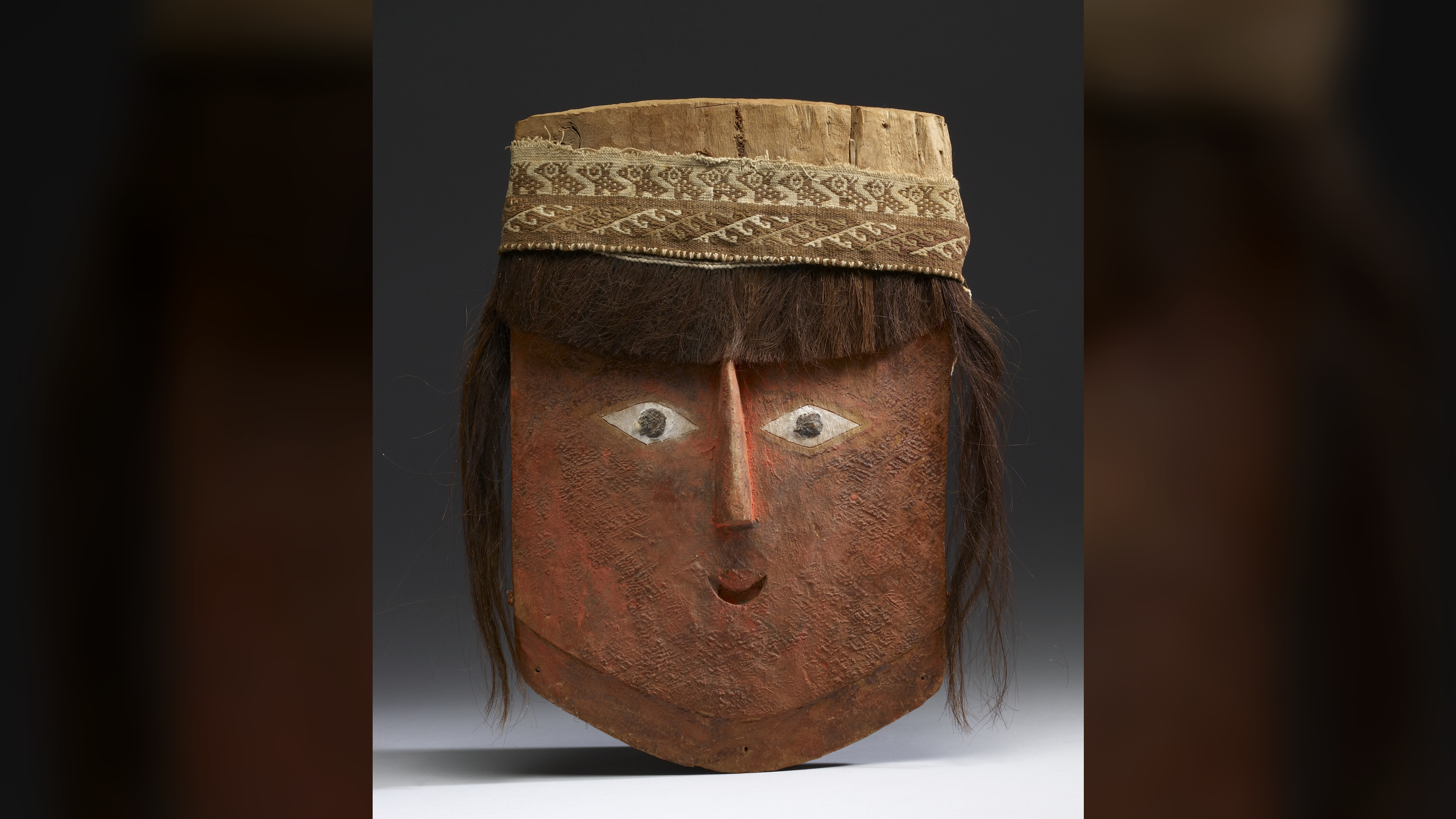
A striking, centuries-old mummy mask, intricately carved from wood and adorned with human hair, offers a profound glimpse into the artistic and spiritual world of the Chancay culture, which flourished in what is now Peru between approximately 1000 and 1450 CE. This artifact, currently housed at The Walters Art Museum and available for public viewing under a Creative Commons Zero license, is more than just an ancient relic; it is a tangible link to the funerary customs, social hierarchies, and aesthetic sensibilities of a sophisticated pre-Columbian civilization. The mask, a stylized representation of a human face, painted in a vibrant red, with a meticulously crafted wig, embodies the Chancay people’s complex approach to death and the afterlife.
The Chancay Culture: A Flourishing Civilization in Ancient Peru
The Chancay culture emerged on the central coast of Peru, a region characterized by arid coastal plains and fertile river valleys. This civilization thrived for several centuries, leaving behind a rich legacy of pottery, textiles, and funerary artifacts. Their society was organized, with evidence of agricultural sophistication, skilled craftsmanship, and a complex belief system. The arid climate of the coast proved exceptionally conducive to the preservation of organic materials, including textiles and human remains, allowing archaeologists to uncover remarkably intact remnants of their daily lives and ceremonial practices.
The period of Chancay dominance, from roughly 1000 to 1450 CE, predates the arrival of the Inca Empire, which would later consolidate much of the Andean region under its rule. The Chancay people, therefore, represent a distinct cultural entity with its own unique traditions and artistic expressions. Their influence extended across a significant portion of the Peruvian coast, and their artifacts have been found in numerous archaeological sites, underscoring their widespread presence and cultural impact.
The Mummy Mask: A Window into Chancay Funerary Rites
Mummy masks were an integral part of Chancay burial practices, particularly for individuals of high status. These masks were not merely decorative but served a vital spiritual purpose. It is believed that they were placed over the face of the deceased, either directly on the mummy bundle or as part of the elaborate wrapping process. The intention was to preserve the identity and spirit of the individual in the afterlife, providing a recognizable form for their soul to inhabit or to be recognized by the gods.
The materials used in the creation of these masks varied, but wood was a common choice, prized for its workability and durability. The application of pigments, often derived from natural minerals, allowed for vibrant and symbolic coloration. Red, as seen on this particular mask, held significant cultural meaning in many ancient societies, often associated with life, blood, power, and protection. The addition of human hair, meticulously attached to the wooden form, further enhanced the lifelike quality of the mask and underscored its connection to the individual it represented. The use of wigs was also a common practice in ancient Peru, reflecting social status and cultural norms.
The craftsmanship evident in this mask speaks volumes about the skill of Chancay artisans. The careful carving of the facial features, the delicate application of paint, and the intricate attachment of the hair all demonstrate a high level of technical expertise and aesthetic understanding. These masks were not mass-produced; each one was likely crafted with individual care, reflecting the unique importance of the person for whom it was made.
Chronology of the Chancay Culture and the Mask’s Creation
The Chancay culture flourished during a period of significant regional development in ancient Peru.
- Circa 900 CE: Early Chancay settlements begin to emerge, laying the groundwork for the culture’s later expansion.
- Circa 1000 – 1450 CE: This is the Classic period of Chancay civilization, characterized by its peak artistic production, agricultural development, and extensive trade networks. The mummy mask in question dates to this era, likely created sometime within this broad timeframe.
- Circa 1450 CE: The Chancay culture begins to decline, partly due to the expansion of the Inca Empire, which gradually absorbed many of the existing regional polities. While the Chancay as an independent entity waned, their cultural influence persisted and was integrated into the broader Inca cultural tapestry.
- Post-1450 CE: Following the Inca conquest, the distinct Chancay traditions gradually merged with those of the dominant empire. However, archaeological evidence continues to reveal the enduring legacy of their artistic and cultural contributions.
- Present Day: Artifacts like the mummy mask are preserved in museums and archaeological collections worldwide, offering invaluable insights into this fascinating ancient civilization.
Supporting Data: Archaeological Context and Preservation
The remarkable preservation of Chancay artifacts, including this mummy mask, is largely due to the extreme aridity of the Peruvian coast. This environment acts as a natural mummification chamber, protecting organic materials from decay for centuries. Archaeological excavations in Chancay burial sites have yielded a wealth of information about their mortuary practices.
- Mummy Bundles: The deceased were often wrapped in multiple layers of textiles, forming elaborate mummy bundles. These bundles could contain personal belongings, food offerings, and ceremonial objects, including mummy masks.
- Textile Production: Chancay textiles are renowned for their intricate weaving techniques, vibrant dyes, and complex patterns. These textiles were not only used for clothing and burial shrouds but also served as a form of artistic expression and social commentary.
- Pottery: Chancay pottery is characterized by its distinctive gray or black ware, often decorated with geometric designs and anthropomorphic or zoomorphic figures. This pottery served practical purposes as well as ceremonial functions.
- Social Stratification: The quality and complexity of funerary offerings, including the elaborateness of mummy masks and the richness of textile wrappings, provide strong evidence of social stratification within Chancay society. Elite individuals were afforded more elaborate burials, reflecting their status in life.
The specific details of the mask’s construction—the type of wood used, the pigments employed, and the method of attaching the hair—can provide further clues about trade routes and resource management within the Chancay territory. For instance, the origin of the wood could indicate trade with inland regions, while the source of pigments might reveal connections with specific mineral deposits.
Inferred Statements and Reactions from Related Parties
While direct statements from the Chancay people are lost to time, the artifacts themselves speak volumes. We can infer the reverence and care with which these masks were created and used.
- Artisans: The creators of such masks likely held a respected position within Chancay society. Their work was not merely manual labor but an essential part of spiritual and funerary rituals. We can imagine their dedication to detail, understanding the profound importance of their task in ensuring the deceased’s journey into the afterlife.
- Family Members and Community: For the families and communities of the deceased, the mummy mask would have been a tangible symbol of their loved one’s identity and their hope for their continued existence in the spirit world. Its presence would have offered solace and a connection to the ancestral realm.
- Archaeologists and Curators (Modern Day): Dr. Kristina Killgrove, a staff writer at Live Science with a focus on archaeology and paleoanthropology, whose expertise is noted in the context of this artifact, would likely emphasize the mask’s importance as a primary source of information. "Each artifact from the Chancay culture is a puzzle piece," she might state, "and this mummy mask is a particularly significant one, allowing us to reconstruct their beliefs about death, the soul, and the construction of identity in the face of mortality. The artistry involved is exceptional and demands careful study."
Museum curators at The Walters Art Museum would express their commitment to preserving and interpreting such artifacts for public education. "We are honored to house this remarkable example of Chancay artistry," a representative might say. "It serves as a powerful reminder of the diverse ways human cultures have sought to understand and navigate the mysteries of life and death across the globe. Our goal is to make these stories accessible to everyone."
Broader Impact and Implications: Understanding Ancient Belief Systems
The study of Chancay mummy masks, like the one featured, has profound implications for our understanding of ancient Peruvian cultures and broader human history.
- The Universality of Death Rituals: The existence of elaborate funerary practices, including the creation of mummy masks, highlights a near-universal human concern with death and the afterlife. Different cultures have developed diverse ways of coping with mortality, and the Chancay offer a unique perspective on this fundamental aspect of human experience.
- Art as a Medium for Belief: This mask underscores the crucial role of art in conveying religious and spiritual beliefs. The stylized representation, the colors, and the materials all carry symbolic meaning, serving as a visual language for the intangible.
- Preservation of Cultural Heritage: The continued study and preservation of such artifacts are vital for understanding the rich tapestry of human history. They provide empirical data for archaeologists, anthropologists, and historians, allowing for more accurate and nuanced interpretations of past societies.
- Intercultural Connections: While the Chancay culture is distinct, its practices can be compared and contrasted with those of other ancient cultures in the Americas and beyond, revealing potential patterns in human social and spiritual development or highlighting unique cultural trajectories.
The Chancay mummy mask is not merely an object of antiquity; it is a testament to human ingenuity, artistic expression, and the enduring quest to understand our place in the cosmos. Its preservation and ongoing study continue to enrich our knowledge of the past, offering a compelling glimpse into the vibrant and complex world of ancient Peru. The intricate details of its creation, from the careful carving of the wood to the meticulous application of hair, invite us to contemplate the beliefs and values of a civilization that, though long gone, continues to speak to us through its enduring artistry.