Market Instability and Geopolitical Undercurrents
Global markets are navigating a complex landscape marked by escalating geopolitical tensions, particularly the intensifying conflict between the U.S. and Iran, alongside unprecedented technological shifts and growing concerns over market transparency. On a day that saw mixed stock performance, the price of crude oil surged past $90 per barrel, reflecting the heightened risk premium associated with the Middle East crisis and threatening to fuel global inflationary pressures. This volatile environment underscores the interconnectedness of international politics, economic stability, and technological advancement, posing significant challenges for investors and policymakers alike.
Trump Media’s ‘Truth API’ Sparks Market Integrity Debate
A controversial proposal by Trump Media & Technology Group (TMTG) to offer early, milliseconds-ahead access to former President Trump’s posts on Truth Social via a specialized API (Application Programming Interface) has ignited a fierce debate over market fairness and transparency. This initiative, coupled with a separate push by some corporate entities for less frequent quarterly earnings reports to the Securities and Exchange Commission (SEC), could, according to critics, fundamentally alter the landscape for investors.
Sources close to Fortune‘s Mia Osmonbekov revealed deep concerns within financial circles that such measures could establish a "two-tiered market." In this scenario, a select group of "insiders" with early access to critical information—whether political statements or corporate financial data—could leverage this advantage for rapid, lucrative trades, leaving ordinary investors perpetually a step behind. Tyler Gellasch, CEO of the Healthy Markets Association and a former SEC counsel, succinctly articulated the sentiment, stating, "When you have a market that looks like that, it looks rigged."
Understanding the Proposed Market Shift
The "Truth API" concept is not entirely novel in financial markets. High-frequency trading (HFT) firms have long paid for co-location services and direct data feeds to gain microsecond advantages in processing market data. However, applying this model to the public pronouncements of a prominent political figure, especially one with a history of market-moving statements, introduces a new dimension of concern. For example, a single post from a figure like Donald Trump on issues ranging from trade policy to corporate actions could trigger immediate and significant market reactions. Accessing such information even milliseconds before the general public could allow sophisticated algorithms to execute trades, front-running the broader market’s reaction.
Simultaneously, the debate around the frequency of SEC filings has gained traction. Proponents of less frequent reporting, often citing burdens on small and medium-sized businesses, argue that quarterly reports can lead to a short-term focus, discouraging long-term strategic investments. However, opponents, including many investor advocacy groups, counter that reducing reporting frequency—from quarterly to semi-annually, for instance—would diminish transparency and increase information asymmetry. Public companies are currently mandated to file Form 10-Q (quarterly reports) and Form 10-K (annual reports), providing essential financial health snapshots. Less frequent updates would mean longer periods where critical financial data remains undisclosed, potentially allowing corporate insiders to trade on non-public information for extended durations.
Implications for Investor Confidence and Regulatory Oversight
The combination of these proposals presents a significant challenge to the principle of equitable access to information, a cornerstone of fair and efficient capital markets. If enacted, critics warn of a potential erosion of public trust in the stock market. Small retail investors, who rely on publicly available information to make informed decisions, would find themselves at an even greater disadvantage against institutional players with access to premium data feeds or less frequent, yet impactful, disclosures.
Regulatory bodies like the SEC would face immense pressure to address these issues. The agency’s mission is to protect investors, maintain fair, orderly, and efficient markets, and facilitate capital formation. Policies that appear to favor certain market participants over others directly contradict this mandate. Any move towards a system perceived as "rigged" could deter individual participation, shifting wealth accumulation further towards sophisticated, well-resourced entities and potentially exacerbating economic inequality. The debate is likely to intensify, requiring careful consideration of innovation, market efficiency, and the fundamental tenets of investor protection.
Quantum Computing: The Looming Cyber Threat of "Harvest Now, Decrypt Later"
While market fairness dominates immediate financial headlines, a more insidious long-term threat is quietly gathering momentum in the cybersecurity realm: the "harvest now, decrypt later" (HNDL) phenomenon. Hackers, including state-sponsored groups, are currently amassing vast quantities of encrypted data—ranging from sensitive financial records and intellectual property to national security secrets—with the explicit intention of decrypting it years down the line using future, more powerful quantum computers.
The debate over the arrival of "quantum supremacy" – the point at which quantum computers can perform tasks impossible for classical supercomputers – is robust. Some experts predict commercially viable quantum computers capable of breaking current encryption standards could be just a few years away. Others, notably researchers at ARK Invest, offer a more conservative timeline, suggesting widespread capability might not materialize until 2044 at the earliest. Despite this chronological uncertainty, malicious actors are not waiting. They are systematically downloading whatever databases they can infiltrate, storing them in anticipation of a quantum future where today’s unbreakable codes will be rendered trivial.
Nicolas Sauvage, President of TDK Ventures, a $500 million fund actively seeking investments in quantum cybersecurity defenses, highlights the urgency. "We understand that there are a lot of hackers who are downloading our information today on the premise that in the future, they can hack that data with quantum, and if you and your password, if your data is still valid by the time they hack it, they have access to everything," Sauvage told Fortune. He emphasizes the critical need for organizations to proactively prepare for "quantum security."
A Timeline of Quantum Threat Perception and Response
- Early 2000s: Theoretical groundwork for quantum algorithms (e.g., Shor’s algorithm for factoring large numbers, threatening RSA encryption) begins to solidify, though practical implementation remains distant.
- Mid-2010s: Governments and large corporations begin to seriously acknowledge the "quantum threat" and initiate research into post-quantum cryptography (PQC).
- 2016: The National Institute of Standards and Technology (NIST) launches a global competition to standardize new quantum-resistant cryptographic algorithms.
- Present (2026): The HNDL phenomenon is widely recognized. Organizations like Salt Typhoon, a Chinese government hacking operation, have reportedly harvested data from over 200 companies across 80 countries, illustrating the global scale of the threat.
- Near Future (Next 5-7 years, per Sauvage): The point at which unprotected data becomes economically viable to decrypt with nascent quantum capabilities.
- Longer Term (2044+ per ARK Invest): Potential for widespread, commercially accessible quantum computing capable of breaking most current encryption.
The Enormous Implications and Urgent Need for Defense
The implications of HNDL are "enormous," according to Sauvage. "You think about all your financial data, my financial data, your privacy, your emails, all of the things that are impossible to hack today. Economically—I mean, everything is hackable—but economically it could become hacked so quickly once quantum kicks in." The threat extends beyond personal privacy to critical national infrastructure, military communications, and the entire global financial system.

The response involves a concerted effort to develop and deploy post-quantum cryptography (PQC) – new cryptographic algorithms designed to resist attacks from both classical and quantum computers. Governments worldwide are investing heavily in PQC research and mandates for migration. Companies are urged to begin inventorying their cryptographic assets, understanding their "crypto-agility," and planning for a transition to quantum-resistant solutions. The cybersecurity industry is seeing a surge in innovation, with venture capital, like TDK Ventures, actively funding startups focused on this emerging defensive frontier. The race is on to secure the world’s digital assets before the quantum key arrives.
Global Markets Experience Mixed Performance Amidst Oil Surge
In immediate market news, global stock indices presented a mixed picture, reflecting investor uncertainty in the face of diverse economic signals and escalating geopolitical risks. Major indices showed divergent trends: some posted modest gains, buoyed by strong corporate earnings in certain sectors, while others experienced slight declines due to concerns over inflation and the geopolitical landscape.
The most significant movement was in the energy sector, as crude oil prices climbed above $90 per barrel. This surge is directly linked to the intensifying conflict in the Middle East, particularly the U.S.-Iran confrontation and Iran’s threats to disrupt oil flows through the Strait of Hormuz. Analysts suggest that the current price includes a substantial geopolitical risk premium, reflecting fears of supply disruptions from the critical oil-producing region. Higher oil prices are a double-edged sword: they can benefit energy companies but act as a significant drag on global economic growth by increasing transportation costs, manufacturing expenses, and consumer prices, thereby impacting discretionary spending and potentially triggering inflationary spirals that central banks would need to address. This dynamic adds another layer of complexity for policymakers already grappling with post-pandemic economic recovery and persistent inflation concerns.
The Sports Page: Goldman Sachs’s Uncanny World Cup Prediction
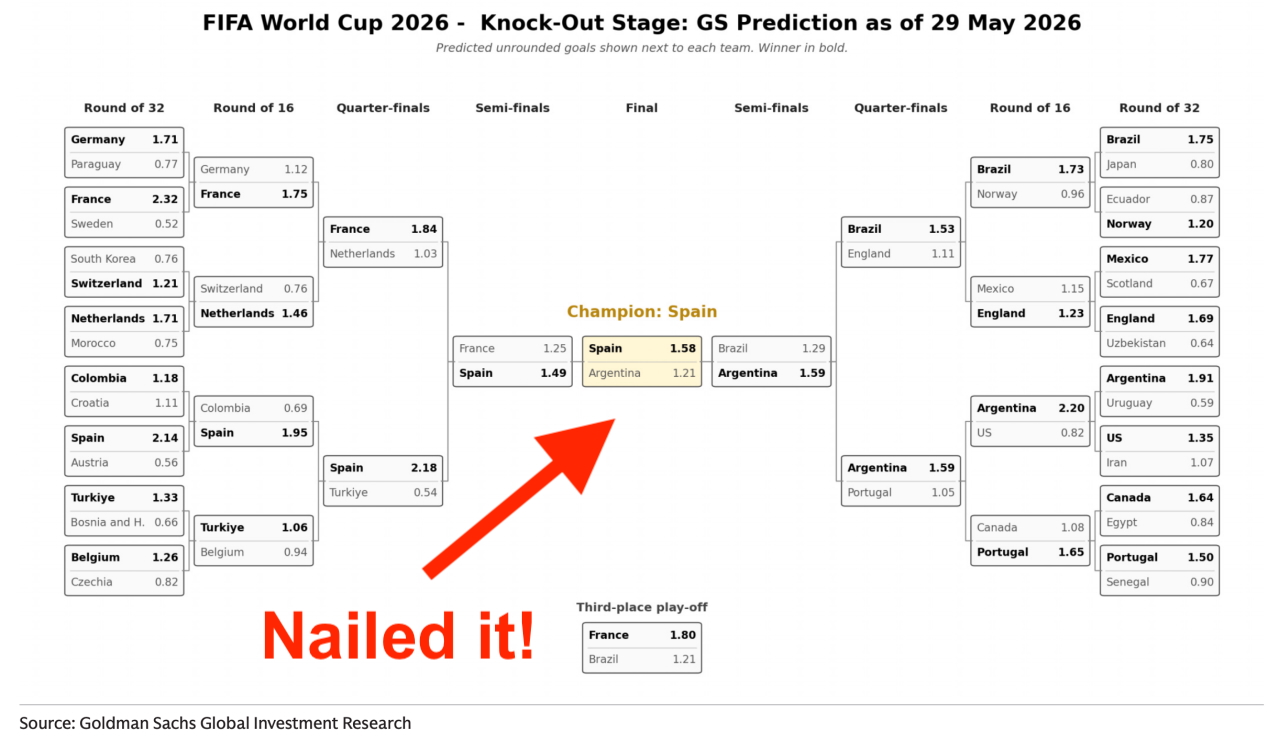
In a surprising display of predictive power, the analytical team at Goldman Sachs correctly forecast the outcome of the recent World Cup final, predicting Spain would defeat Argentina. This achievement comes despite some playful skepticism earlier in the tournament regarding the extensive resources the investment bank dedicated to its sports analytics.
Back on June 2, Fortune had lightheartedly noted the "bonkers level of work" Goldman’s Jan Hatzius and his team had invested in their World Cup predictions. Today, a mea culpa is in order: their ultimate call for the final match was spot-on. While not every prediction in their elaborate bracket proved accurate – Turkey, for instance, was knocked out in the early stages despite Goldman having them reach the quarter-finals against Spain, and Brazil exited in the Round of 16 instead of making it to the semi-finals – the crucial final match prediction was exact. Spain ultimately triumphed over Argentina, just as the bank’s models had projected.
Goldman Sachs’s methodology typically involves sophisticated statistical models, machine learning algorithms, and a vast dataset incorporating player performance metrics, team historical data, match simulations, and even geopolitical factors. While the accuracy of such models can vary significantly in the unpredictable world of sports, this particular success underscores the increasing sophistication of data analytics across various fields, even those seemingly far removed from finance. It serves as a reminder of the power of quantitative analysis, even when applied to endeavors that also heavily rely on human talent, strategy, and sheer luck.
Escalation in the Middle East: Iran Vows to Choke Off Hormuz Oil Flow Amid Rising U.S. Casualties
The Middle East remains a flashpoint, with the U.S. having conducted a ninth consecutive night of bombing raids against targets in Iran. This escalating conflict has tragically resulted in a growing toll of American service members killed, with three reported fatalities in Iranian attacks on U.S. positions in Iraq and Jordan. The total U.S. casualty count has now reached 17 dead and 420 wounded since the current round of hostilities began. Estimates for total casualties across Iran and Lebanon, where related proxy conflicts are active, vary widely, from over 4,000 to more than 10,000.
Despite the intensifying military actions, Iran maintains that talks between the two sides are ongoing, adding a layer of diplomatic complexity to the military confrontation. This duality of engagement – military escalation alongside purported diplomatic channels – highlights the precarious nature of the conflict.
Chronology of Escalation and Strategic Threats
- Initial Phase (Pre-conflict): Long-standing tensions between the U.S. and Iran over nuclear program, regional influence, and proxy conflicts in Iraq, Syria, Lebanon, and Yemen.
- Recent Weeks: U.S. initiates retaliatory strikes following attacks on its personnel in the region, triggering a cycle of escalation.
- Past Nine Nights: Continuous U.S. bombing operations against Iranian targets.
- Recent Days: Iranian counter-attacks lead to U.S. casualties in Iraq and Jordan.
- Current Reporting: U.K. Maritime Operations Centre reports a ship on fire off the Oman coast; Iran claims to have struck two ships in the Strait of Hormuz within 24 hours.
The most alarming development for global markets and energy security is the Islamic Revolutionary Guard Corps (IRGC)’s explicit vow to close the Strait of Hormuz. A statement from the IRGC declared: "This passage will not be safe for the transit of petrochemical products, nor even a single drop of oil and gas." This threat carries immense weight, as the Strait of Hormuz is the world’s most important oil transit chokepoint. Approximately 20% of the world’s petroleum liquids and about one-third of the world’s liquefied natural gas (LNG) pass through this narrow waterway daily. Its closure, or even severe disruption, would trigger a catastrophic global energy crisis, sending oil and gas prices soaring to unprecedented levels and devastating international trade.
International Reactions and Broader Implications
The international community is watching with increasing alarm. While U.S. Senator Marco Rubio indicated that the U.S. remains open to diplomacy with Iran, the military actions continue to overshadow any potential for de-escalation. Regional allies of the U.S. are expressing deep concern, while other global powers are calling for restraint and a diplomatic resolution to prevent a wider regional conflagration.
The economic implications are already being felt through rising oil prices and market uncertainty. A prolonged or expanded conflict, particularly one involving the closure of the Strait of Hormuz, would have far-reaching consequences, including:
- Global Recession: Soaring energy costs could plunge major economies into recession.
- Supply Chain Disruption: Beyond oil, general shipping and trade routes could be severely impacted.
- Humanitarian Crisis: Further displacement and casualties in an already volatile region.
- Geopolitical Realignments: Potential for new alliances and heightened instability across the Middle East.
The situation remains highly fluid, with the intertwined threads of military action, diplomatic overtures, and economic threats dictating the immediate future of the region and, by extension, the global economy. Live coverage from outlets like The Guardian continues to provide real-time updates on this rapidly unfolding crisis.
More from Fortune: A Glimpse into Business and Innovation
Beyond the day’s major headlines, Fortune delves into a range of compelling business narratives:
- Nestlé’s Brand Masterclass: Sam Birchall explores how Nestlé ingeniously transformed a "chocolate heist" into a strategic opportunity for brand building, showcasing resilience and innovative marketing.
- The Dawn of Agentic Commerce: Diane Brady reports on the impending rise of "agentic commerce" and the fierce competition among companies, like Circle with its stablecoins, to construct the foundational infrastructure for this new economic paradigm.
- Minimum Wage at a 70-Year Low: Sasha Rogelberg highlights a concerning report indicating that the U.S. federal minimum wage has reached its lowest value in 70 years, effectively becoming "officially a poverty wage" for many.
- Warren Buffett’s Serendipitous Career: Sarah Glodek shares Warren Buffett’s humble reflection that his colossal $147 billion investing career was largely "an accident," attributing much of his success to being "one of the 10 luckiest in the world."
- Cymbiotika’s $150M Success Story: Sydney Lake profiles Durana Elmi, the Afghan-born founder who, with celebrity backing from figures like Daymond John and Post Malone, built the wellness supplements brand Cymbiotika into a $150 million enterprise, driven by a mission to support women back home.
- Netflix Embraces AI for Content Creation: Amanda Gerut reveals how Netflix leveraged AI to produce 17 minutes of a documentary "twice as fast and at half the cost," a strategic move as streaming competition drives content spending towards an estimated $20 billion.
Chart of the Day: Deutsche Bank’s "Cheap Date Index"
Deutsche Bank’s whimsical yet insightful "Cheap Date Index" offers a comparative look at the cost of romance across global cities, revealing Geneva as the most expensive locale for a casual outing.
According to Jim Reid of Deutsche Bank, the index calculates the cost, in U.S. dollars, of a standardized "cheap date" scenario: "a new pair of jeans and a dress, two one-way public transport tickets, two coffees, a meal for two, two cinema tickets, a bottle of wine to dissect the film afterwards, and finally a taxi ride home." Reid humorously adds, "That last item may prove controversial depending on how established the relationship is." While the index is designed with a touch of levity, it provides a fascinating, albeit anecdotal, snapshot of purchasing power parity and the varied cost of living in major metropolitan centers worldwide. For instance, while Geneva tops the list for extravagance, cities like Mumbai or Kuala Lumpur might offer significantly more affordable romantic evenings, reflecting broader economic disparities and local price levels for goods and services.
Number of the Day: $2 Trillion AI Investment Boom
The staggering figure of $2 trillion represents the combined AI-related "remaining performance obligations" (RPOs) listed by the top four cloud service providers for the next 12 months. This data, highlighted by Vivek Arya and his team at Bank of America, underscores the colossal and rapidly accelerating investment in artificial intelligence infrastructure and services.
"Remaining performance obligations" refers to the contractual agreements for future work that have not yet been fulfilled or paid for. This $2 trillion figure signifies the massive pipeline of committed spending by enterprises and developers for AI-centric cloud services, including:
- AI Model Training: Access to powerful GPU clusters and specialized hardware for training complex AI models.
- AI Software Development Kits (SDKs) and Platforms: Utilization of cloud-based tools and services for building and deploying AI applications.
- Data Storage and Processing for AI: Infrastructure dedicated to managing the vast datasets required for AI.
- AI Consulting and Integration Services: Expert support for implementing AI solutions within organizations.
This unprecedented level of commitment reflects the pervasive belief across industries that AI is not merely a technological trend but a fundamental shift that will redefine business operations, innovation, and competitive advantage. The cloud providers – Amazon Web Services (AWS), Microsoft Azure, Google Cloud, and Alibaba Cloud (or similar top four depending on the exact market share and definition) – are positioning themselves as the foundational infrastructure for this AI revolution, securing long-term revenue streams and consolidating their pivotal role in the future economy. The $2 trillion figure points to sustained growth in AI investment, indicating a transformative period ahead for technology, business, and society.
The Front Pages Today: A Global Snapshot
Major news outlets around the globe are grappling with a diverse array of pressing issues:
- WSJ: "Ukraine Escalates Air War With Deadly Strikes on Russia’s ‘Amazon’" – Reporting on intensified Ukrainian air attacks, potentially targeting Russian logistics and supply chains.
- FT: "US day traders flock to ‘the most dangerous product in crypto’" – Highlighting the risky investment trends among retail traders in highly volatile cryptocurrency derivatives.
- CNBC: "Russia pounds Kyiv as NATO military chief warns Moscow would ‘lose a lot’ by attacking Baltics" – Detailing renewed Russian assaults on Ukraine’s capital and NATO’s strong deterrence message to Moscow.
- Axios: "Top Pentagon official blasts OpenAI’s Dean Ball" – Covering a high-level dispute or criticism from the U.S. defense establishment regarding a prominent figure at OpenAI.
- The Independent: "Andy Burnham’s father unaware of son becoming prime minister due to Alzheimer’s" – A poignant personal story of the UK political leader’s family situation amidst his professional ascent.
- NYT: "Rubio Says U.S. Is Still Open to Diplomacy With Iran" – Offering a diplomatic counterpoint to the ongoing military conflict, suggesting a continued path for negotiations.
One More Thing: The Perils of "Social Atrophy" in the Modern Workplace
In an era increasingly defined by remote work, hybrid models, and the pervasive influence of artificial intelligence, renowned therapist and author Esther Perel is sounding an alarm about a phenomenon she terms "social atrophy" within the workplace. Perel, known for her insights into relationships and human connection, posits that the gradual erosion of everyday human contact is silently undermining organizational cohesion and employee engagement.
Her concerns are echoed by recent data, including a new Gallup poll that measured the "level of psychological attachment employees have to their work," indicating a slow but steady disengagement. Perel argues that AI, the shift to remote-hybrid working structures, and the rise of distributed global teams are inadvertently contributing to this invisible decay of rapport among colleagues. "Professional relationships actually need physical proximity," Perel emphasized in a recent conversation with Fortune‘s Sam Birchall, challenging the notion that digital interactions alone can fully replicate the nuances of in-person connection.
The Blurred Background and the Erosion of Intimacy
A particular "bugbear" for Perel is the ubiquitous blurred Zoom background. She observes that "in the early days of video calls, people were unintentionally visible in each other’s homes, which paradoxically created more intimacy than the polished, decontextualized version we have now." This unintended glimpse into colleagues’ personal lives, however fleeting, fostered a sense of shared humanity and informal connection. Today’s virtual meetings, by contrast, often feel sterile and transactional: "You go on Zoom, nobody says hello, everyone’s pretending to do something else while they wait so it doesn’t look like they’re just sitting there."
This lack of informal interaction, of "small, insignificant conversations," is not just a matter of social grace; it has profound implications for leadership and organizational effectiveness. Perel asserts, "You can only handle difficult and important conversations as a leader if you’ve built up a foundation of small, insignificant ones first." These seemingly trivial interactions are the bedrock upon which trust, empathy, and effective communication are built. Without them, leaders struggle to navigate complex issues, and teams find it harder to collaborate, innovate, and weather challenges.
Implications for Corporate Culture and Future of Work
Perel’s insights suggest a critical challenge for organizations as they adapt to the future of work. While remote and hybrid models offer undeniable benefits in flexibility and talent access, they risk severing the informal bonds that are vital for a healthy, vibrant workplace culture. The rise of AI, automating many routine interactions, further reduces the opportunities for human-to-human engagement.
To counter social atrophy, businesses may need to proactively design strategies that foster genuine connection, even in distributed environments. This could include intentional in-person gatherings, creating virtual spaces for informal chat, encouraging "water cooler" moments, and training leaders to prioritize relationship-building alongside task management. The mental health and well-being of employees, as well as the overall resilience and innovation capacity of organizations, depend on addressing this subtle but significant erosion of human connection.