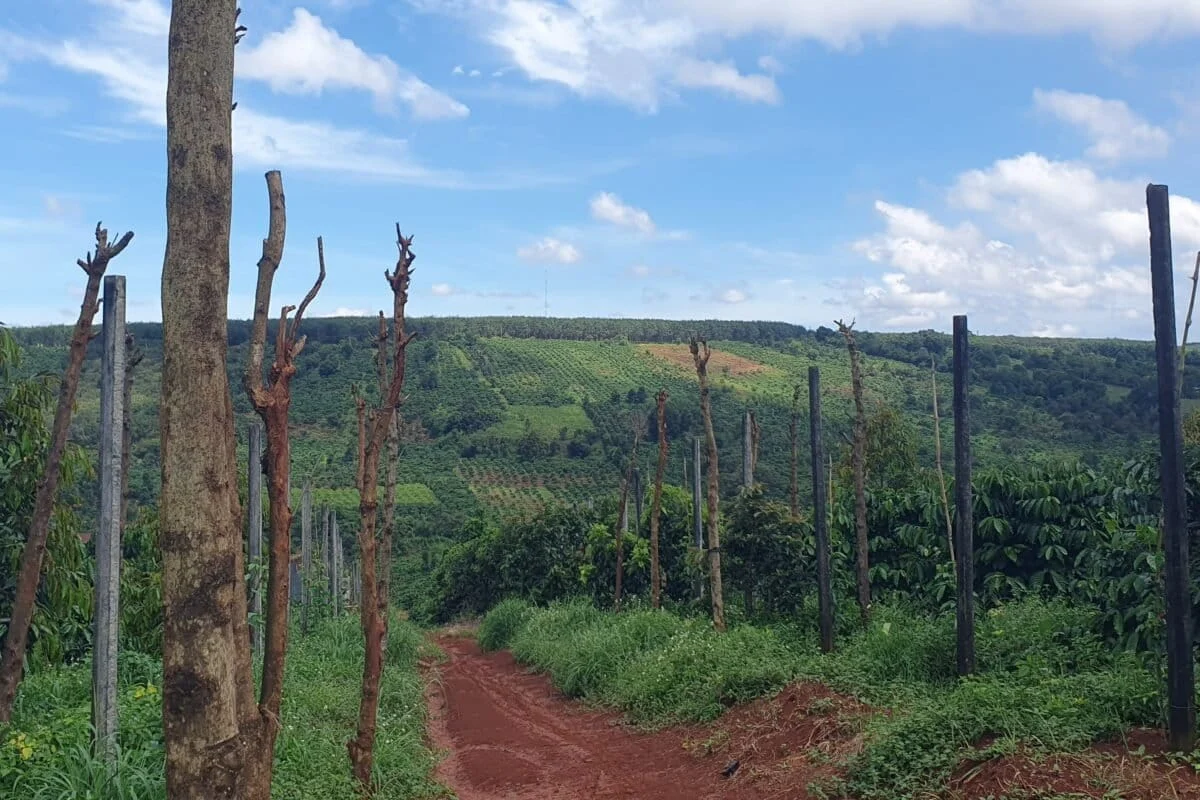
Vietnam’s rise to the pinnacle of the global coffee trade has come at a staggering ecological price, with decades of unchecked deforestation for coffee production devastating the nation’s Central Highland forests. According to a comprehensive new investigation by Coffee Watch, a Berlin-headquartered watchdog group, the rapid expansion of coffee plantations has fundamentally altered the landscape of one of Southeast Asia’s most biodiverse regions. While Vietnam has successfully positioned itself as the world’s second-largest coffee producer—trailing only Brazil—the environmental toll of this economic success is now reaching a critical breaking point. The investigation, which synthesized satellite imagery, geospatial data, and government records, paints a sobering picture of a landscape transformed from dense tropical moist forest into a fragmented patchwork of monoculture plantations.
Vietnam currently dominates the global market for Robusta coffee (Coffea canephora), supplying nearly 40% of the world’s exports of this specific variety. Robusta is the backbone of the instant coffee industry and a key component in espresso blends worldwide, valued for its high caffeine content and resilience. However, the "resilience" of the crop has not translated to the resilience of the ecosystems that host it. The Coffee Watch report reveals that in the Central Highlands—a region responsible for 95% of the country’s total coffee output—tropical forest cover plummeted from 42.8% in 1990 to a mere 19% by 2020. This rapid decline represents one of the most significant land-use shifts in the region’s modern history, driven by a global thirst for cheap, accessible coffee.
A Chronology of Expansion: From Reform to Industrialization
The roots of the current environmental crisis can be traced back to the late 1980s and early 1990s. Following the "Doi Moi" economic reforms of 1986, the Vietnamese government transitioned from a centrally planned economy toward a "socialist-oriented market economy." This shift encouraged the cultivation of cash crops for export to generate foreign exchange. Coffee was identified as a primary vehicle for this growth.
Between 1995 and 2010, forest loss reached its most aggressive pace. During this window, international coffee prices fluctuated, but the overall trend was one of massive area expansion. Attracted by the fertile volcanic soils of the Central Highlands—specifically in provinces such as Dak Lak, Lam Dong, Gia Lai, and Dak Nong—thousands of migrants from northern Vietnam moved to the region to establish smallholder farms. This internal migration was often incentivized by government policy and supported by international development financing. Organizations like the World Bank and various bilateral aid agencies provided loans and technical assistance during the 1990s to modernize Vietnam’s agricultural sector, often prioritizing yield and export volume over long-term ecological stability.
By the early 2000s, Vietnam had surpassed traditional coffee giants like Colombia and Indonesia to secure its second-place global ranking. However, by the 2020s, the report notes that forest loss began to stabilize at low levels. This stabilization is not necessarily a sign of successful conservation, but rather an indication that there is very little accessible forest left to clear. Much of the remaining tropical moist forest is now confined to steeper, less accessible terrain at higher elevations, or within the boundaries of formally designated protected areas and national parks, which still face the constant threat of illegal encroachment.
The Ecological Toll and the "Nutrient Treadmill"
The environmental consequences of replacing complex forest ecosystems with coffee monocultures are multifaceted and increasingly severe. The Coffee Watch investigation highlights that the removal of natural canopy has led to fragmented habitats, which isolates wildlife populations and reduces biodiversity. Furthermore, the loss of deep-rooted forest trees has accelerated soil erosion. In the absence of natural leaf litter and root structures to hold the soil in place, the region’s nutrient-rich topsoil is being washed away during the heavy monsoon rains characteristic of the Central Highlands.
This degradation has forced farmers onto what researchers call a "nutrient treadmill." As the natural fertility of the exhausted soil declines, farmers must apply increasing amounts of chemical fertilizers to maintain the high yields required to remain profitable in a competitive global market. This reliance on synthetic inputs creates a vicious cycle: the chemicals further degrade soil health and leach into local waterways, while the rising cost of fertilizers squeezes the profit margins of smallholder farmers.
The report also emphasizes the disruption of the hydrological cycle. Forests play a crucial role in water flow regulation and groundwater recharge. In the Central Highlands, the removal of forest cover has led to more frequent water shortages during the dry season and flash flooding during the wet season. As coffee is a water-intensive crop, the depletion of local aquifers poses a direct threat to the long-term viability of the very industry that caused the depletion.
Climate Change: A Looming Existential Threat
The investigation issues a stark warning regarding the intersection of historical deforestation and future climate change. It estimates that 50% of Vietnam’s current Robusta-growing belt could become unsuitable for coffee production in the coming decades. This is due to the compounding effects of rising temperatures, prolonged droughts, and erratic rainfall patterns.
Robusta coffee, while more heat-tolerant than its Arabica counterpart, still has specific thermal windows for optimal growth. As the "heat island" effect intensifies in deforested landscapes, temperatures in the Central Highlands are reaching levels that stress the plants, leading to reduced bean quality and lower yields. Without the cooling effect of natural forest buffers, coffee plantations are directly exposed to climate extremes. The Coffee Watch report notes that the loss of carbon storage capacity—previously provided by the dense forests—further contributes to the regional and global climate crisis, creating a localized feedback loop of environmental degradation.

Industry Shifts and the Path to Sustainability
In response to these findings, environmental experts and industry stakeholders are calling for a fundamental shift in how coffee is produced in Vietnam. Ly Thi Minh Hai, Vietnam country director at the international environmental nonprofit RECOFTC (The Center for People and Forests), acknowledges the historical role of coffee in forest loss but points to a changing paradigm within the sector.
"Coffee expansion was indeed one of the major drivers of forest loss in parts of the Central Highlands," Minh Hai stated. However, she emphasized that the current focus is shifting away from land expansion and toward "improving the productivity, resilience, and sustainability of existing coffee-growing landscapes."
The path forward, according to experts, involves a transition to regenerative farming and agroforestry. This includes "rejuvenating or replanting aging coffee plantations and introducing intercropping, such as shade trees, to avoid monoculture," Minh Hai explained. By planting fruit trees or timber species alongside coffee, farmers can restore some of the ecological functions of a forest—such as carbon sequestration and soil stabilization—while diversifying their income streams.
RECOFTC is currently working with local communities in the Central Highlands to promote these practices and, crucially, to secure forest tenure. Providing farmers with legal rights to the land they manage is seen as an essential foundation for preventing further encroachment into natural forests. When farmers have long-term security, they are more likely to invest in sustainable, multi-year agricultural practices rather than short-term "slash-and-burn" expansion.
Global Market Pressures and Regulatory Changes
The urgency for Vietnam to reform its coffee sector is not only environmental but also economic. Global markets are increasingly demanding "deforestation-free" products. The European Union, a major destination for Vietnamese coffee, recently introduced the EU Deforestation Regulation (EUDR). This law requires companies to prove that products like coffee, cocoa, and soy imported into the EU were not grown on land deforested after December 31, 2020.
For Vietnam, complying with the EUDR will require a robust national system for traceability and mapping. The Coffee Watch report serves as a reminder that the industry’s past "reckoning" is now meeting the regulatory realities of the present. If Vietnam cannot demonstrate that its coffee is produced sustainably, it risks losing access to its most lucrative export markets.
The transition is not without its challenges. The vast majority of Vietnam’s coffee is produced by roughly 600,000 smallholder farmers, many of whom lack the capital or technical knowledge to implement regenerative practices or sophisticated mapping technologies. Government intervention and support from international buyers will be critical in ensuring that the cost of this transition does not fall solely on the shoulders of the most vulnerable producers.
Conclusion: A New Metric for Success
The findings of the Coffee Watch investigation underscore a pivotal moment for Vietnam’s coffee industry. The era of growth through expansion has ended, leaving behind a legacy of ecological loss that now threatens the industry’s future. The "Robusta reckoning" suggests that the survival of the sector depends on its ability to repair the landscapes it has damaged.
As Ly Thi Minh Hai aptly summarized, "Vietnam’s coffee sector should not be defined by the deforestation challenges of the past. The future of Vietnam’s coffee sector will not be measured by how much land we cultivate, but by how well we manage the landscapes we already have."
The challenge ahead is to transform the Central Highlands from a cautionary tale of industrial agriculture into a model for tropical landscape restoration. This will require a coordinated effort between the Vietnamese government, international donors, global coffee corporations, and the hundreds of thousands of farmers whose livelihoods depend on the red soil of the highlands. Without such a shift, the very success that made Vietnam a coffee giant may ultimately lead to the industry’s undoing in the face of a changing climate and a more conscious global consumer base.