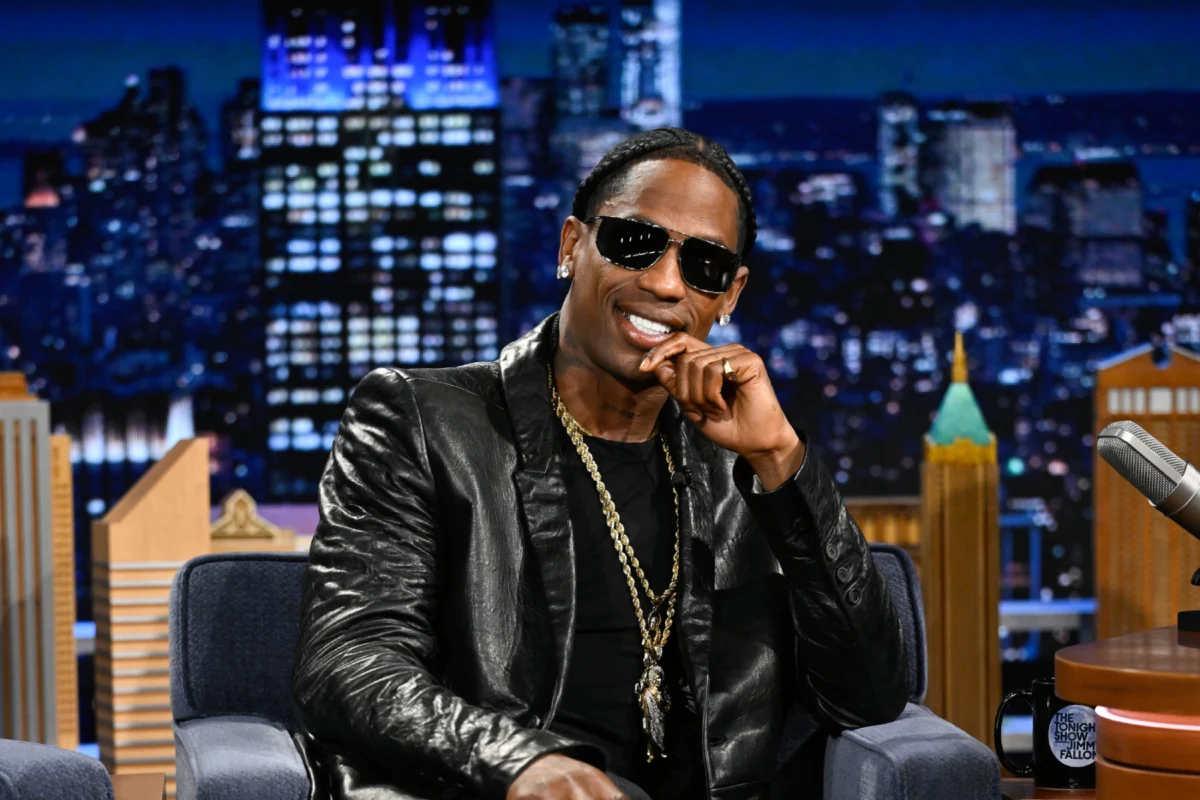
Travis Scott, the globally recognized artist whose influence spans music, fashion, and culture, recently graced the stage of The Tonight Show Starring Jimmy Fallon to offer an in-depth look into his surprising foray into acting within Christopher Nolan’s critically acclaimed epic, The Odyssey. The film, which has captivated audiences worldwide and secured a prominent spot at the box office, features Scott’s original song, "When I’m Home," as the closing track, a collaboration with composer Ludwig Göransson and singer James Blake. This marks a significant milestone for Scott, as it is his first time being associated with a number one film, a distinction he shared with palpable excitement during his interview.
Scott articulated that the experience of being part of a number one film felt "way different," a sentiment that resonated with the host, Jimmy Fallon. He elaborated on the profound impact this success has had, extending beyond the immediate accolades. "Even my theater teacher from high school, they reached out to my mom," Scott revealed, highlighting the unexpected validation from figures who once guided his early development. This achievement, he mused, represents "another stratosphere of greatness," where individuals who may have once been critical are now acknowledging his accomplishments, stating, "You finally did something good." This reflection underscores the personal significance of his role in The Odyssey, transcending the typical metrics of chart success to touch upon deeply felt vindication.
The genesis of Scott’s involvement in The Odyssey is rooted in a prior collaboration with Nolan on the visually stunning and thematically complex film Tenet. For Tenet, Scott contributed an end-credits song, a testament to his established relationship with the visionary director. However, the invitation for The Odyssey took a decidedly different and unexpected turn. Nolan’s initial outreach was not to discuss music, but rather to explore Scott’s potential as an actor.
Scott recounted the moment his phone buzzed with a message from "Chris," a communication that initially left him uncertain of its purpose. "I was thinking, ‘Okay, I don’t know what this is about. Maybe he wants to go to a show,’" Scott confessed, recalling his anticipation of a casual engagement. The subsequent question, however, was far from ordinary: "Would you be interested in acting in a movie?" The rapper admitted to initial disbelief, a sentiment amplified by his perception of Nolan’s esteemed status. "I didn’t think it was for him. I thought it might be for somebody else," he stated, underscoring the magnitude of the offer and the sheer talent associated with Nolan’s productions.
Describing Christopher Nolan as "a real mentor of mine," Scott expressed a profound desire to be involved in any project the esteemed director embarked upon. This dedication likely played a significant role in his willingness to embrace a new artistic challenge. In The Odyssey, Scott assumes the role of a Greek bard, a character tasked with narrating the triumphs of Odysseus during the epic Trojan War. Despite his burgeoning confidence in the music industry, Scott confessed to experiencing significant apprehension about his acting debut. "I was nervous as F," he candidly admitted.
The weight of the ensemble cast further amplified his anxieties. "I didn’t know that it was going to be Anne Hathaway, Tom [Holland], and Robert Pattinson," Scott revealed, listing a constellation of acclaimed actors who also feature in the film. The presence of such formidable talent, coupled with his own nascent acting experience, led him to question his place: "A bunch of amazing people. And I don’t know what the fuck I’m doing." However, Scott was quick to acknowledge the supportive environment fostered by Nolan and the cast. "Chris is an amazing director. Everybody made me feel comfortable," he stated, expressing gratitude for the opportunity to learn and observe. "I was just glad to be there and to watch him." This sentiment speaks volumes about the collaborative spirit on set and Nolan’s ability to cultivate an environment where artists from diverse disciplines can thrive.
Maintaining the secrecy surrounding his role in The Odyssey proved to be a manageable challenge for Scott. The greater difficulty, he explained, lay in convincing others of the authenticity of his involvement. "I didn’t want people to think I got placed in this," he asserted, indicating a desire to be recognized for his merit rather than through preferential treatment. This drive for genuine recognition highlights Scott’s commitment to his craft and his ambition to be taken seriously as a multifaceted artist.
The initial focus for Scott was his hope that Nolan would invite him to contribute an end-credits song. This musical aspiration materialized only after Nolan had completed a cut of the film, presenting a new opportunity for collaboration. Scott then joined forces with composer Ludwig Göransson, who had also helmed the film’s score, and the talented James Blake to craft and record "When I’m Home." The track, a powerful sonic accompaniment to the film’s conclusion, is set to be accompanied by a music video directed by Scott himself, slated for release in the coming week, further extending his creative imprint on the project.
Nolan’s Vision: Oral Tradition and Hip-Hop Analogies
Christopher Nolan himself has previously shed light on the unique reasoning behind his decision to cast Travis Scott in The Odyssey. Speaking on the thematic resonance between ancient oral traditions and contemporary hip-hop, Nolan explained, "I cast [Scott] because I wanted to nod towards the idea that this story has been handed down as oral poetry, which is analogous to rap." This insightful comparison frames Scott’s role not merely as a musical contribution, but as a narrative bridge connecting ancient storytelling techniques with the vibrant, rhythmic expressiveness of modern music. Nolan’s deliberate choice to cast Scott, a prominent figure in the rap world, underscores his commitment to finding contemporary parallels for timeless artistic forms. This approach not only adds a layer of cultural relevance to The Odyssey but also acknowledges the enduring power of spoken word and musical narrative across different eras and genres.
A Legacy of Musical Crossover in Nolan’s Cinema
Travis Scott’s casting in The Odyssey places him in esteemed company, joining a distinguished lineage of musicians who have lent their talents to Christopher Nolan’s directorial endeavors. Nolan has a demonstrated history of recognizing and integrating musical artists into his cinematic universes, often leveraging their unique expressive capabilities to enrich his narratives.
Perhaps the most iconic example is the legendary David Bowie, who captivated audiences with his portrayal of the brilliant inventor Nikola Tesla in the 2006 film The Prestige. Bowie’s otherworldly presence and magnetic charisma made him a natural fit for the enigmatic scientist, and his performance remains a celebrated moment in the film’s rich tapestry.
More recently, pop superstar Harry Styles made a significant impact with his acting debut in Nolan’s wartime epic Dunkirk. Styles, who had already established a massive global following with his music, took on the role of Alex, a young soldier fighting for survival. His performance in Dunkirk was widely praised, marking one of the singer’s earliest and most impactful forays into major acting roles, and signaling a promising new avenue for his artistic expression.
These instances highlight Nolan’s discerning eye for talent that transcends traditional acting boundaries. By casting musicians, he taps into a different kind of performance artistry, one that often involves a strong connection to rhythm, emotion, and storytelling. This practice not only introduces new dimensions to his films but also provides a platform for musicians to explore their acting potential, often with remarkable success, further blurring the lines between different creative disciplines.
The Broader Impact: Music and Film Intersecting
The integration of musicians into film productions, as exemplified by Travis Scott’s role in The Odyssey, represents a continuing trend of artistic cross-pollination that enriches both industries. For artists like Scott, the opportunity to act in a major motion picture directed by a filmmaker of Nolan’s caliber offers a significant expansion of their creative portfolio and a chance to reach new audiences. It allows them to explore different facets of their artistic identity and to engage with storytelling in a novel and impactful way.
For the film industry, the inclusion of popular musicians can bring a built-in fanbase and a unique energy to a project. It can also introduce fresh perspectives and innovative performance styles that might not emerge from a purely traditional acting background. Nolan’s specific approach, drawing parallels between ancient oral poetry and modern rap, demonstrates a sophisticated understanding of how different art forms can inform and enhance one another.
The success of such collaborations, from David Bowie’s iconic turn to Harry Styles’ early breakthrough and now Travis Scott’s foray into acting, suggests that the boundaries between music and film are becoming increasingly fluid. This synergy not only benefits the individual artists and projects involved but also contributes to a broader cultural landscape where creativity is celebrated in all its diverse forms. As Travis Scott’s experience in The Odyssey demonstrates, the journey from the recording studio to the silver screen can be a remarkably fruitful one, pushing artistic boundaries and creating memorable cinematic moments. The anticipation for the "When I’m Home" music video, directed by Scott himself, further emphasizes his multifaceted engagement with this project, promising a visual extension of the narrative and a testament to his growing influence across creative domains.