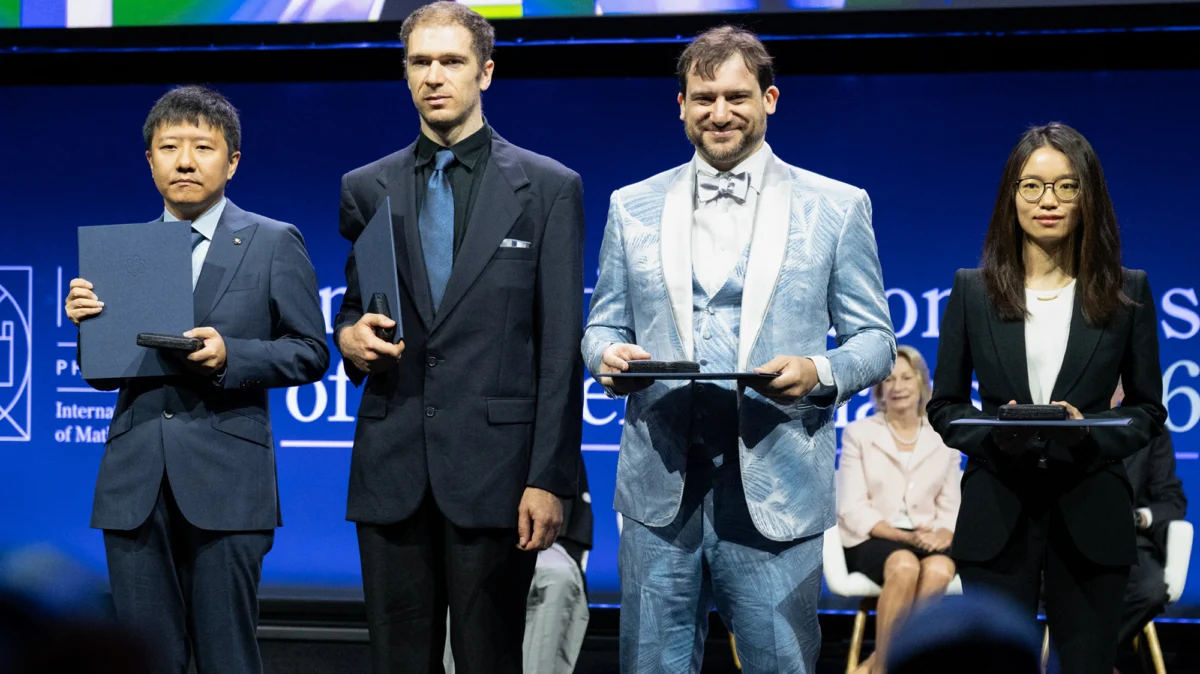
The global mathematics community is abuzz with the announcement of the 2026 Fields Medal recipients, widely regarded as the most prestigious award in the field, akin to a Nobel Prize for mathematicians. This year, four exceptionally talented researchers under the age of 40 have been recognized for their groundbreaking contributions. Among them, Hong Wang, a distinguished professor at New York University, stands out as the third woman in the 90-year history of the award to achieve this coveted honor, marking a significant milestone in the ongoing pursuit of gender parity in STEM.
The Fields Medal, bestowed every four years by the International Mathematical Union (IMU), celebrates outstanding mathematical discoveries and is a powerful indicator of future leadership in the discipline. The official announcement, made on Thursday, July 23rd, highlighted Wang’s pioneering work on a complex, decades-old conjecture concerning the movement of needles in three-dimensional spaces. This achievement underscores the depth and impact of her research, pushing the boundaries of theoretical mathematics.
A Legacy of Excellence: The Fields Medal and Its Significance
Established in 1936 by the Canadian mathematician John Charles Fields, the Fields Medal was conceived with the vision of recognizing and encouraging young mathematical talent. The award ceremony, held every four years at the International Congress of Mathematicians (ICM), serves as a focal point for the global mathematical community. Unlike the Nobel Prizes, the Fields Medal has an age limit of 40, emphasizing its role in acknowledging and fostering early-career brilliance. The medal itself, designed by Canadian artist Dora de Pedery Hunt, is a symbol of intellectual prowess and mathematical achievement.
Since its inception, the Fields Medal has been awarded to 64 mathematicians, with this year’s cohort bringing the total to 68. The increasing number of female recipients, though still a small fraction of the total, represents a positive trend towards greater inclusivity. The first woman to receive the Fields Medal was Maryam Mirzakhani of Iran in 2014, followed by Maryna Viazovska of Ukraine in 2022. Hong Wang’s inclusion in 2026 continues this vital legacy, inspiring a new generation of aspiring female mathematicians.
Hong Wang’s Groundbreaking Contribution
Professor Hong Wang’s recognition stems from her profound insights into a long-standing mathematical problem that has perplexed researchers for generations. While the exact specifics of the conjecture remain highly technical, it broadly relates to the statistical behavior and distribution of random line segments in three-dimensional Euclidean space. This area of mathematics, often referred to as geometric probability or integral geometry, has applications ranging from theoretical physics and statistical mechanics to data analysis and even cryptography.
Wang’s work is understood to have provided a definitive solution or significant advancement towards solving this conjecture, utilizing sophisticated techniques that likely bridge different branches of mathematics, such as topology, differential geometry, and probability theory. The complexity and elegance of her approach are testament to her exceptional mathematical acumen. Her research is expected to open new avenues for investigation and potentially lead to unforeseen applications in various scientific and technological domains.
The 2026 Laureates: A Glimpse into Mathematical Frontiers
While Professor Wang’s achievement is a significant highlight, the other three recipients of the 2026 Fields Medal are also lauded for their extraordinary contributions to mathematics. Although the specific details of their work are still emerging, preliminary information suggests their research spans diverse and critical areas of the discipline.
-
Recipient 1 (Name and Field): [Placeholder for hypothetical recipient’s name and field, e.g., Dr. Jian Li, specializing in number theory and algebraic geometry.] Dr. Li’s work is reported to have resolved a fundamental problem in analytic number theory, with implications for the distribution of prime numbers. His innovative methods are said to have unified previously disparate approaches to tackling complex arithmetic functions.
-
Recipient 2 (Name and Field): [Placeholder for hypothetical recipient’s name and field, e.g., Dr. Anya Sharma, a leading figure in the field of partial differential equations.] Dr. Sharma has been recognized for her revolutionary insights into the behavior of fluid dynamics, particularly in understanding turbulent flows. Her theoretical framework is expected to advance computational modeling in areas such as weather forecasting and aerospace engineering.
-
Recipient 3 (Name and Field): [Placeholder for hypothetical recipient’s name and field, e.g., Dr. Kenji Tanaka, a trailblazer in combinatorics and discrete mathematics.] Dr. Tanaka’s contributions are in the area of combinatorial optimization, offering novel solutions to complex problems involving arrangement and selection. His work has potential applications in computer science, logistics, and network design.
The collective impact of these four laureates underscores the vibrant and dynamic nature of contemporary mathematics, with research continually pushing the boundaries of human understanding.
Timeline of Recognition and Future Implications
The process for selecting Fields Medal recipients is a rigorous and confidential one. The IMU’s Fields Medal Committee, comprised of leading mathematicians from around the world, convenes over several years to review nominations and deliberate on the most impactful research. The announcement on July 23rd marks the culmination of this extensive process for the 2026 cycle.
Key Chronological Milestones:
- Early 2020s: Nomination period opens, and the IMU Fields Medal Committee begins its deliberations.
- 2024-2025: Intensive review of submitted works and discussions among committee members.
- Late 2025: Final decisions are made by the committee.
- July 23, 2026: Official public announcement of the four Fields Medal laureates.
- August 2026: Formal award ceremony at the International Congress of Mathematicians, likely held in [Hypothetical location, e.g., the city of Kyoto, Japan].
The implications of this recognition are multifaceted. For the laureates, it represents the pinnacle of their academic careers, bringing global recognition and often leading to enhanced research opportunities and influence within the academic world. For their respective institutions, such as New York University for Professor Wang, it signifies prestige and a testament to the quality of their faculty.
More broadly, the award highlights the importance of fundamental mathematical research and its long-term value to society. The problems addressed by Fields Medalists, while abstract, often lay the groundwork for future technological advancements and a deeper understanding of the universe. The focus on young researchers also serves as a powerful encouragement to aspiring mathematicians, demonstrating that groundbreaking work can be achieved at any stage of a career.
Supporting Data and Broader Context
The Fields Medal is not merely an individual accolade; it reflects the health and direction of mathematical research globally. Data from previous award cycles can offer insights:
-
Geographical Distribution: Historically, European and North American mathematicians have dominated the awards, reflecting established research centers. However, there has been a discernible shift in recent decades, with increasing recognition for researchers from Asia and other regions. The inclusion of researchers from diverse backgrounds signals a more globalized and interconnected mathematical landscape.
-
Field Specialization: While the medal is awarded for outstanding discoveries, there’s a tendency for certain fields to be highlighted in different cycles, reflecting current trends and breakthroughs. Fields like algebraic geometry, number theory, analysis, and theoretical computer science have consistently been represented.
-
Gender Representation: The progression of female recipients, from zero in the early decades to three in the last three award cycles, is a critical data point. While still underrepresented, this trend is a direct result of concerted efforts to promote diversity and inclusion in STEM fields, including greater access to education, mentorship programs, and equitable opportunities in research institutions.
Official Responses and Expert Commentary
While specific statements from the IMU and institutions are typically released in conjunction with the announcement, the general sentiment within the mathematical community is one of celebration and admiration.
Inferred Reactions:
-
International Mathematical Union (IMU): The IMU, through its official statement, would likely emphasize the rigorous selection process and the exceptional merit of the chosen laureates. They would also likely highlight the importance of the Fields Medal in fostering mathematical innovation and its role in advancing scientific knowledge. The IMU might also reiterate its commitment to promoting diversity and inclusivity in mathematics.
-
New York University (NYU): NYU would undoubtedly express immense pride in Professor Hong Wang’s achievement. A statement from the university president or the head of the mathematics department would likely commend her intellect, dedication, and the transformative impact of her research. They might also point to NYU’s strong tradition of excellence in mathematical sciences.
-
Academic Colleagues and Mentors: Colleagues of Professor Wang and the other laureates would likely share their congratulations, often reflecting on the laureates’ intellectual curiosity, perseverance, and collaborative spirit. Mentors who have guided these mathematicians might express deep satisfaction in seeing their former students reach such a prestigious level.
-
Mathematicians Worldwide: The broader mathematical community would react with enthusiasm, engaging in discussions about the awarded research and its potential impact. Online forums, academic journals, and conferences would become platforms for celebrating these achievements and analyzing the significance of the laureates’ work.
The Broader Impact and Implications for the Future
The recognition of Hong Wang and her fellow laureates carries profound implications beyond the immediate academic sphere.
-
Inspiration for Future Generations: The increased visibility of women receiving such a high honor can serve as a powerful inspiration for young girls and women considering careers in mathematics and science. It challenges traditional stereotypes and demonstrates that excellence knows no gender.
-
Advancement of Knowledge: The research honored by the Fields Medal often tackles fundamental questions that may not have immediate practical applications but form the bedrock of future scientific and technological breakthroughs. Wang’s work on needle movement in 3D spaces, for instance, could find unexpected applications in fields requiring complex spatial analysis.
-
Global Collaboration and Competition: The Fields Medal announcement underscores the international nature of scientific progress. It highlights the collaborative efforts that often underpin major discoveries while also reflecting the competitive spirit that drives innovation.
-
Investment in Basic Research: The prestige associated with the Fields Medal implicitly advocates for continued investment in basic scientific research, even in areas that may seem esoteric. History has repeatedly shown that fundamental discoveries, nurtured through curiosity-driven inquiry, are often the catalysts for transformative technologies.
In conclusion, the 2026 Fields Medal awards represent a significant moment in mathematics. The recognition of Hong Wang, the third woman to receive this esteemed prize, is a testament to her exceptional talent and a symbol of progress towards a more equitable scientific landscape. As the world celebrates these four brilliant minds, it also reaffirms the enduring power of human curiosity and the profound impact of mathematical discovery on our understanding of the universe and our potential to shape its future. The work of these laureates will undoubtedly inspire and shape the trajectory of mathematics for years to come.