Larry David, the celebrated co-creator of Seinfeld and the mastermind behind the long-running improvisational gem Curb Your Enthusiasm, has made a triumphant return to HBO Max with his new sketch comedy series, Life, Larry and the Pursuit of Unhappiness. This ambitious project, which debuted following the conclusion of Curb Your Enthusiasm, reimagines American history through David’s signature lens of awkward social interactions and mundane absurdities. Beyond the executive production talents of former President Barack Obama and Michelle Obama, the series boasts an extraordinary ensemble cast, featuring dozens of prominent celebrities portraying iconic and often overlooked figures from the nation’s past.
The show’s premise is a bold departure from David’s previous work, eschewing the contemporary Los Angeles milieu for the grand stages of American history. Each episode is densely populated with guest stars, transforming historical events into fertile ground for David’s unique brand of observational humor. The caliber of talent involved is staggering, drawing from David’s Curb alumni, esteemed actors, acclaimed musicians, and even legendary comedians. Notably, the series marks what is understood to be the final on-screen performance of the late director and actor Rob Reiner, adding a poignant layer to the ensemble’s contributions. Major Hollywood figures like Samuel L. Jackson and Lin-Manuel Miranda don period attire and accents, appearing alongside television staples such as Jerry Seinfeld and Jon Hamm, all contributing to David’s often anachronistic, always hilarious historical reinterpretations. The Hollywood Reporter is meticulously tracking the extensive cast to ensure proper recognition for their involvement in this unique comedic endeavor.
New episodes of Life, Larry and the Pursuit of Unhappiness are scheduled to air Friday nights at 9 p.m. on HBO and are available for streaming on HBO Max, offering a weekly dose of historical satire that has quickly become a talking point in the entertainment landscape.
A Deep Dive into American History, Larry David Style
The series’ approach is to inject Larry David’s persona into pivotal moments of American history, often as a bewildered observer or an unintentionally disruptive participant. The intention is not a dry historical reenactment, but rather a comedic deconstruction of historical narratives through the filter of modern social anxieties and interpersonal dynamics.
Episode 1: "Livingston"
The premiere episode, "Livingston," sets the tone with a meta-introduction featuring former President Barack Obama. As an executive producer through his Higher Ground Productions, Obama offers a warm, yet subtly jabbing, welcome to the nation as it approaches its semiquincentennial. His presence serves as a nod to the project’s significant backing and Obama’s personal investment in exploring American narratives. This is followed by the gravelly narration of Samuel L. Jackson, whose voiceover work has become a hallmark of contemporary prestige television.
The initial sketch places Henry Winkler as John Hancock, Chris Parnell as Benjamin Franklin, and Alan Tudyk as Thomas Jefferson in a debate over the Declaration of Independence. David, as Robert Livingston, attempts to insert his own, presumably mundane, grievances into the document, a classic Davidian move that highlights his character’s inability to grasp the gravity of historical moments. The humor lies in the clash between the profound weight of the occasion and David’s character’s petty concerns.
Later, David portrays Alexander Graham Bell, introducing the telephone to an audience that, in classic David fashion, is already complaining about the lack of modern amenities like text messaging and color options. This segment features a host of familiar comedic faces, including Alison Becker, Mary Sohn, and Rodney J. Hobbs, who embody the perpetually dissatisfied public.
The third sketch thrusts David into the grim realities of World War I trenches, where he plays a cowardly soldier under the command of Michael Chiklis’s stern sergeant. The camaraderie and shared fear of the battlefield are juxtaposed with David’s character’s predictable anxieties. The presence of Jake Reiner, son of the late Rob Reiner, adds a personal touch to the ensemble.
The episode concludes with a provocative sketch featuring David as an irritant bus passenger encountering Jurnee Smollett’s poignant portrayal of Rosa Parks. This pairing, while potentially controversial, underscores the series’ willingness to place David’s character in direct contact with profound historical figures, generating dramatic and comedic tension.
Episode 2: "Farewell"
"Farewell" opens with a highly anticipated reunion between Larry David and Jerry Seinfeld, the architects of Seinfeld. Here, they portray explorers Lewis and Clark, embarking on their monumental expedition. The sketch playfully subverts the historical narrative by depicting them as drinking buddies whose shared endeavor feels suspiciously convenient, a point humorously underscored by Rita Wilson as Meriwether Lewis’s long-suffering wife, Mavis.
David then tackles the complexities of the 1876 presidential election as Samuel Tilden, who, despite winning the popular vote, narrowly lost the Electoral College. The ensuing frustration is amplified by his aides, portrayed by Curb alum Matthew Jones and The Mighty Boosh‘s Rich Fulcher, capturing the political machinations of the era.
A shift to the Great Depression era sees David interacting with Larry Wilmore and Colton Dunn. A particularly memorable moment features Kaley Cuoco as a grieving widow, whose emotional state David attempts to exploit to gain an advantage in a bread line. This highlights David’s penchant for depicting characters who weaponize social conventions and personal misfortunes.
The episode culminates with the final on-screen performance of Rob Reiner, who embodies George Washington. Reiner’s portrayal is part of a sketch that touches upon presidential term limits, implicitly critiquing contemporary political figures. Jimmy Kimmel also makes an appearance, offering meta-commentary on his ongoing public feud with Donald Trump, adding another layer of self-referential humor to the historical context.
Episode 3: "McCarthy"
In "McCarthy," David finds himself immersed in colonial unrest, appearing as an unwelcome participant in the Boston Tea Party. Lin-Manuel Miranda, drawing from his Hamilton experience, shines as a ringleader of the protest, while Lou DiMaggio also features. The sketch emphasizes David’s character’s perpetual state of being on the periphery of significant events.
J.B. Smoove provides comic relief as a demanding individual encountered along the Underground Railroad, further showcasing David’s strategy of placing his character in ethically complex and historically sensitive situations.
The episode then shifts to the early days of aviation. While Jon Hamm and Sean Hayes portray the pioneering Wright brothers, Orville and Wilbur, David plays a less accomplished Wright sibling, whose domestic squabbles with his wife, Isla Fisher, over butter-churning skills provide a humorous contrast to the monumental achievement of powered flight.
The most talked-about segment of the episode features David as Senator Joseph McCarthy, a figure synonymous with paranoia and political persecution. Michael McKean delivers a powerful rendition of attorney Joseph Welch’s iconic "Have you no decency, sir?" rebuke, while Rob Huebel embodies a senator facilitating the McCarthy hearings. This sketch tackles a dark period in American history with a blend of historical accuracy and David’s characteristic comedic disruption.
Episode 4: "Deepthroat"
"Deepthroat" delves into the Watergate scandal, with David portraying the titular anonymous informant. His "Deepthroat" character, however, proves to be less informative and more comically inept, providing trivial nonsense rather than crucial details to Beck Bennett’s Bob Woodward.
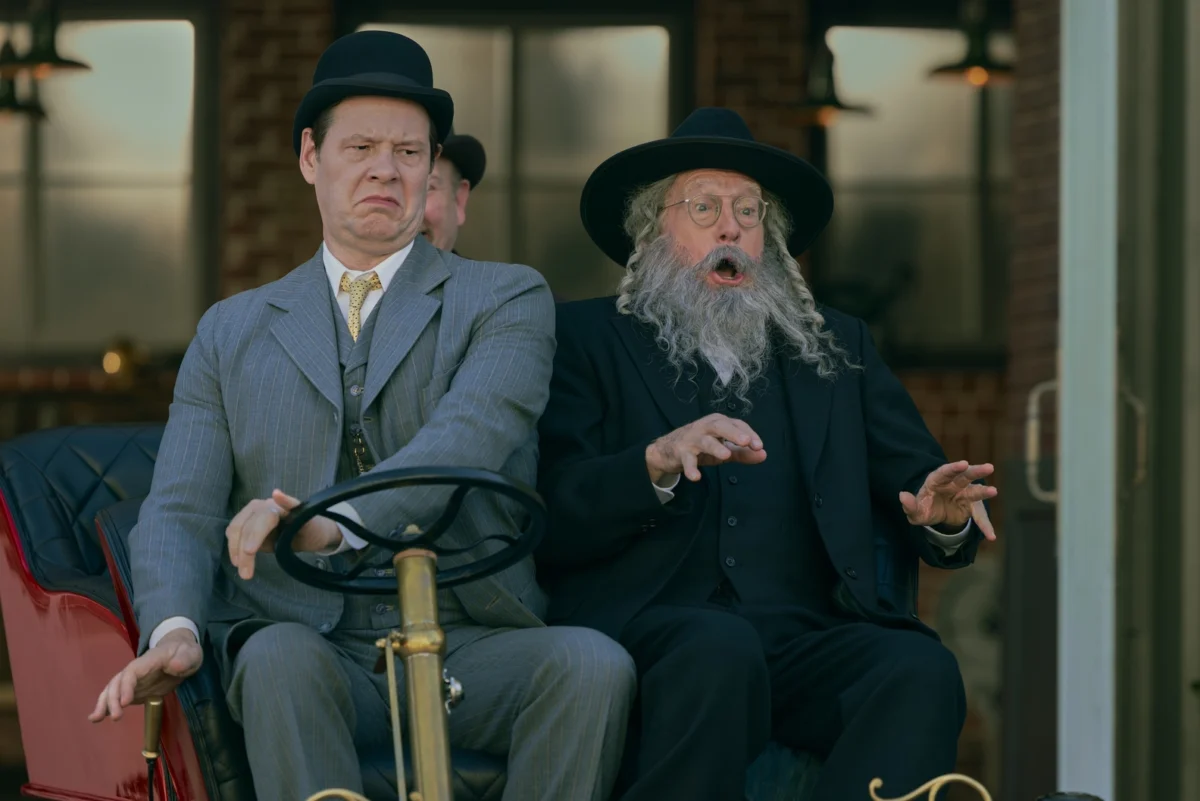
The episode continues with Ike Barinholtz as a vehemently antisemitic Henry Ford, interacting with David’s rabbi character during a demonstration of his new automobile. This sketch tackles historical prejudice head-on, using David’s character as a catalyst for confronting uncomfortable truths.
David then embodies President James Buchanan, navigating a social gathering and making inappropriate advances towards women. This segment, featuring Jordana Brewster and Katie Aselton, highlights David’s ability to portray historical figures in unflattering and socially awkward situations. Diallo Riddle appears as Buchanan’s assistant.
The episode’s most significant segment revolves around David’s portrayal of Dora Salk, the proud mother of Jonas Salk, the developer of the polio vaccine. This sketch satirizes parental pride and touches upon contemporary anti-vaccine sentiments, referencing David’s former friend and colleague Cheryl Hines’ husband, HHS Secretary Robert F. Kennedy Jr. The dialogue, with a character named Bobby predicting dire consequences from the vaccine, parodies the politicization of public health issues, a hallmark of David’s topical commentary.
Episode 5: "Lincoln"
The penultimate episode, "Lincoln," focuses on two significant historical moments. The first sketch transports viewers to the O.K. Corral, where Timothy Olyphant as Wyatt Earp and Don Johnson as Doc Holliday are engaged in a typically Curb-esque negotiation over the logistics of their legendary shootout. David’s character, a cowboy, finds himself at odds with the Earps and Clantons, adding another layer of interpersonal conflict to a historically charged event.
The second, and arguably more anticipated, sketch examines the strained relationship between Abraham Lincoln and his wife, Mary Todd Lincoln. Bill Hader portrays a beleaguered Lincoln, who, along with his chief of staff, conspires to remove Mary from Ford’s Theatre during a performance of Our American Cousin. Kathryn Hahn plays a mentally unstable Mary Todd Lincoln, and Lennon Parham plays Laura Keene, the actress. The sketch culminates in a petty argument between Mary and the chief of staff over a stolen sweater, a moment that feels strikingly familiar to fans of Curb Your Enthusiasm. Jay Renshaw as John Wilkes Booth and Seth Morris as Andrew Johnson round out the cast for this historical vignette.
Broader Impact and Future Implications
Life, Larry and the Pursuit of Unhappiness represents a significant artistic undertaking, blending the comedic genius of Larry David with the rich tapestry of American history. The series’ success lies not only in its star-studded cast but also in its bold approach to historical commentary. By juxtaposing David’s signature brand of observational humor with significant events and figures, the show encourages viewers to re-examine the past through a fresh, often irreverent, lens.
The collaboration with the Obamas’ Higher Ground Productions signals a growing interest in utilizing entertainment platforms to engage with historical narratives and national identity. The series’ willingness to tackle sensitive topics, from political scandals to social movements, demonstrates a commitment to provocative storytelling. The extensive guest list, featuring actors and comedians from diverse backgrounds and generations, ensures broad appeal and highlights the enduring power of David’s comedic influence across the entertainment industry.
As the series progresses, its impact will likely be measured not only by viewership numbers and critical reception but also by its ability to spark conversations about history, culture, and the human condition. Life, Larry and the Pursuit of Unhappiness is more than just a comedy show; it is a cultural commentary that uses humor to illuminate the complexities and absurdities of the American experience, past and present. The series, with its innovative format and exceptional talent, has firmly established itself as a must-watch event for fans of intelligent comedy and insightful historical exploration.