A Recursive Narrative Structure
The narrative architecture of Company is built upon a foundation of stories within stories, reminiscent of classic Gothic literary tropes. The film initiates its cycle in 1975, introducing Evelyn, played by Emily Alyn Lind, who seeks shelter at a suburban residence during a torrential downpour. Her arrival, underscored by the thematic resonance of Bob Dylan’s Shelter From the Storm, serves as the catalyst for a series of recursive tales.
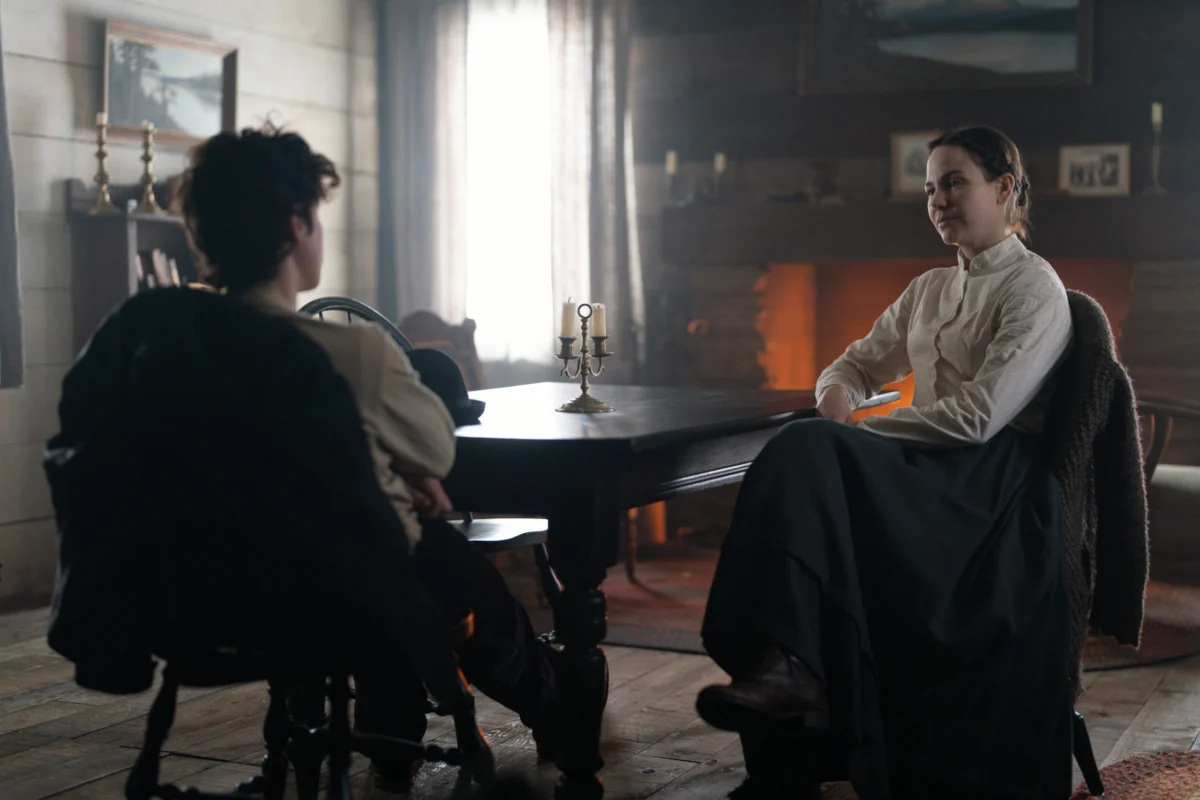
Within this framework, the timeline shifts back to 1953, where an elderly, grizzled widower named Tom, portrayed by Nick Nolte, encounters an enigmatic woman named Alice (Caylee Cowan). In a secondary layer of the narrative, Alice recounts a story set in 1903, focusing on a farming couple, Rebecca (Adelaide Clemens) and Emmett (Scoot McNairy). This third timeline becomes the primary focus of the film, centering on the arrival of a mysterious drifter named Caleb, played by Atticus Affleck. The deliberate, often molasses-like pacing of the film’s first two acts is designed to build tension through this mystery; however, the lack of narrative momentum has been noted as a significant barrier to audience engagement.
The Vampire Genre Pivot
The film’s central conceit—the true nature of the "mysterious strangers" in each timeline—represents a late-stage genre pivot that has polarized early viewers. As the narrative progresses, it becomes clear that these travelers, all clad in severe, monochrome tailoring, are vampires. This revelation attempts to reframe the film as a period heartland vampire story, utilizing the tropes of the undead to comment on themes of community, isolation, and the American spirit.
However, the interpretation of vampire lore in Company diverges significantly from traditional horror conventions. The film posits that these bloodthirsty entities are capable of grace and mercy when treated with kindness. While this attempt to subvert the genre provides a novel mythos, the execution has been described as lacking the necessary intensity to elevate the stakes. The transition from a melancholically revisionist Western to a supernatural fable creates a tonal dissonance that challenges the audience’s suspension of disbelief.
Production and Creative Challenges
One of the most unusual aspects of the production is its reliance on a rotating roster of cinematographers. The film credits eight different Directors of Photography, including accomplished industry figures such as Masanobu Takayanagi, Adam Arkapaw, and Marcell Rév. In standard film production, a singular visual identity is typically maintained by one DP to ensure consistency across the color palette, lighting schemes, and lens choices. The fragmentation of the visual department has led to industry speculation regarding the stability of the production process.
While the film remains visually consistent—maintaining an earthy, ascetic, and chambray-textured aesthetic—the decision to employ such a large number of cinematographers remains a point of confusion for critics. If the intent was to distinguish the three eras through varying visual styles, that objective appears to have been lost in the final edit. The resulting product suggests a project that may have been plagued by logistical hurdles or shifting creative mandates, ultimately failing to synthesize the work of its many contributors into a cohesive whole.
The Role of the Ensemble Cast
Despite the film’s broader narrative issues, certain performances have emerged as highlights. Atticus Affleck’s portrayal of Caleb, characterized by a willowy insolence and a pale, judgmental gaze, provides the film with its only moments of genuine danger. His performance has been compared to a fusion of contemporary sensibilities, providing a sharp contrast to the more traditional characterizations surrounding him.
Ben Mendelsohn, appearing as the neighboring farmer Kleinschmidt, delivers a performance that has been widely cited as the ensemble’s strongest. His verbal sparring with Caleb provides the script—co-written by Casey Affleck and Ron Hansen—with rare flashes of sharp, foreboding dialogue. Hansen, who previously collaborated with Affleck on The Assassination of Jesse James by the Coward Robert Ford and The World to Come, brings a familiar lyrical weight to the screenplay. Yet, even with these strong individual performances, the film struggles to maintain a consistent energy level across its runtime.
Marketing and Distribution Implications
The Venice competition premiere has left distributors with a difficult task. The film’s most significant "hook"—the reveal of the supernatural element—is also its most carefully guarded secret, making the creation of a compelling marketing campaign a complex proposition. In an era where audiences often arrive at screenings with prior knowledge gained from social media and early festival reviews, the "surprise" element of Company may fail to resonate as intended.
For distributors, the challenge is twofold: first, overcoming the reputation of the film’s slow-burn pacing, and second, communicating the genre shift without alienating potential viewers or setting misleading expectations. Given the muted critical reception at the festival, the film’s path to a wide theatrical release appears precarious. Industry analysts suggest that such projects often find a more natural home in boutique streaming environments or limited arthouse runs, where the film’s deliberate, atmospheric style is more likely to be appreciated than in a high-volume multiplex environment.
Critical Analysis and Broader Context
The trajectory of Casey Affleck’s directorial career offers context for the reception of Company. Light of My Life established him as a filmmaker capable of sustaining a mournful, atmospheric tone. In that respect, Company is an aesthetic continuation of his earlier work. However, the failure to marry this atmosphere to a compelling, tightly wound narrative marks a step back from his previous success.
The film stands as a case study in the difficulties of balancing high-concept genre subversion with the demands of character-driven drama. By prioritizing the "hide-the-genre" structure, the filmmakers have inadvertently sidelined the development of the characters themselves, leaving the audience with a series of vignettes that feel disconnected. While the film demonstrates technical proficiency in cinematography and production design, it serves as a reminder that a film’s structural integrity is as vital as its visual polish. As the industry continues to evaluate the film’s standing, it remains a divisive example of auteur-driven filmmaking that prioritizes thematic ambition over narrative clarity.
Ultimately, Company serves as a cautionary tale regarding the limitations of nested storytelling. By attempting to echo narratives across three distinct eras, the film creates a repetitive cycle that dilutes the emotional impact of each segment. Whether viewed as an experiment in tone or a departure from conventional horror, the project highlights the challenges inherent in crafting a genre-defying work that must simultaneously function as a period piece, a family drama, and a supernatural fable. As it moves beyond the festival circuit, the film’s legacy will likely be defined by the disparity between its high-minded intentions and its fragmented, often elusive, final execution.