The intersection of celebrity advocacy, social media discourse, and the ongoing geopolitical tensions surrounding the Israel-Hamas conflict reached a new flashpoint this week as pop superstar P!NK issued a comprehensive statement addressing the intense public scrutiny she faced following her criticism of rapper Macklemore. The controversy, which erupted in the wake of Macklemore’s recent performances, highlights the volatile nature of public figures navigating deeply polarizing political narratives in the digital age.
The Chronology of the Conflict
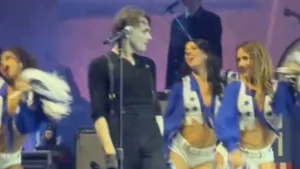
The friction originated during a concert at MetLife Stadium in East Rutherford, New Jersey, where Macklemore was serving as a supporting act for Ed Sheeran. During his set, the rapper, who has been a vocal proponent of Palestinian rights, explicitly called for a "Free Palestine." Addressing the stadium crowd, Macklemore stated, "One of the reasons why I wanted to come on this tour was because I wanted to stand up here on stages in stadiums across America and say two words that are very near and dear to my heart: ‘Free Palestine.’ I want those words to be loud and clear so that people from Gaza, all the way to the occupied West Bank, know that we have not forgotten them."
Following the performance, the advocacy group StopAntisemitism shared a critique of the rapper’s comments, characterizing his rhetoric as a distortion of facts and accusing him of turning a mainstream entertainment event into a "political nightmare against the Jewish state." P!NK, whose own Jewish heritage is a subject of public record, reshared the organization’s post. This action triggered an immediate and widespread backlash from fans and social media users who viewed her engagement as an endorsement of the post’s specific claims and a dismissal of the humanitarian concerns raised by Macklemore.
P!NK’s Formal Response and Clarification
In an effort to de-escalate the situation and clarify her personal stance, P!NK posted a lengthy statement on Instagram. She acknowledged that her initial reaction—reposting content written by others—was a misstep in communication. "Last Sunday I reposted somebody else’s post about Macklemore’s set at Ed Sheeran’s show. It said things in words I didn’t write, and I wouldn’t have chosen all of them," she wrote.
She further addressed the subsequent digital "pile-on," admitting that her initial decision to respond to criticism with "snarky memes" was an inadequate way to engage with such a sensitive topic. "A repost isn’t a statement, and a meme isn’t a spine," she noted.
Central to her statement was an attempt to decouple her identity as a Jewish individual from the policies of the Israeli government. She emphasized that she does not speak for the state of Israel, nor has she ever claimed to. "I was born a Jew. I didn’t pick it, and I’ve never hidden it," she stated. Reaffirming her stance from October 2023, she categorized Hamas as a terrorist organization while simultaneously calling for a future that honors the humanity and aspirations of Palestinians. "Protecting innocent life comes first, everywhere, and nobody should ever celebrate the death of a child," she added.
Humanitarian Context and UNICEF Advocacy
To provide depth to her position, P!NK highlighted her decade-long tenure as a UNICEF ambassador. She argued that her advocacy for children in conflict zones has been rooted in firsthand experience rather than digital rhetoric. "I’ve spent a decade as a UNICEF ambassador for kids who didn’t choose the country or the war they were born into, and I have grieved every one of them, on both sides of that fence," she wrote. She expressed a desire to avoid "litigating a complex war in an Instagram caption," signaling a preference for direct, human-centered advocacy over the binary nature of social media debates.
Analyzing the "Zionist" Discourse and Public Perception
A significant portion of P!NK’s statement focused on the linguistic shift in modern political discourse, specifically regarding the term "Zionist." She criticized the use of the word as a "slur" by individuals who she suggested were operating from a pre-determined narrative. According to P!NK, many of her detractors were not interested in her actual beliefs but were instead acting out a script in which a "Jew who won’t apologize for existing must be the villain."
This analysis touches on a broader trend in political commentary where labels are increasingly used to categorize public figures into monolithic groups. By challenging this dynamic, P!NK sought to reclaim her agency, asserting that one can support the security and existence of Jewish people without necessarily endorsing every action taken by the Israeli government.
Broader Implications for Celebrity Advocacy
The incident serves as a case study for the risks inherent in celebrity activism. In an era where digital platforms demand immediate reactions to complex geopolitical events, artists are increasingly forced to balance their personal values with the expectations of their global fan bases.
Data from social media sentiment trackers indicates that public figures who engage with the Israel-Palestine conflict often face significant "audience churn," where followers may drop or increase based on the perceived alignment of the celebrity’s statement with the follower’s personal ideology. For an artist like P!NK, whose career has spanned 25 years, the challenge lies in maintaining a consistent relationship with a diverse audience while refusing to be forced into performative political stances.
Fact-Based Context of the Region
The conflict referenced by both Macklemore and P!NK remains one of the most complex geopolitical situations of the 21st century. Following the October 7, 2023, attacks led by Hamas, which resulted in the deaths of approximately 1,200 people in Israel and the taking of over 200 hostages, the subsequent Israeli military campaign in Gaza has led to a catastrophic humanitarian situation.
According to reports from international bodies, including the United Nations and various humanitarian NGOs, the death toll in Gaza has climbed into the tens of thousands, with widespread displacement, infrastructure collapse, and severe food and medical shortages. The intensity of the debate surrounding these events is reflective of the deep-seated trauma and political divides that characterize the region.
Closing Reflections: Tradition and Humanity
P!NK concluded her statement by grounding herself in her personal traditions, noting that the timing of the controversy coincided with the 25th anniversary of the September 11th attacks and the onset of Rosh Hashanah, the Jewish New Year. Her emphasis on "lighting candles and dipping apples in honey" served as a pivot back to her private life, framing her response as an effort to set boundaries between her public persona and her personal values.
Macklemore, for his part, has maintained his position, sharing a clip of his speech with the caption: "Wanting all humans to be treated equal should never be controversial."
As the discourse continues to evolve, the tension between the desire for political expression and the reality of public scrutiny remains a defining characteristic of the modern entertainment landscape. For both artists, the events of the past week underscore the difficulty of navigating a global crisis where the demand for clarity often clashes with the reality of nuance. As P!NK noted in her closing, she remains accessible to those who seek a genuine understanding of her views, rejecting the "cheap and fast" nature of social media as a viable medium for addressing the weight of the current humanitarian tragedy.