
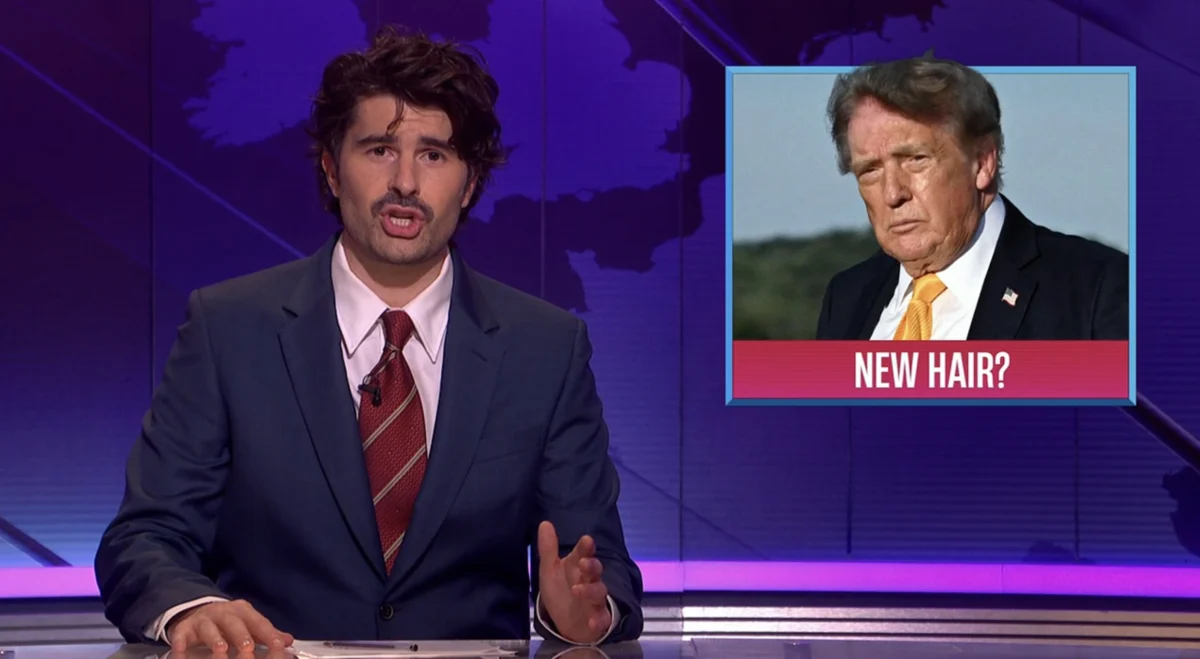
The second season of Saturday Night Live UK premiered this week, bringing a sharp satirical focus to international political figures, British societal tensions, and the complexities of the royal education system. Hosted by Hollywood veteran Jeff Goldblum, the episode utilized the program’s signature “Weekend Update” news desk format to dissect recent headlines, ranging from the aesthetic choices of former U.S. President Donald Trump to the volatile landscape of contemporary protest movements in the United Kingdom.
Analysis of the Weekend Update Segment
The satirical news segment, anchored by comedians Ania Magliano and Paddy Young, opened with a critique of Donald Trump’s recent public appearance. The anchors addressed a notable shift in the former president’s hair color during a recent arrival at an airfield. The segment attempted to frame the physical transformation through a series of comedic observations, though the broadcast was notably punctuated by an interjection regarding legal oversight.
During the exchange, co-anchor Paddy Young alluded to a potential restriction placed upon the broadcast’s script by the production’s legal department. While it remains unclear whether the interruption was a pre-scripted comedic device—a common trope in sketch comedy programs designed to simulate corporate censorship—it drew significant attention to the boundaries of political satire within the current UK regulatory framework.
Educational Controversies and Royal Protocol
The broadcast transitioned to a discussion regarding the British monarchy, specifically focusing on the schooling of Prince George. The comedic commentary centered on the transition of the young royal into the elite secondary education system, with specific reference to Eton College.
The hosts drew connections between the historical reputation of elite boarding institutions and the ongoing public discourse regarding safeguarding and institutional history in the UK. By referencing the institution’s long-standing reputation alongside contemporary concerns, the segment tapped into a broader national conversation about the necessity of reform in the private school sector. The audience’s audible reaction to these remarks underscored the sensitive nature of the subject matter, highlighting the tension between traditional institutions and the evolving expectations of modern British society.
Sociopolitical Unrest and Far-Right Activism
A significant portion of the segment was dedicated to the recent anti-migrant protests that have manifested across various UK cities. The hosts analyzed the rise of figures such as Danny Tommo and the activities of groups like Patriot Platform.
The reportage within the sketch format provided a biographical overview of Tommo, noting his transition from diverse trades to his current role as a political activist. The hosts utilized a combination of observational humor and anecdotal biographical details to frame the activities of the group. From a journalistic perspective, the inclusion of these segments reflects the program’s intent to comment on the increasing visibility of fringe political movements and the subsequent public backlash these groups have faced. By focusing on the intersection of protest, personal history, and public rhetoric, the show emphasized the polarization currently affecting the UK political climate.
Contextualizing Saturday Night Live UK
The adaptation of the American Saturday Night Live format for a British audience presents unique challenges and opportunities. The original US program, created by Lorne Michaels, has served as a cultural touchstone for nearly five decades, relying on a blend of celebrity guests and timely political commentary. In the UK, the format faces a different media landscape characterized by stricter libel laws and a more concentrated tradition of political satire, often seen in programs such as "Have I Got News for You."
The decision to cast Jeff Goldblum as the host for the second-season premiere suggests a strategy aimed at maintaining a bridge between international appeal and local relevance. Goldblum, known for his eccentric delivery and extensive career in film, provided a stable anchor for the episode’s diverse array of sketches.
The Evolution of Political Satire in the UK
The role of television satire in the United Kingdom has historically served as a critical valve for public frustration. Research conducted by media analysts indicates that during periods of high political volatility, viewership for satirical programming tends to increase. This trend suggests that audiences are not merely looking for entertainment, but for a simplified, digestible synthesis of complex news cycles.
However, the inclusion of legal disclaimers or "mock-censorship" in the Weekend Update segment highlights a recurring theme in modern broadcasting: the navigation of legal boundaries. In the UK, the Office of Communications (Ofcom) maintains rigorous standards regarding "due impartiality" and "harm and offence." While comedy is granted a wider latitude, broadcasters must still ensure that their content does not cross into actionable defamation. The apparent intervention of the legal team, whether real or performative, serves as a reminder that satire is subject to the same regulatory pressures as hard news.
Public Reaction and Broader Implications
Initial responses to the episode have been mixed, reflecting the wider ideological divide in the country. Supporters of the show’s comedic direction praise the willingness to tackle polarizing figures like Donald Trump and the leaders of protest groups. Critics, conversely, argue that the tone of the comedy can sometimes obfuscate the seriousness of the issues being discussed, particularly regarding the anti-migrant protests.
Sociologists note that the use of humor as a medium for political critique is a double-edged sword. While it can engage younger demographics who might otherwise ignore traditional news broadcasts, it risks trivializing the underlying issues. The caricature of activists and the mockery of public figures can sometimes serve to solidify existing biases rather than foster meaningful dialogue.
A Look Ahead at Season Two
With the premiere behind them, the production team for Saturday Night Live UK faces the challenge of sustaining momentum. The coming weeks will likely see the program return to the headlines as they attempt to balance the satirical demands of a modern, fast-paced news cycle with the logistical constraints of producing a weekly sketch show.
The success of the second season will ultimately be measured by its ability to adapt to the shifting political landscape. As the UK navigates ongoing economic challenges, international geopolitical shifts, and internal social debates, the appetite for political commentary remains high. Whether the program can maintain its relevance—and its edge—will depend on its ability to navigate the fine line between provocative commentary and responsible broadcasting.
The inclusion of international figures like Donald Trump demonstrates an awareness of the globalized nature of modern political discourse. For many viewers, the former president remains a central figure in the cultural zeitgeist, and his inclusion in the premiere was clearly intended to draw in a broad audience. By keeping these global figures in the crosshairs, SNL UK ensures that it is not merely a regional program, but one that participates in the broader international conversation about power, celebrity, and political accountability.
As the series progresses, viewers can expect continued scrutiny of both domestic and foreign policy, delivered through the lens of late-night comedy. Whether the show chooses to refine its satirical edge or pivot toward more experimental formats remains to be seen, but the season premiere has undeniably set a tone of confrontation and commentary that will likely define the weeks ahead.





Leave a Reply