
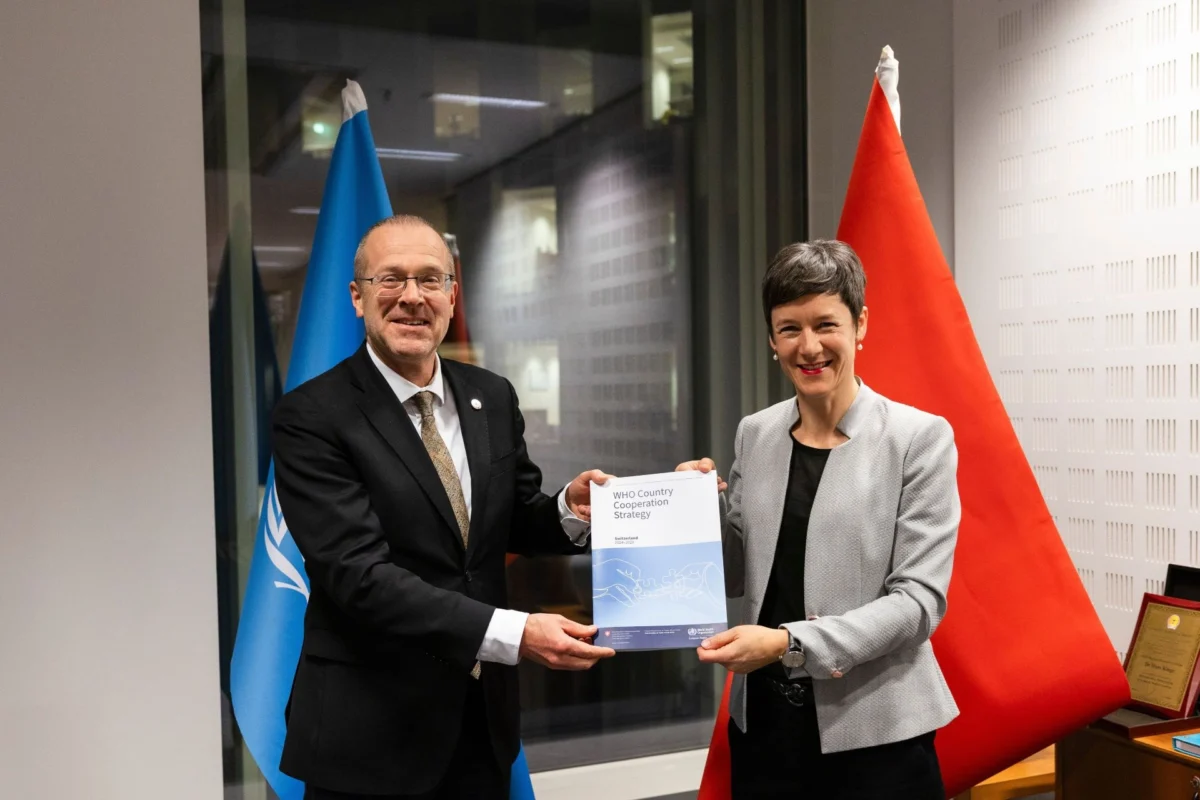
The World Health Organization (WHO) and the Swiss Confederation have officially cemented their long-standing partnership by signing a renewed Country Cooperation Strategy (CCS) spanning the years 2024 through 2028. The formal agreement, finalized on March 4, 2025, at the WHO Regional Office for Europe in Copenhagen, Denmark, builds upon a pioneering history of collaboration that began over a decade ago. This strategic framework is designed to align national public health priorities in Switzerland with broader European and global health agendas, focusing on health security, resilience, innovation, and equity.
The signing ceremony brought together key figures in international diplomacy and public health administration. Barbara Schedler, Ambassador for Global Health at the Swiss Federal Office of Public Health, met with Dr. Hans Henri P. Kluge, WHO Regional Director for Europe, to officially endorse the strategic roadmap. The event marked a milestone in relations between the global health body and one of its most critical high-income member states, underscoring a shared commitment to addressing contemporary health challenges through multilateral cooperation and evidence-based interventions.
Historical Context and Evolution of the WHO-Switzerland Partnership
The relationship between Switzerland and the WHO has deep historical roots, largely anchored by the fact that Geneva serves as the global headquarters for the organization. However, operational collaboration took on a structured, formalized dimension in 2013. That year, Switzerland made history by becoming the first high-income country within the WHO European Region to pilot a dedicated Country Cooperation Strategy.
Prior to this pilot, country cooperation strategies were primarily deployed in low- and middle-income countries to guide resource allocation, technical assistance, and capacity building. Switzerland’s decision to adopt the mechanism signaled a paradigm shift: recognizing that even advanced economies with robust domestic healthcare systems benefit profoundly from structured, bidirectional engagement with international public health agencies.
Over the subsequent decade, the initial framework facilitated closer alignment on a range of domestic and international health priorities. Switzerland leveraged WHO’s normative guidance to refine its national policies, while the WHO benefited from Switzerland’s advanced technical expertise, financial contributions, and strategic positioning in global health diplomacy. By 2022, as the world emerged from the acute phases of the COVID-19 pandemic, both entities recognized the necessity of updating the framework to address post-pandemic vulnerabilities, emerging infectious diseases, antimicrobial resistance, and the accelerating impacts of climate change on human health.
Chronology of the Renewal Process
The path to the 2024–2028 strategy involved a multi-year consultative process characterized by rigorous evaluation and strategic realignment.
- 2022: WHO and Swiss health authorities jointly initiated a comprehensive review of the preceding cooperation framework. The evaluation assessed the efficacy of joint initiatives, identified gaps exposed by recent global health crises, and outlined strategic imperatives for the medium term.
- 2023: Extensive consultations took place between technical experts from the Swiss Federal Office of Public Health, various Swiss academic and research institutions, and divisions across the WHO Regional Office for Europe. These sessions focused on defining priority areas where synergistic action could yield the highest impact.
- 2024: Although the strategic timeframe officially designates the period from 2024 onward, operational drafting and policy harmonization continued throughout the year. Notably, this period also saw parallel strengthening of bilateral ties in specialized areas, such as the WHO-Switzerland partnership for the global BioHub system, which enhances the rapid sharing of novel pathogens of epidemic and pandemic potential.
- March 4, 2025: The formal signing ceremony took place in Copenhagen, Denmark, where Ambassador Barbara Schedler and Dr. Hans Henri P. Kluge formally adopted the final document, translating years of strategic planning into an actionable operational roadmap.
Core Pillars of the 2024–2028 Cooperation Strategy
The newly enacted WHO–Switzerland Country Cooperation Strategy 2024–2028 is built upon several strategic pillars designed to address both national health priorities and global public health goods.
First, the strategy emphasizes health security and emergency preparedness. Drawing critical lessons from the COVID-19 pandemic, the framework outlines enhanced mechanisms for surveillance, risk assessment, and cross-border collaboration. Switzerland’s integration into broader European health security architectures is a primary focus, ensuring that national response protocols remain agile, transparent, and fully interoperable with international standards.
Second, the partnership places a heavy emphasis on health innovation and digital transformation. As a global hub for pharmaceutical research, biotechnology, and health technology development, Switzerland offers immense technical capacity. The cooperation strategy facilitates platforms where Swiss innovation can be harnessed to address public health challenges globally, particularly in improving access to diagnostics, therapeutics, and vaccines. This aligns closely with ongoing collaborative efforts, such as the global BioHub system, which provides a safe, secure, and transparent mechanism for member states to share biological materials for countermeasure development.

Third, the framework addresses non-communicable diseases (NCDs) and mental health, which represent significant public health burdens in high-income settings. By fostering joint research initiatives and sharing best practices in prevention and care delivery, both entities aim to curb the rising incidence of cardiovascular diseases, cancer, diabetes, and mental health disorders.
Fourth, the strategy addresses the social determinants of health and health equity. Even within wealthy nations, disparities in health outcomes persist across socioeconomic strata, migrant populations, and marginalized communities. The renewed strategy commits both parties to targeted interventions aimed at closing these gaps, ensuring universal access to quality healthcare services.
Official Statements and Stakeholder Perspectives
The formalization of the strategy elicited strong endorsements from leadership on both sides, emphasizing the mutual benefits of the enhanced partnership.
Dr. Hans Henri P. Kluge, WHO Regional Director for Europe, highlighted the unique role that high-income nations play in regional and global health solidarity. "Switzerland is not only a vital host nation for international health governance but also a pioneer in public health innovation and policy," Dr. Kluge noted. "By renewing this cooperation strategy, we are reaffirming that health security is a shared responsibility. The lessons we have learned together over the past decade will serve as a robust foundation for tackling the complex health crises of the future, ensuring that no population is left behind."
Ambassador Barbara Schedler, speaking on behalf of the Swiss Federal Office of Public Health, emphasized Switzerland’s steadfast commitment to multilateralism and global health security. "Our partnership with the World Health Organization represents a cornerstone of Swiss foreign health policy," Ambassador Schedler stated. "Through this updated cooperation strategy, Switzerland is well-positioned to contribute its technical expertise, research capabilities, and financial support to address transnational health threats. At the same time, the insights and normative frameworks provided by the WHO enable us to continuously strengthen our domestic health systems against emerging challenges."
Fact-Based Analysis of Implications for Global and Regional Health
The renewal of the WHO-Switzerland cooperation framework carries significant implications for the broader European Region and international health governance.
From a regional perspective, the strategy serves as a model for how high-income countries can structure their engagement with the WHO. While many affluent nations primarily act as financial donors to the organization, the CCS model transforms the relationship into an active, collaborative partnership built on mutual accountability and technical exchange. This approach acknowledges that high-income countries are equally vulnerable to transnational health threats, such as antimicrobial resistance, climate-induced health emergencies, and zoonotic spillover events.
Furthermore, Switzerland’s active participation in specialized WHO initiatives—such as the global BioHub system—demonstrates the practical utility of the agreement. In an era where rapid pathogen sharing is critical for vaccine development, the establishment of trusted, legally secure multilateral frameworks is indispensable. By cementing their cooperation through 2028, Switzerland and the WHO have ensured a predictable, institutionalized mechanism for addressing these operational complexities.
The emphasis on digital health and innovation within the 2024–2028 strategy also addresses the future of healthcare delivery. As artificial intelligence, big data analytics, and precision medicine transform the medical landscape, regulatory harmonization and ethical oversight become paramount. The cooperation strategy provides a neutral platform where regulatory authorities, researchers, and public health officials can collaborate on setting international standards that balance innovation with patient safety and data privacy.
Conclusion and Outlook
The signing of the WHO-Switzerland Country Cooperation Strategy for 2024–2028 marks a mature continuation of a pioneering bilateral relationship. By moving beyond traditional donor-recipient dynamics into a collaborative framework focused on shared resilience, innovation, and health equity, both entities have established a resilient blueprint for modern public health governance. As the international community navigates an increasingly complex landscape of epidemiological, environmental, and geopolitical challenges, the renewed partnership between WHO and Switzerland stands as a testament to the enduring value of multilateral cooperation in safeguarding human health.










Leave a Reply