
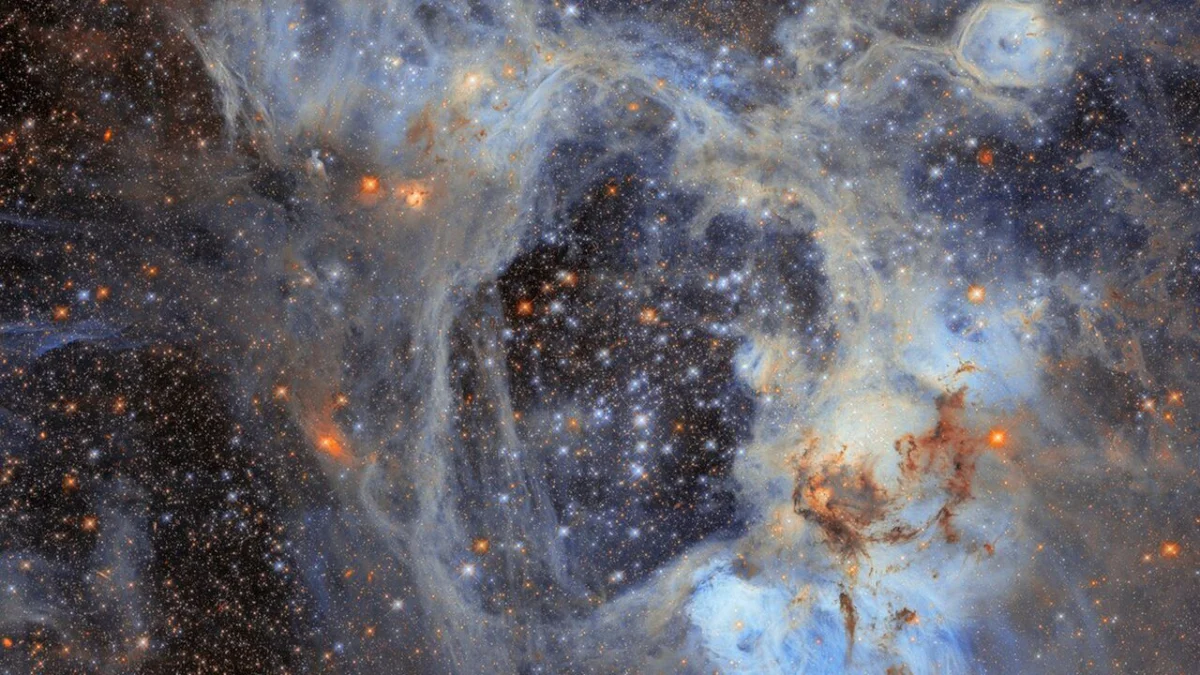
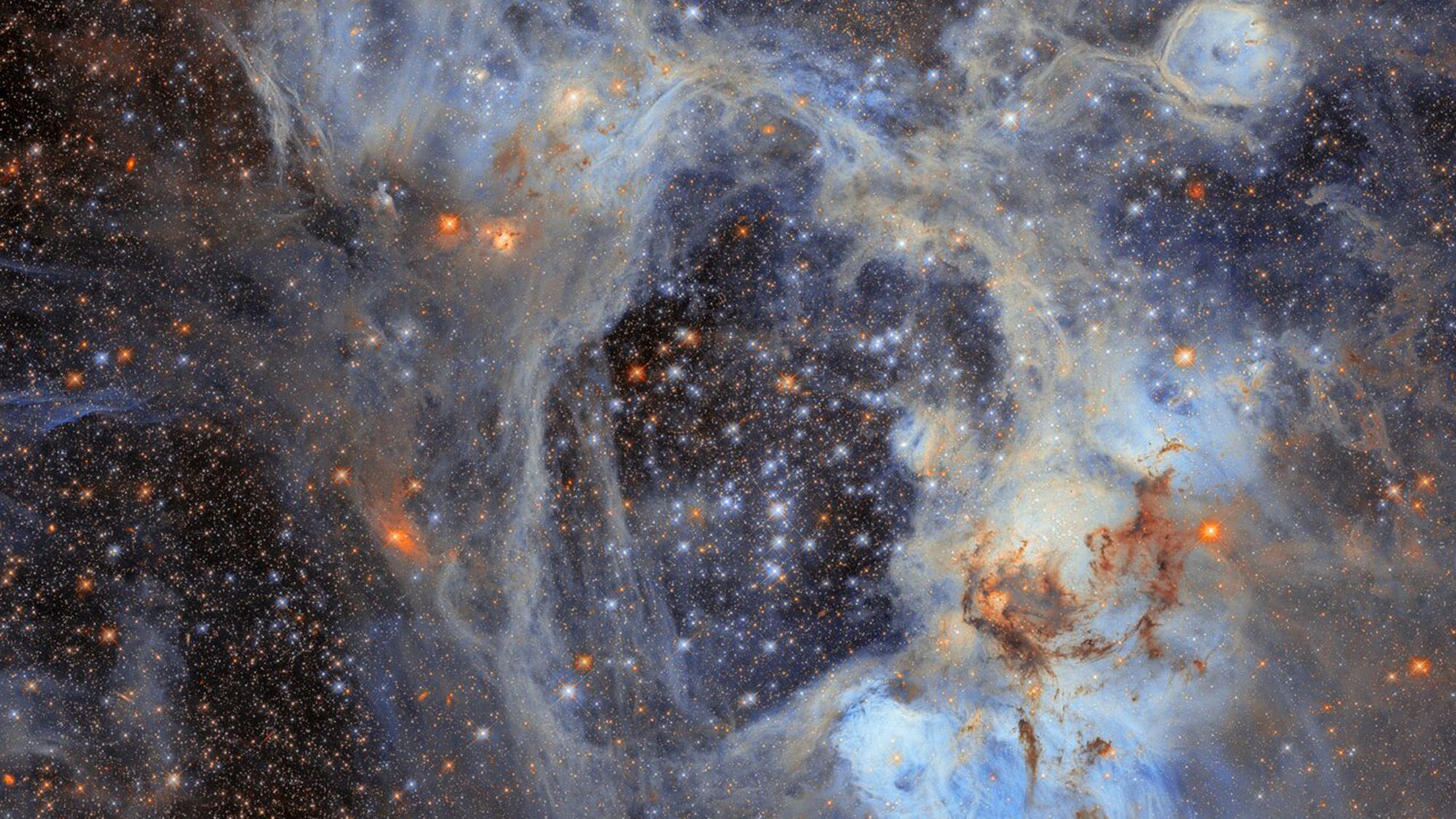
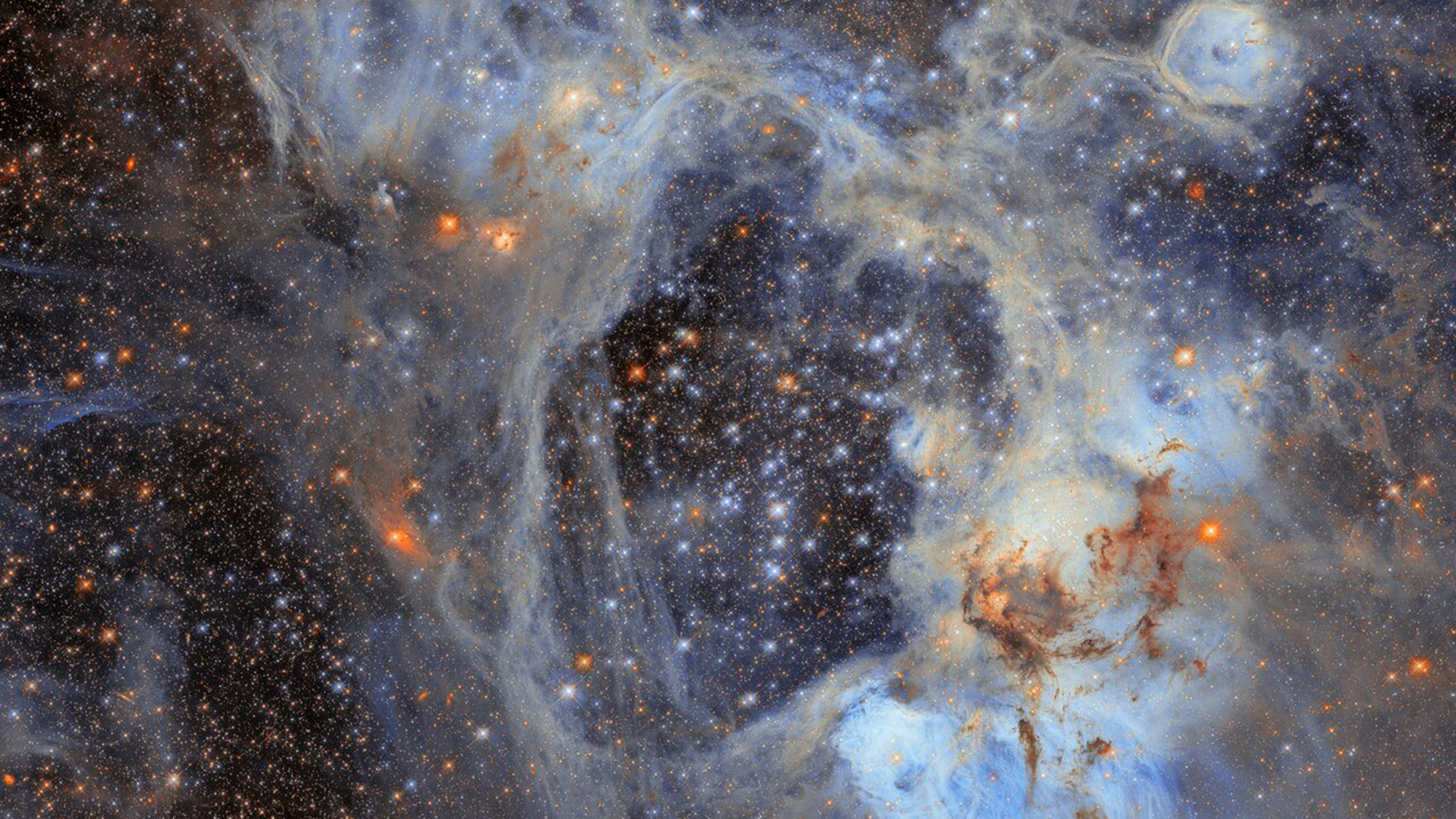
The Hubble Space Telescope has once again captivated the global scientific community and astronomy enthusiasts alike by releasing a breathtaking new image of the vibrant LHA 120-N44 nebula. Located approximately 160,000 light-years away from Earth, this mesmerizing celestial nursery resides within the Large Magellanic Cloud, one of our Milky Way’s nearest satellite galaxies, situated in the southern constellation of Dorado. Shared publicly on September 3, 2026, the newly processed image showcases intricate swirls of brown and blue gas, offering astronomers an unprecedented glimpse into the complex dynamics of star formation and stellar evolution in the deep cosmos.
Main Facts and Cosmic Anatomy of LHA 120-N44
The celestial object officially designated as LHA 120-N44, or simply N44, is an emission nebula spanning roughly 1,000 light-years across. Unlike smaller, more isolated stellar nurseries, N44 is classified as a complex, super-bubble system. Within its glowing boundaries, multiple generations of massive stars have lived, evolved, and died, leaving behind a chaotic landscape carved by stellar winds, intense ultraviolet radiation, and supernova explosions.
The swirling brown and blue hues captured in Hubble’s latest composition represent a detailed chemical and thermal map of the region. The brilliant blue pockets typically highlight regions of intense ionization where scorching, newly born massive stars strip electrons from hydrogen atoms, while the dense, winding brown filaments indicate thick swaths of cosmic dust and cool molecular gas. These dusty corridors are the fundamental building blocks of future solar systems, containing the raw materials necessary to eventually forge new stars and planets.
Chronology and Observational History
The exploration of the Large Magellanic Cloud and its rich inventory of nebulae dates back centuries, but the detailed study of N44 accelerated dramatically following the launch and subsequent servicing missions of the Hubble Space Telescope.
- Early Discoveries: While the Large Magellanic Cloud was cataloged by early astronomers and prominently noted by explorers like Ferdinand Magellan, the distinct features of N44 were formally classified during mid-20th-century surveys conducted by astronomer Karl Henize, from whom the "LH" and "N" catalog designations originate.
- The Hubble Era: Over the past three decades, Hubble has trained its sensitive Wide Field and Planetary Cameras, and later the Advanced Camera for Surveys, on N44 multiple times. Each successive observation has peeled back layers of cosmic dust, helping astrophysicists understand how massive star clusters interact with their surrounding gas clouds.
- September 2026 Release: The latest imagery, released in late 2026, utilizes advanced image processing techniques to combine data from various filters, highlighting previously obscured structural details within the nebula’s glowing cavities and dusty pathways.
Supporting Data and Astrophysical Significance
To fully grasp the magnitude of the N44 nebula, astrophysicists rely on multi-wavelength data gathered by both space-based observatories—such as Hubble, the James Webb Space Telescope, and the Chandra X-ray Observatory—and powerful ground-based telescopes.
The Large Magellanic Cloud provides an ideal laboratory for studying star formation because it possesses a lower metal content (elements heavier than hydrogen and helium) than our own Milky Way. This distinct chemical composition mirrors the conditions of the early universe, billions of years ago. By studying how stars form and evolve in environments like N44, scientists can gain critical insights into galactic evolution on a cosmic scale.
Key data points regarding the observation include:
- Distance: 160,000 light-years from Earth, placing it securely outside the Milky Way galaxy within a neighboring satellite system.
- Constellation: Located in Dorado (the Dolphinfish or Swordfish), a constellation primarily visible from the Southern Hemisphere.
- Instrument Heritage: Captured using Hubble’s high-resolution optical and infrared imaging capabilities, allowing researchers to pierce through localized dust obscurations.
Official Responses and Expert Perspectives
While direct commentary from specific space agency officials regarding this particular September 2026 drop emphasizes the ongoing legacy of the aging yet remarkably capable Hubble Space Telescope, planetary and stellar scientists frequently underscore the importance of such continuous monitoring.
"Nebulae like N44 act as cosmic laboratories that allow us to observe the life cycles of stars in real time," note researchers affiliated with the European Space Agency (ESA) and NASA Hubble outreach initiatives. "The intricate interplay between stellar winds from massive central stars and the surrounding interstellar medium creates Sculptor-like cavities that teach us fundamental lessons about galactic feedback loops."
Astrophysicists also emphasize that while newer telescopes like the James Webb Space Telescope specialize in infrared observations that can peer deeply into the dusty cores of star-forming regions, Hubble’s unparalleled optical and ultraviolet acuity remains critical for mapping ionized gas and visible structures with razor-sharp precision.
Broader Impact and Implications for Future Astronomy
The release of the N44 image serves a dual purpose within the scientific community: it fuels public engagement with astronomy while providing researchers with high-fidelity data for ongoing peer-reviewed studies. Publicly accessible datasets from Hubble continue to empower citizen scientists, educators, and professional astronomers alike to model complex hydrodynamic phenomena in distant galaxies.
As humanity looks forward to the next generation of space exploration, observations of neighboring galaxies like the Large Magellanic Cloud bridge the gap between local stellar neighborhoods and distant, early-universe cosmology. The swirling gas and dust of N44 are not merely artistic spectacles of deep space; they are dynamic archives of stellar history, chronicling the continuous cycle of birth, destruction, and rebirth that shapes the universe we inhabit today.









Leave a Reply