
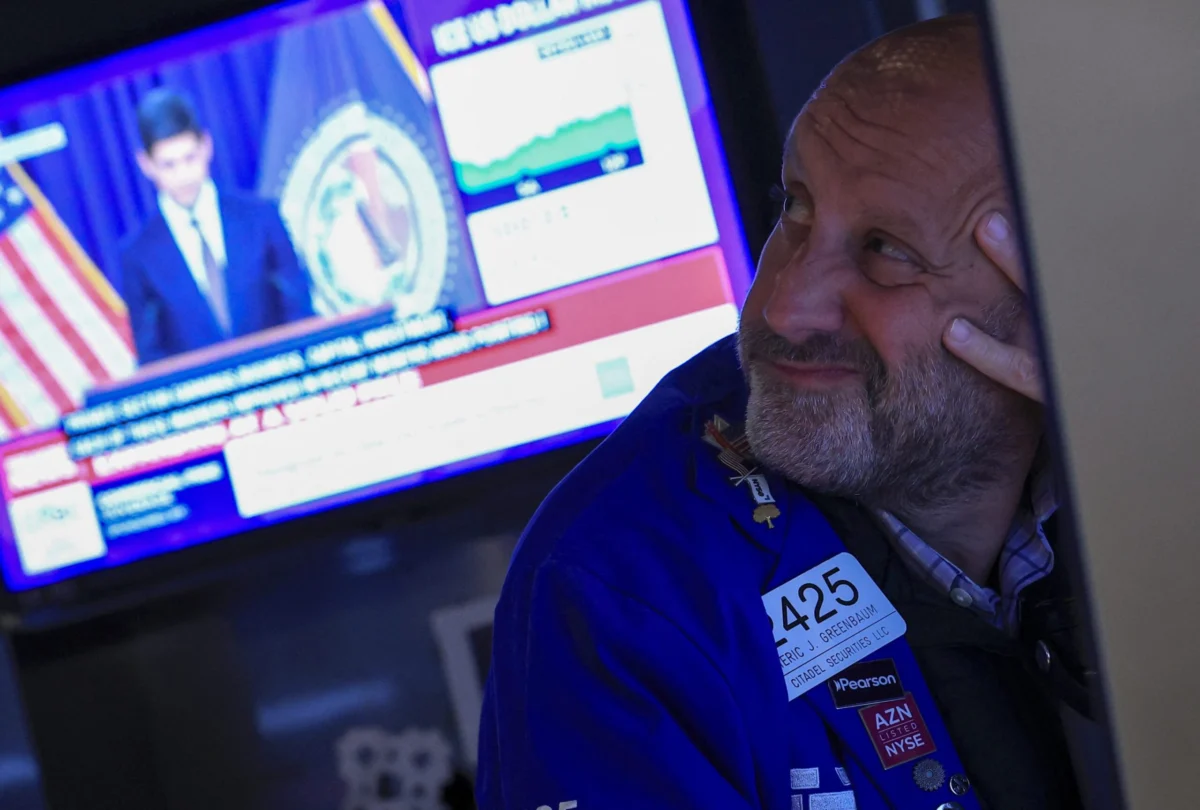
U.S. financial markets experienced a sharp downturn on Wednesday afternoon, erasing early gains after Federal Reserve Chair Kevin Warsh delivered a post-meeting press conference that left investors rattled. The central bank implemented its first interest rate hike in three years, raising the benchmark federal funds rate by a quarter of a percentage point to a range of 3.5% to 3.75%. While the quarter-point increase itself had been widely anticipated and largely priced into equity and debt markets, Chair Warsh’s subsequent remarks signaled that monetary policymakers may not be finished tightening financial conditions, sparking a broad-based sell-off across major indices.
The sudden shift in market sentiment underscores the delicate balancing act facing the Federal Reserve as it attempts to tame persistent inflationary pressures without inducing a severe economic contraction. Equity benchmarks, which had hovered in positive territory leading up to the central bank’s 2:00 p.m. policy announcement, reversed course rapidly as traders digested Warsh’s hawkish tone and his departure from previous communication styles established under former leadership.
Market Sell-Off and Debt Yield Movements
The immediate fallout in the equities market was swift and severe. The S&P 500 tumbled 1%, putting the benchmark index on a trajectory toward its lowest closing level since July. Simultaneously, the Dow Jones Industrial Average suffered a steep decline of 1.7%, shedding more than 700 points. Financial sector shares bore the brunt of the selling pressure, dragging down the broader index as investors reassessed the profitability and credit risk environments under higher-for-longer borrowing costs. The technology-heavy Nasdaq Composite fared slightly better in comparison but still closed down 0.8%.
Fixed-income and currency markets reacted with equal intensity. The yield on the benchmark 10-year U.S. Treasury note held firm near the psychological 5% threshold, hovering just a day after touching its highest level since 2007. Meanwhile, the U.S. dollar index climbed 0.6%, reaching its strongest valuation since late July as foreign exchange traders priced in higher relative yields for U.S. assets.
Prior to the Federal Open Market Committee (FOMC) statement release, all three major U.S. equity indexes were trading higher. Investors had seemingly embraced the expectation that a standard 25-basis-point adjustment would represent a singular, cautious step rather than the opening salvo of an aggressive, multi-meeting tightening campaign. That optimism evaporated within minutes of the press conference commencing.
Decoding Chair Warsh’s Hawkish Posture
Entering the press briefing, Chair Warsh faced a formidable communications challenge. Financial analysts had debated whether the new Fed chief would frame the rate adjustment as a localized, one-off policy calibration—a move that risked signaling complacency to the bond market and failing to anchor inflation expectations—or as the preliminary phase of a prolonged monetary tightening cycle.
Warsh ultimately charted a course that surprised many institutional investors by adopting a distinctly hawkish rhetoric. In his opening remarks, he challenged prevailing assumptions regarding the restrictiveness of current monetary policy.
“I would be hard pressed to describe broad financial conditions as restrictive,” Warsh told reporters. “This view was widely shared by the committee, so we removed a dose of accommodation.”
This phrasing marked a notable departure from the lexicon utilized by his predecessor, Jerome Powell. Throughout Powell’s tenure, the central bank frequently characterized monetary policy as “modestly restrictive,” implying that existing interest rates were already sufficiently elevated to cool economic activity and suppress inflation over time. By asserting that rates at the 3.5% to 3.75% range were not yet restrictive, Warsh effectively communicated that a single quarter-point adjustment was insufficient to achieve the committee’s long-term price stability mandates. When explicitly pressed by journalists on whether current policy could be classified as restrictive, Warsh declined to give an affirmative answer.
Furthermore, the Fed chair distanced himself from the central bank’s internal economic projections, which had previously mapped out a trajectory featuring just one additional rate hike this year followed by an extended policy pause stretching through 2027.
“Those aren’t my forecasts,” Warsh stated regarding the Summary of Economic Projections. “Those are the forecasts of my 18 colleagues.”
Highlighting his unique position as a relatively new appointee who took office in May, Warsh noted that he had not yet submitted his own formal economic projection since assuming the chairmanship. When questioned about whether Wednesday’s rate hike would be followed by a sequential series of increases, he succinctly remarked, “I’m not in the forward guidance business.”
Analyst Reactions and Divergent Expert Opinions
For equity investors who had positioned their portfolios around the hope of a brief, shallow rate-hiking cycle, Warsh’s commentary delivered a triple blow: a central bank leader who believes borrowing costs remain too low, refuses to define a terminal rate, and declines to endorse official forecasts suggesting an imminent end to tightening.
Jeffrey Roach, chief economist at LPL Financial, captured the prevailing anxiety in a research note published immediately following the meeting. “If the economy keeps up like it has, the Fed is telling us that we may not see a cut until 2028,” Roach wrote. “Instead, another hike may be on its way.”
Other market strategists echoed the sentiment that historical precedent rarely favors one-and-done monetary tightening campaigns. Chris Zaccarelli, chief investment officer at Northlight Asset Management, pointed out that “the history is clear that once the Fed begins raising rates, they do it multiple times.” Reflecting this sudden repricing of monetary risk, fed funds futures data indicated that interest rate traders were evenly split on whether the central bank would implement a subsequent rate increase as early as its October meeting.
Conversely, not all macroeconomic analysts shared the view that a prolonged, aggressive tightening cycle is guaranteed. Michael Pearce, chief U.S. economist at Oxford Economics, offered a more moderate interpretation of the Fed’s actions, maintaining his forecast for a single additional rate hike followed by a definitive pause.
“We don’t think this is the beginning of another major tightening cycle,” Pearce wrote in a note to clients, arguing that “markets have too much tightening priced in over the coming year.”
Background Context and Chronological Timeline
Wednesday’s policy decision represents a watershed moment in contemporary U.S. monetary history. To understand the gravity of the shift, it is necessary to examine the timeline of actions and economic pressures leading up to this point:
- Post-Pandemic Inflationary Surge (2021–2022): Following massive fiscal and monetary stimulus deployed during the global health crisis, U.S. inflation accelerated rapidly, reaching a four-decade high of 9.1% in mid-2022.
- The Powell Tightening Cycle (2022–2023): Under Jerome Powell, the FOMC embarked on one of the most aggressive monetary tightening cycles in modern history, raising the federal funds rate from near-zero to a peak range of 5.25% to 5.5% by July 2023.
- The Policy Plateau (2023–2025): As inflation gradually receded toward the Fed’s statutory 2% target, the central bank maintained its restrictive policy posture, eventually executing a series of cautious rate cuts as labor markets showed signs of normalization.
- Leadership Transition (May 2025): Kevin Warsh assumed the role of Federal Reserve Chair, bringing a reputation for skepticism toward prolonged balance sheet expansion and an analytical focus on financial market plumbing.
- Autumn Policy Pivot (September 2025): Following persistent economic resilience, consumer spending robustnes, and stubbornly sticky core inflation metrics, the FOMC enacted its first rate hike in three years, moving the benchmark rate to 3.5%–3.75% and setting off Wednesday’s market correction.
Broader Economic Implications and Outlook
The immediate market reaction highlights the precarious environment in which monetary authorities currently operate. By signaling a willingness to tolerate higher borrowing costs to ensure price stability, Chair Warsh has signaled a prioritization of long-term inflation anchoring over short-term equity market valuations.
However, this stance introduces substantial risks for capital-intensive industries, commercial real estate, and consumer borrowing sectors. With the 10-year Treasury yield anchored near 5%—a multi-decade high—mortgage rates, corporate debt issuance costs, and auto loan pricing will remain elevated, filtering through the broader economy over the coming quarters.
As autumn progresses, all eyes will turn to upcoming employment reports, consumer price index (CPI) prints, and the upcoming October FOMC meeting. Whether Chair Warsh’s hawkish posture proves to be a preemptive strike against re-accelerating inflation or an overcorrection that risks tipping a resilient economy into a downturn remains the central debate defining global financial markets.




Leave a Reply