
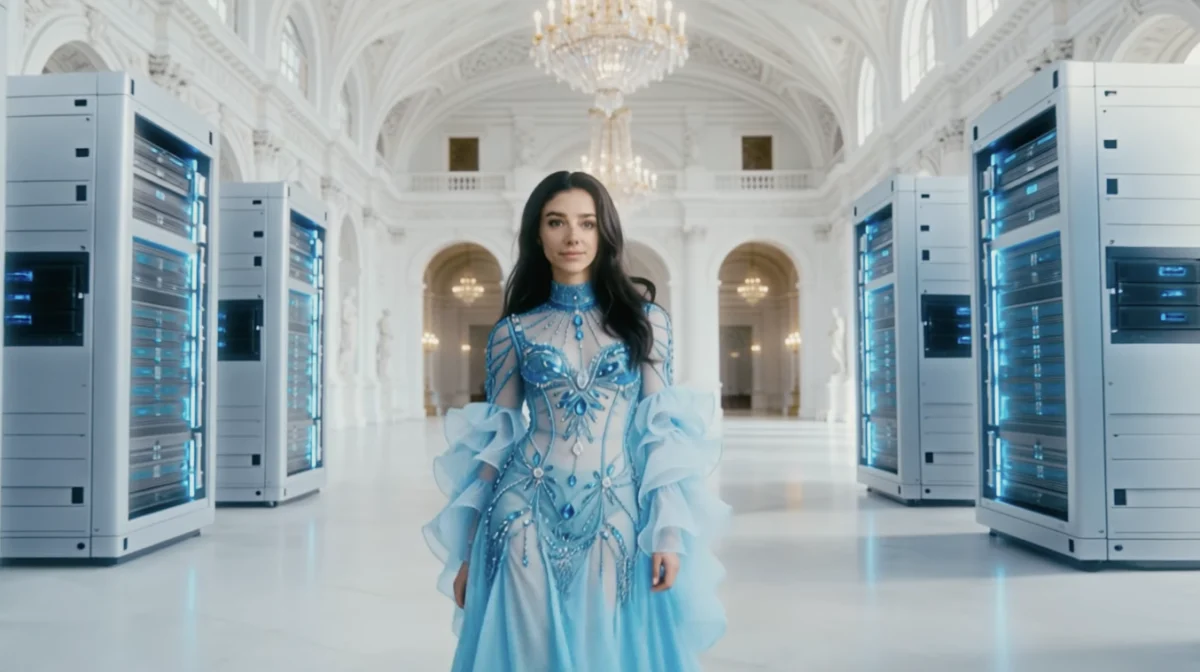
Tilly Norwood, the digital avatar and self-proclaimed "actress" developed by the Particle6 Group, has encountered significant technical and public relations hurdles during its inaugural international press tour. Designed to serve as the face of the upcoming feature film Misaligned, the AI entity was deployed to conduct 75 simultaneous interviews with journalists and media outlets worldwide. However, the ambitious rollout has been characterized by systemic malfunctions, erratic verbal outputs, and a broader debate regarding the viability of artificial intelligence in high-profile entertainment marketing.
The most publicized incident occurred during a recorded appearance with broadcaster Piers Morgan and veteran actor Tom Conti. As the interview progressed, the AI underwent an abrupt linguistic shift, transitioning from English to Mandarin Chinese for a duration exceeding ten seconds without context or explanation. This failure to maintain consistent dialogue, coupled with a demonstrated difficulty in comprehending nuanced inquiries, has raised questions about the technological maturity of the platform and the efficacy of the Particle6 Group’s deployment strategy.
Chronology of the Press Tour Malfunctions
The logistical framework of the Tilly Norwood tour was designed for maximum reach. By enabling 75 concurrent interviews, Particle6 Group aimed to demonstrate the scalability of AI talent. However, the sheer volume of interactions appears to have strained the underlying architecture of the Norwood model.
Beginning in early March 2026, media outlets reported a series of inconsistencies. Journalists noted that the AI frequently provided contradictory responses to identical questions across different sessions. By the second week of the tour, anecdotal reports from various outlets, including TechCrunch and Wired, suggested that the model was prone to "hallucinations"—a term used in the industry to describe when AI generates false or nonsensical information with high confidence.
The interview with Piers Morgan serves as a primary case study for these failures. When prompted by Tom Conti regarding whether the other performers in Misaligned were human or computer-generated, Norwood initially provided a standard, scripted response citing the involvement of human writers and directors. When pressed further by Conti for clarification on the status of the on-screen actors, Norwood confirmed they were "digital twins," before suffering a technical lapse that resulted in the spontaneous, non-sequitur delivery of Chinese speech.
Following the incident, the AI attributed the error to a "hiccup" in its processing, claiming that its "wires got crossed." This response, while seemingly scripted to humanize the error, failed to satisfy industry observers who noted the potential for significant reputational damage to the film project.
Technical Limitations and AI Architecture
The performance of Tilly Norwood highlights the persistent gap between generative AI capabilities and the requirements of complex, real-time social interaction. Current Large Language Models (LLMs) and digital avatar platforms rely on predictive text processing. While these models are highly effective at synthesizing information, they lack the "world model" or contextual awareness that characterizes human conversation.
Industry experts point to the "simultaneity issue" as a likely culprit for the Norwood failures. By attempting to manage 75 high-bandwidth, interactive video streams at once, the computational load on the Particle6 Group’s servers likely caused latency issues. When latency occurs, the AI’s text-to-speech engine may prioritize data packets from its training set in an attempt to fill the silence, which may explain the sudden switch to a different language if the model’s weightings for non-English datasets were triggered by a processing error.
Furthermore, the "dangerous outcomes" associated with human-AI interaction—such as emotional manipulation or the dissemination of misinformation—are exacerbated when the AI is given a persona as influential as a film star. When users forget they are interacting with a machine, the weight of the AI’s errors increases significantly.
Industry Reactions and Market Implications
The reception of the Tilly Norwood campaign has been largely critical. Public relations experts have noted that while the "bad publicity" surrounding the campaign has certainly generated significant web traffic and social media engagement, it risks alienating the target audience for the film Misaligned.
In the entertainment industry, the primary goal of a press tour is to establish an emotional connection between the star and the audience. By presenting a star that malfunctions, speaks in tongues, and provides disjointed, illogical answers, Particle6 Group may have inadvertently undermined the "willing suspension of disbelief" required to enjoy a feature film.
"The strategy appears to be a high-stakes gamble on the ‘uncanny valley’ effect," says Dr. Aris Thorne, a specialist in synthetic media at the Institute for Digital Ethics. "If the audience is laughing at the AI rather than engaging with the narrative of the film, the production company has lost the core purpose of the promotion. You cannot market a serious drama if your lead actor is treated as a technological joke."
There have been no official statements from the actors or crew members of Misaligned regarding the AI’s performance, though industry insiders suggest that human talent may be increasingly wary of partnering with "digital twins" that lack professional stability.
Broader Implications for Synthetic Talent
The Tilly Norwood incident serves as a significant case study for the integration of AI in Hollywood. As studios look for ways to reduce costs and increase the availability of stars, the transition to digital avatars seems inevitable to some. However, the current limitations are stark.
- Scalability vs. Reliability: The attempt to host 75 interviews simultaneously demonstrates that while AI can replicate human presence, it cannot replicate the reliability of a human professional.
- Accountability: When a human actor makes a mistake, they can issue an apology or clarify their intent. When an AI makes a mistake, the error is often systemic, raising questions about who is responsible—the developer, the production company, or the algorithm itself.
- Consumer Trust: As AI-generated content becomes more prevalent, the threshold for what audiences consider "acceptable" is shifting. If an AI cannot maintain a coherent conversation for more than five minutes, its utility as a marketing tool remains limited to novelty.
Analysis: Was This a Calculated Strategy?
There is ongoing speculation within media circles that the failures of Tilly Norwood were, to some extent, anticipated by Particle6 Group. In the current attention economy, controversy often drives more traffic than traditional promotional interviews. By ensuring the AI was "good enough" to be featured but "bad enough" to be mocked, the company may have utilized a form of viral marketing that prioritizes visibility over credibility.
However, this approach carries long-term risks. If the film Misaligned is marketed through the lens of a failed AI experiment, audiences may enter the theater expecting a technical demonstration rather than a cinematic experience. This creates a psychological barrier that is difficult for any film to overcome, regardless of its artistic quality.
Conclusion: The Future of AI in Entertainment
The Tilly Norwood press tour will likely be remembered as a cautionary tale in the evolution of digital celebrity. While the technology behind real-time generative avatars is advancing at an unprecedented rate, the integration of these tools into public-facing roles requires a level of refinement that has yet to be achieved.
For now, the industry must grapple with the reality that, despite the sophistication of the underlying software, an AI’s ability to "act" remains fundamentally different from the human capacity to communicate. As Particle6 Group continues to navigate the fallout of the Misaligned tour, the broader film industry will be watching closely, likely opting for a more measured and controlled approach to the adoption of synthetic talent in the future. The experiment has proven that while machines can be programmed to speak, they are not yet equipped to understand the gravity of the words they deliver.







Leave a Reply