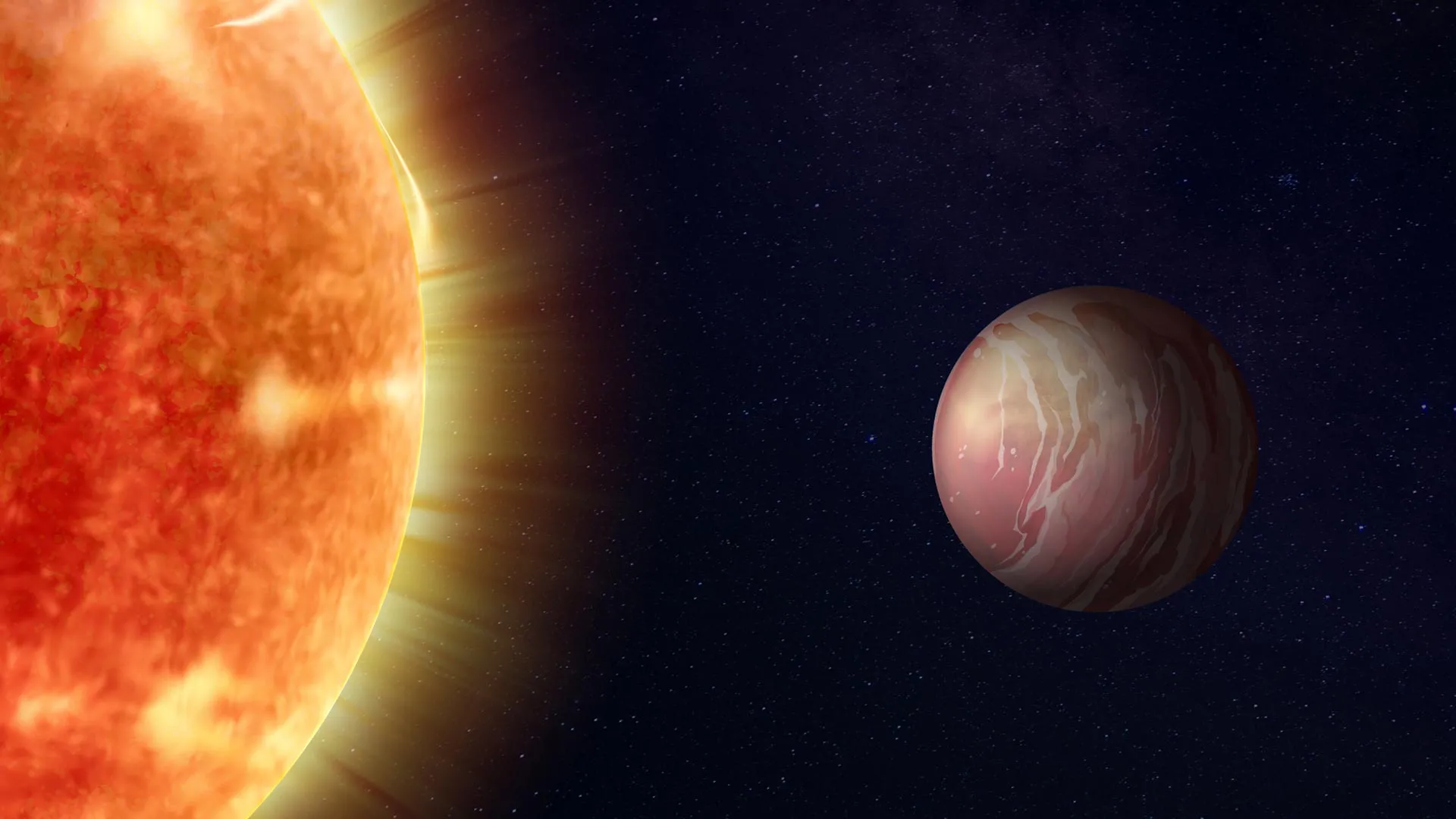
In a discovery that challenges fundamental tenets of planetary evolution, an international team of astrophysicists has identified an unexpected atmospheric phenomenon on TOI-561 b, a rocky exoplanet that orbits its host star in such close proximity that its surface is a roiling ocean of molten rock. Utilizing the unparalleled sensitivity of the James Webb Space Telescope (JWST), researchers have determined that this world—a place previously thought to be a barren, airless cinder—is shrouded in a reflective, high-altitude layer of silicate clouds. This planetary "sunscreen" appears to be the primary mechanism allowing the planet to retain an atmosphere despite the intense, stripping radiation of its nearby star, a finding that forces a significant reassessment of how rocky planets survive in extreme environments.
The Anatomy of an Extreme World
TOI-561 b is classified as a super-Earth, though it bears little resemblance to the hospitable conditions of our own planet. Situated approximately 280 light-years away, the planet completes a full orbit around its star in less than half a day. This proximity subjects the planet to a constant, brutal barrage of stellar radiation, which under standard astrophysical models should have evaporated any primordial atmosphere billions of years ago.
For years, the scientific community operated under the assumption that such heavily irradiated worlds were essentially "stripped" of their gases, leaving behind nothing more than a geologically active but atmosphere-free surface. However, the data returned by the JWST’s Mid-Infrared Instrument (MIRI) paints a different picture. By monitoring the planet over 37 hours—capturing nearly four full orbital cycles—researchers were able to map the thermal emissions and light reflectivity of the planet with unprecedented precision.
Chronology of the Discovery
The investigation into TOI-561 b is the culmination of a multi-year research effort led by an international consortium, including Professor Lisa Dang of the University of Waterloo and Dr. Anjali Piette of the University of Birmingham. The project was conceived to resolve a long-standing discrepancy: early ground-based observations suggested the planet was significantly cooler than its orbital distance should allow.
In early 2024, the team secured dedicated time on the JWST, recognizing that only the telescope’s infrared capabilities could pierce the veil of the planet’s extreme environment. The observation campaign took place over several days, utilizing a technique known as "phase curve" analysis. By observing the planet as it transitioned through its orbit, the team was able to measure the brightness and temperature fluctuations of both the permanently sun-drenched dayside and the perpetual shadow of the nightside.
The data was processed and analyzed throughout late 2024, culminating in the formal findings published recently in The Astronomical Journal. The discovery marks a critical milestone in exoplanetary science, as it provides the first concrete evidence of atmospheric persistence on a planet where such a feature was theoretically ruled out.
Data-Driven Insights: A Reflective Shield
The core of the mystery lay in the planet’s albedo—the measure of how much light it reflects. Observations showed that TOI-561 b reflects approximately 75% of the starlight that hits it. To put this in perspective, this level of reflectivity is comparable to Venus, which is blanketed in thick, highly reflective sulfuric acid clouds.
When researchers fed this data into climate simulation models, they realized that a bare, rocky surface could not achieve such a high albedo. The only logical explanation was the presence of an atmosphere capable of forming clouds. Specifically, the models indicate that these clouds are composed of silicate minerals, such as silicon dioxide (SiO2) and magnesium silicate (MgSiO3). At the extreme temperatures of TOI-561 b, these minerals transition into a vapor phase before condensing at higher, cooler altitudes to form a dense, reflective cover.
Furthermore, the phase curve measurements revealed that the heat distribution on the planet is remarkably uniform for such a short-period orbit. If the planet lacked an atmosphere, the dayside would be intensely hot while the nightside would be freezing. Instead, the heat is effectively redistributed, suggesting that a significant atmospheric mass is circulating energy around the globe, further confirming the presence of a stable gas envelope.
The Volcanic Engine: Replenishing the Atmosphere
One of the most profound implications of this study is the mechanism by which the atmosphere is sustained. Given the intensity of the stellar wind and radiation, any atmosphere should be lost over geological timescales. The team proposes that TOI-561 b is effectively a "self-replenishing" planet.
"We are looking at a planet that may be acting as a global, perpetual volcano," said Dr. Anjali Piette. "The molten surface likely releases massive quantities of gas—potentially carbon dioxide or sulfur dioxide—directly into the atmosphere. This constant outgassing could be compensating for the atmospheric loss caused by stellar irradiation."
This hypothesis mirrors the volcanic activity observed on Jupiter’s moon Io, which is frequently cited as the most volcanically active body in our solar system. If TOI-561 b is indeed a scaled-up version of Io, it would imply that the interior of the planet is churning with a level of tectonic and volcanic energy that is effectively fueling its own atmospheric longevity.
Official Perspectives and Scientific Impact
The findings have sent ripples through the astrophysical community. By challenging the "evaporation theory" of rocky exoplanets, the team has expanded the search parameters for potentially habitable—or at least interesting—worlds.
Professor Lisa Dang noted the importance of the phase curve technique in this discovery, stating, "By measuring how the planet’s brightness and heat changed throughout its orbit, we were able to peel back the layers of the mystery. The evidence for an atmosphere is overwhelming, and it points to a complex, dynamic environment that we are only just beginning to understand."
The implications extend to how scientists classify exoplanets in the future. If worlds as hostile as TOI-561 b can maintain an atmosphere, it suggests that smaller, cooler, and more temperate rocky planets might be even more resilient to stellar activity than previously modeled. This provides a optimistic outlook for the study of Earth-sized planets orbiting red dwarf stars, which are often subjected to similar, if not more aggressive, stellar conditions.
Future Research: Probing the Chemistry
Despite the breakthrough, the precise chemical composition of the atmosphere remains an open question. Is it a CO2-dominated system like Venus, or is it rich in sulfur compounds similar to Io?
The research team is already planning follow-up observations. By utilizing the JWST at longer wavelengths, they hope to conduct transmission spectroscopy—a process of analyzing starlight as it filters through the planet’s atmosphere during a transit. This will allow them to identify the specific "chemical fingerprints" of the gases present.
The successful detection of this atmosphere represents a triumph for modern observational astronomy. It highlights the capability of the JWST to transform our understanding of the galaxy from a collection of static, predictable objects into a diverse array of active, evolving worlds. As the scientific community looks toward the next phase of observations, the story of TOI-561 b stands as a testament to the fact that in the realm of planetary science, the most extreme environments often hold the keys to the most fundamental truths about how worlds are born, how they change, and how they survive against the backdrop of the cosmos.
The study of TOI-561 b is far from complete, but with the presence of a silicate-based "sunscreen" now confirmed, astronomers have a new lens through which to view the volatile nature of rocky worlds. The coming years of data acquisition promise to clarify whether this planet is an anomaly of extreme geology or a representative of a widespread class of "lava worlds" that have defied the odds to hold onto their gaseous shells.