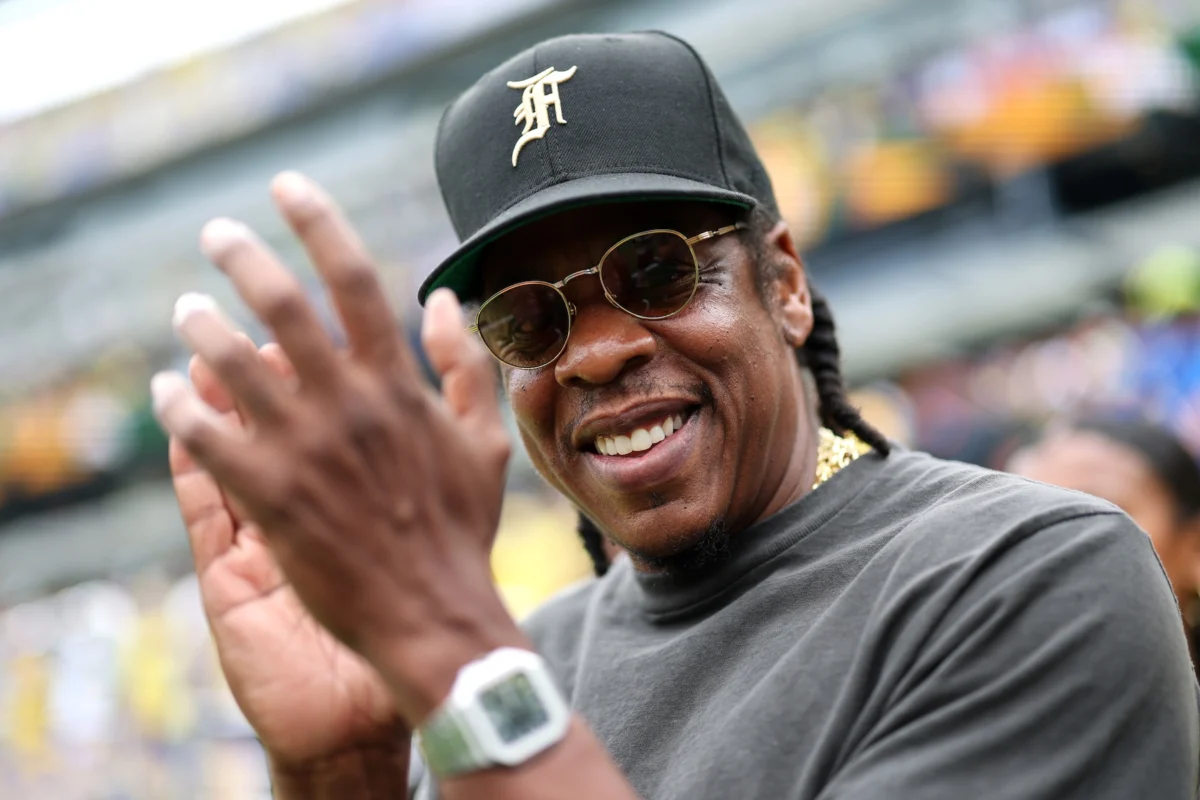
The long-standing speculation surrounding the future of the NFL’s premier entertainment showcase has finally reached its conclusion. Jay-Z has officially been confirmed as the headliner for the Super Bowl LXI Apple Music Halftime Show, scheduled to take place on Sunday, February 14, 2027, at SoFi Stadium in Los Angeles, California. This announcement marks a monumental milestone not only for the legendary rapper and entrepreneur, whose legal name is Shawn Carter, but also for hip-hop’s enduring integration into the mainstream American cultural landscape.
The decision to place Carter at the helm of the world’s most-watched musical broadcast has immediately sparked significant industry dialogue. Given that Roc Nation—the entertainment agency founded by Jay-Z—has served as the live music entertainment strategist for the NFL since 2019, the appointment carries an inherent layer of insider dynamics. Critics have occasionally scrutinized this professional synergy, questioning the optics of the company’s executive producer selecting its principal to take the stage. However, music historians, industry analysts, and cultural pundits overwhelmingly argue that Carter’s three-decade career portfolio places him in an elite echelon of American artists who are indisputably qualified for the assignment.
The Case for the Catalog: Metrics and Legacy
To evaluate Jay-Z’s suitability for the Super Bowl stage is to examine one of the most prolific discographies in modern recorded music. Over a career spanning more than thirty years, Carter has amassed an unprecedented 14 albums that have debuted at Number 1 on the Billboard 200 chart—a record for any solo artist in history. Furthermore, he has secured four chart-topping singles on the Billboard Hot 100 as a lead artist, alongside an extensive catalog of collaborative smashes, underground essentials, and cultural anthems that have defined successive generations of urban music.
When placed against the historical metrics of previous Super Bowl halftime show headliners since 2010—such as Coldplay, Maroon 5, Shakira, Justin Timberlake, and The Who—Carter’s commercial performance metrics, cultural ubiquity, and critical acclaim meet or exceed the benchmarks established by prior bookings. Moreover, the historical expectation that hip-hop acts must alter their artistic identity to appease conservative or mainstream broadcast standards has progressively dissolved. As hip-hop continues to dictate global pop culture, fashion, and language, Carter’s upcoming performance represents a validation of the genre’s structural dominance in American entertainment.
Historical Chronology and Background Context
The road to Super Bowl LXI has been paved by a series of strategic partnerships between the NFL and Roc Nation. When the league first brought on Carter’s agency to curate the entertainment for the league, the objective was twofold: revitalize the halftime show with culturally resonant acts and repair relationships within the creative community that had been strained by previous controversies.
Since that partnership commenced, the halftime show has witnessed a succession of critically acclaimed and culturally definitive performances. In 2022, the league presented a historic hip-hop showcase in Los Angeles featuring Dr. Dre, Snoop Dogg, Eminem, Mary J. Blige, and Kendrick Lamar, which subsequently won an Emmy Award for Outstanding Variety Special. This was followed by Rihanna’s gravity-defying performance in 2023, Usher’s roller-skating spectacle in 2024, and Kendrick Lamar’s upcoming headlining engagement for Super Bowl LIX. By the time Jay-Z takes the stage in February 2027, he will step into the spotlight not merely as a guest or a curator behind the scenes, but as the central protagonist of an era of hip-hop dominance within the NFL’s entertainment strategy.
Anticipated Setlist, Special Guests, and Production Logistics
While official setlist details remain strictly under wraps, music industry insiders and production analysts have begun mapping out potential configurations for the performance. Given the standard 13-to-15-minute runtime of a Super Bowl halftime set, Carter will be tasked with condensing a 30-year career into a high-octane medley. Based on historical precedents, thematic resonance, and his vast network of high-profile collaborators, a comprehensive forecast of the performance outlines several key sequences.
Act I: The Foundations and Early Classics
The performance is widely expected to nod to the ongoing celebration of Reasonable Doubt, Carter’s critically revered 1996 debut album, which recently marked its milestone anniversary. Industry projections suggest an opening sequence featuring Mary J. Blige joining Carter for a powerful rendition of "Can’t Knock The Hustle," establishing an immediate tone of New York grit blended with soulful vocal arrangements.
This could transition seamlessly into "Hard Knock Life (Ghetto Anthem)," the track that sampled the 1982 Broadway musical Annie and yielded Carter’s first major solo commercial breakthrough and Grammy recognition. The nostalgic vocal loop paired with motivational lyricism offers the kind of anthemic scale required for a stadium environment.
Act II: The Blueprint Era and Hometown Anthems
No Jay-Z stadium performance is complete without acknowledging his definitive chart successes from the turn of the millennium. "Izzo (H.O.V.A.)," built upon the instantly recognizable Jackson 5 "I Want You Back" sample, provides a natural segue for a high-energy dance sequence. Given Carter’s history of bringing out legendary figures—such as his iconic 2000s-era moment with Michael Jackson—speculation has turned toward potential theatrical cameos, including Michael’s nephew, Michael star Jaafar Jackson.
The momentum would undoubtedly peak with "Empire State of Mind." Joined by Alicia Keys at the piano, the 2009 anthem is practically engineered for massive arenas. Even in SoFi Stadium, situated squarely in the heart of Southern California, the unifying power of the New York City tribute song transcends geographic rivalries, serving as a defining communal moment for the broadcast audience.
Act III: Genre-Blending and Collaborative Surprises
The Super Bowl halftime show historically favors genre-crossing collaborations that appeal to varied demographics. One of the more compelling wild-card possibilities involves Linkin Park, with whom Carter released the groundbreaking 2004 mashup EP Collision Course. A live rendition of "Numb/Encore" would effectively bridge the worlds of rock and hip-hop while providing a direct nod to California music history.
Additionally, Carter’s extensive roster of global collaborators opens the door for high-profile guest appearances. Rihanna, who headlined the halftime show in 2023, could potentially return to the stage to handle her vocal contributions on "Run This Town" and transition directly into their global chart-topper "Umbrella," maximizing staging efficiency and star power.
Similarly, appearances by Eminem for "Renegade" or Lenny Kravitz for "Guns & Roses" would inject alternative sonic textures into the mix, satisfying rock and rap purists alike. A nod to the West Coast could manifest through an appearance by Kendrick Lamar for a collaborative moment on "Don’t Kill My Vibe," framing a symbolic passing of the torch within modern hip-hop royalty.
Act IV: The Grand Finale
As the performance approaches its climax, expectations point toward a family affair. The arrival of Beyoncé to perform their Tupac-inspired collaboration "’03 Bonnie & Clyde" followed by the explosive energy of "Crazy In Love" would inevitably generate the highest peak of audience engagement for the evening.
Finally, industry analysts predict that Carter will close out the production with "P.S.A." (Public Service Announcement) from The Black Album, serving as a definitive closing statement on his career, his cultural authority, and his unassailable status within the American musical canon.
Broader Impact and Industry Implications
The announcement of Jay-Z as the Super Bowl LXI headliner carries financial, cultural, and symbolic implications for the music industry at large. From a commercial standpoint, past performers routinely experience immediate surges in streaming volume, catalog consumption, and physical media sales following the broadcast. For an independent mogul and catalogue owner like Carter, the platform translates into massive economic value for his holdings, including Roc Nation and his extensive publishing portfolio.
More broadly, the booking solidifies the structural shift in how corporate America and major sports leagues view Black artistic leadership. By integrating the primary architect of modern hip-hop culture directly into the center of America’s most-watched television broadcast, the NFL continues its pivot toward contemporary cultural alignment.
As preparations begin for the February 14, 2027 showcase in Inglewood, California, the entertainment industry watches with heightened anticipation. Whether the performance meets the dizzying expectations of purists or challenges the conventions of televised musical spectacles, Jay-Z’s Super Bowl LXI Halftime Show is poised to be analyzed, debated, and celebrated as a watershed moment in contemporary pop culture history.