The landscape of cloud computing security is undergoing a profound transformation, driven by the rapid decentralization of enterprise networks and the widespread adoption of artificial intelligence. According to the Cloud Security Alliance (CSA) in its newly published Top Threats to Cloud Computing Survey Report 2026, identity and access management (IAM) has surged to become the foremost security concern for organizations globally. Meanwhile, artificial intelligence-related vulnerabilities have broken into the rankings for the first time, signaling a pivotal shift in how security professionals must evaluate risk.
The findings are the result of an exhaustive survey conducted by the CSA Top Threats Working Group, which polled 507 cybersecurity professionals, enterprise architects, and risk management executives. Participants were asked to evaluate and rank 23 distinct cloud security issues. The resulting Top 11 list reflects a modern threat paradigm dominated by identity vulnerabilities, artificial intelligence integration risks, compromised third-party resources, and insecure application programming interfaces (APIs).
As enterprises increasingly migrate core operations, customer data, and proprietary algorithms to multi-cloud and hybrid environments, the traditional perimeter-based security model has become obsolete. The 2026 report emphasizes that concerns tied directly to underlying hardware, basic cloud service provider (CSP) infrastructure, and low-level data loss have been eclipsed by vulnerabilities stemming from how humans and machines interact with cloud services.

Shifting Priorities: A Comparative Analysis of the 2024 and 2026 Rankings
To fully understand the current trajectory of cloud risk, cybersecurity analysts often look at the evolution of threats across survey cycles. A comparative review of the CSA’s 2024 findings versus the newly released 2026 metrics highlights how quickly enterprise priorities are forced to pivot in response to technological innovation and adversarial tactics.
In the 2024 survey, identity and access management held the number two position, trailing behind misconfiguration and inadequate change control. By 2026, however, identity management climbed to the number one spot. This ascent underscores the reality that credentials—rather than raw infrastructure exploits—have become the primary attack vector for sophisticated cybercriminal syndicates and nation-state actors. With cloud environments accessible from anywhere in the world, stolen session tokens, compromised passwords, and mismanaged privileged accounts grant attackers the keys to the kingdom without requiring them to breach underlying network perimeters.
Conversely, 2024’s top-ranked concern—misconfiguration and inadequate change control—has receded to the number five position. While misconfigurations remain a pervasive issue, automated deployment tools, Infrastructure as Code (IaC) scanning, and enhanced cloud security posture management (CSPM) platforms have helped organizations catch and remediate basic setup errors more efficiently.
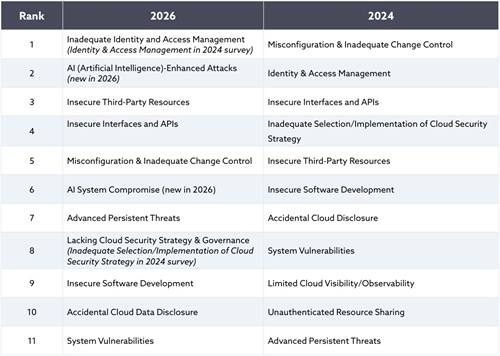
At the same time, the third-party risk landscape has deteriorated. Insecure third-party resources climbed from number five in 2024 to number three in 2026. As organizations rely more heavily on software-as-a-service (SaaS) vendors, open-source libraries, and external managed service providers, the interconnectedness of the digital supply chain introduces countless unseen entry points for malicious actors. Furthermore, Advanced Persistent Threats (APTs) experienced a notable jump, moving from number eleven up to the number seven position, reflecting the persistent, targeted nature of modern espionage and ransomware campaigns directed at cloud infrastructure.
The Emergence of Artificial Intelligence as a Primary Threat Vector
Perhaps the most significant development in the 2026 report is the debut of artificial intelligence-related security issues within the top rankings. While AI has offered unprecedented productivity gains and data-processing capabilities for businesses, it has simultaneously introduced an entirely new attack surface that organizations are struggling to govern.
The integration of Large Language Models (LLMs), machine learning pipelines, and automated generative tools into enterprise workflows has created complex security challenges. These include risks associated with prompt injection, model poisoning, unauthorized data exfiltration via AI agents, and the unintentional exposure of sensitive corporate intellectual property fed into public or poorly secured private models.

Security experts note that the inclusion of AI threats in the CSA’s top rankings marks a maturation of the technology’s risk profile. In previous years, AI security was largely viewed as an abstract, theoretical concern confined to academic laboratories. Today, as enterprises rush to deploy production-grade AI applications atop their cloud environments, securing these models has become an urgent operational imperative. The CSA report notes that AI risks are intricately linked to identity and data governance, as autonomous agents often require extensive access permissions to corporate data repositories to function effectively.
Methodology and Target Audience for the 2026 Report
The data underpinning the 2026 report was gathered through a rigorous surveying methodology designed to capture expert consensus from across the global technology sector. The CSA Top Threats Working Group collected responses from 507 vetted security professionals, representing a diverse cross-section of industries, company sizes, and geographic regions.
Respondents evaluated 23 potential cloud security issues on a standardized scoring matrix. The resulting scores for the Top 11 threats were remarkably tightly grouped, ranging from a high of 7.95 for identity and access management down to 7.45 for the eleventh-ranked issue. This narrow spread indicates that security professionals do not view these challenges in isolation; rather, they recognize a dense web of interconnected risks where a failure in one area—such as identity management—directly exacerbates vulnerabilities in others, such as API security or third-party access.

The report is specifically designed to be actionable. Rather than serving as a purely theoretical overview, the documentation targets a broad audience that includes compliance officers, risk managers, chief information security officers (CISOs), enterprise architects, and executive leadership teams. Each individual threat analysis within the comprehensive report is paired with technical and business impact assessments, real-world case studies, key takeaways, and specific CSA security controls designed to mitigate the identified risks.
Broader Industry Implications and the Evolution of the Threat Landscape
The findings from the Cloud Security Alliance’s 2026 survey paint a clear picture of an industry in transition. For the past decade, much of the discourse surrounding cloud security focused on the "shared responsibility model"—the division of security duties between the cloud service provider and the customer. In this early era, organizations worried heavily about whether AWS, Microsoft Azure, or Google Cloud Platform was secure at the hypervisor and physical data center level.
The 2026 report confirms that this foundational anxiety has largely stabilized. Modern cloud infrastructure provided by major hyperscalers is exceptionally robust, shifting the burden of vulnerability almost entirely to the customer’s configuration, architecture, and operational practices. Consequently, systemic issues that once dominated headlines—such as denial-of-service attacks, shared technology vulnerabilities, CSP data loss, unauthenticated resource sharing, and limited cloud visibility or observability—have fallen out of the Top 11 entirely.

Instead, the challenges defining the modern era are behavioral, procedural, and architectural. Identity is now the security perimeter. When an employee’s credentials or an API key can be compromised via phishing, social engineering, or credential stuffing, the underlying cryptographic strength of the cloud environment becomes irrelevant. Attackers simply log in through the front door with legitimate privileges.
Furthermore, the blurring of traditional software boundaries through complex API integrations and interconnected cloud ecosystems means that a single compromised vendor can cascade failures across thousands of downstream clients. This reality explains the prominence of supply chain concerns in the new rankings.
Strategic Recommendations for Enterprise Security Leaders
As organizations digest the findings of the CSA Top Threats to Cloud Computing Survey Report 2026, security leaders are urged to reevaluate their governance, risk, and compliance (GRC) frameworks. Relying on legacy security postures built for on-premises data centers is no longer sufficient to protect dynamic, cloud-native environments.

First and foremost, organizations must accelerate the implementation of zero-trust architecture (ZTA), treating every access request as untrusted regardless of whether it originates from inside or outside the traditional corporate network. Implementing robust multi-factor authentication (MFA), continuous identity verification, granular least-privilege access policies, and automated identity threat detection systems will be critical in addressing the number one threat identified by the CSA.
Second, enterprises deploying artificial intelligence must establish rigorous governance frameworks before connecting models to production data stores. This includes conducting regular security audits of AI pipelines, securing training data against poisoning attacks, and establishing strict data loss prevention (DLP) guardrails to prevent sensitive intellectual property from being processed by unauthorized external algorithms.
Finally, third-party risk management must evolve from a periodic, compliance-driven paperwork exercise into a continuous, real-time monitoring discipline. As supply chain threats continue to climb the rankings, organizations must maintain total visibility into their software bills of materials (SBOMs) and demand rigorous security attestations from all external vendors and API providers.
By aligning their security program planning, risk prioritization, and capital investments with the empirical insights provided by the Cloud Security Alliance, enterprise leaders can better navigate the complex, rapidly shifting risk topography of the modern cloud and artificial intelligence era.