In a landmark report released by the global energy think tank Ember, researchers have demonstrated that the transition to decentralized renewable energy is no longer merely a matter of environmental stewardship but a critical necessity for national security and disaster resilience. The analysis, titled "Shaping a Resilient Power System in ASEAN," highlights a fundamental shift in how Southeast Asian nations must view their energy infrastructure. As one of the most disaster-prone regions on Earth, the Association of Southeast Asian Nations (ASEAN) faces an existential threat from climate-induced shocks that the current centralized, fossil-fuel-heavy grid is ill-equipped to handle.
The report reveals that distributed renewable energy networks—comprising solar, wind, and battery storage—offer a level of robustness that traditional coal and gas plants cannot match. By decentralizing generation and strengthening grid interconnections, nations can isolate damage during natural disasters, ensuring that a failure in one node does not trigger a systemic collapse. Furthermore, the recovery time for distributed systems is significantly shorter than the months or years often required to repair massive thermal power stations.
The Current State of ASEAN Energy Infrastructure
Currently, the ASEAN energy landscape is heavily tilted toward traditional, centralized models. Approximately 64% of the region’s installed power capacity is derived from fossil fuels. This reliance creates a precarious situation. Centralized systems typically feature large, high-capacity power plants located far from urban centers, connected by long-distance transmission lines. While efficient under normal operating conditions, this architecture creates "single points of failure." If a major coal plant is knocked offline by a flood or an earthquake, or if a primary transmission line is severed by a typhoon, entire provinces can be plunged into darkness for extended periods.
Southeast Asia’s geographical reality exacerbates these risks. The region sits atop the "Pacific Ring of Fire," making it susceptible to volcanic eruptions and earthquakes. Simultaneously, it is situated in a major tropical cyclone path, facing increasingly frequent and intense typhoons. Ember’s findings suggest that while climate change will gradually erode the efficiency of all energy assets, fossil fuel and nuclear plants are far more vulnerable to both chronic and acute stressors than wind and solar installations.

Chronic Stress vs. Acute Disaster Shocks
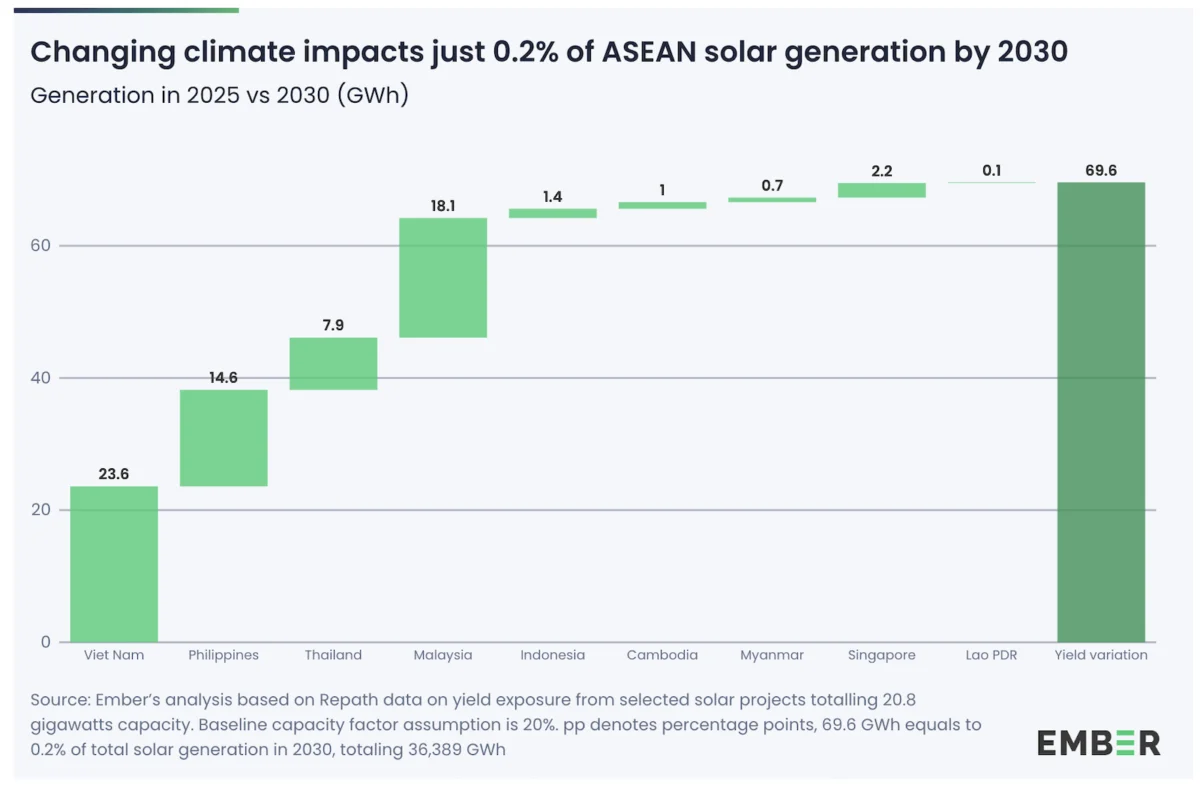
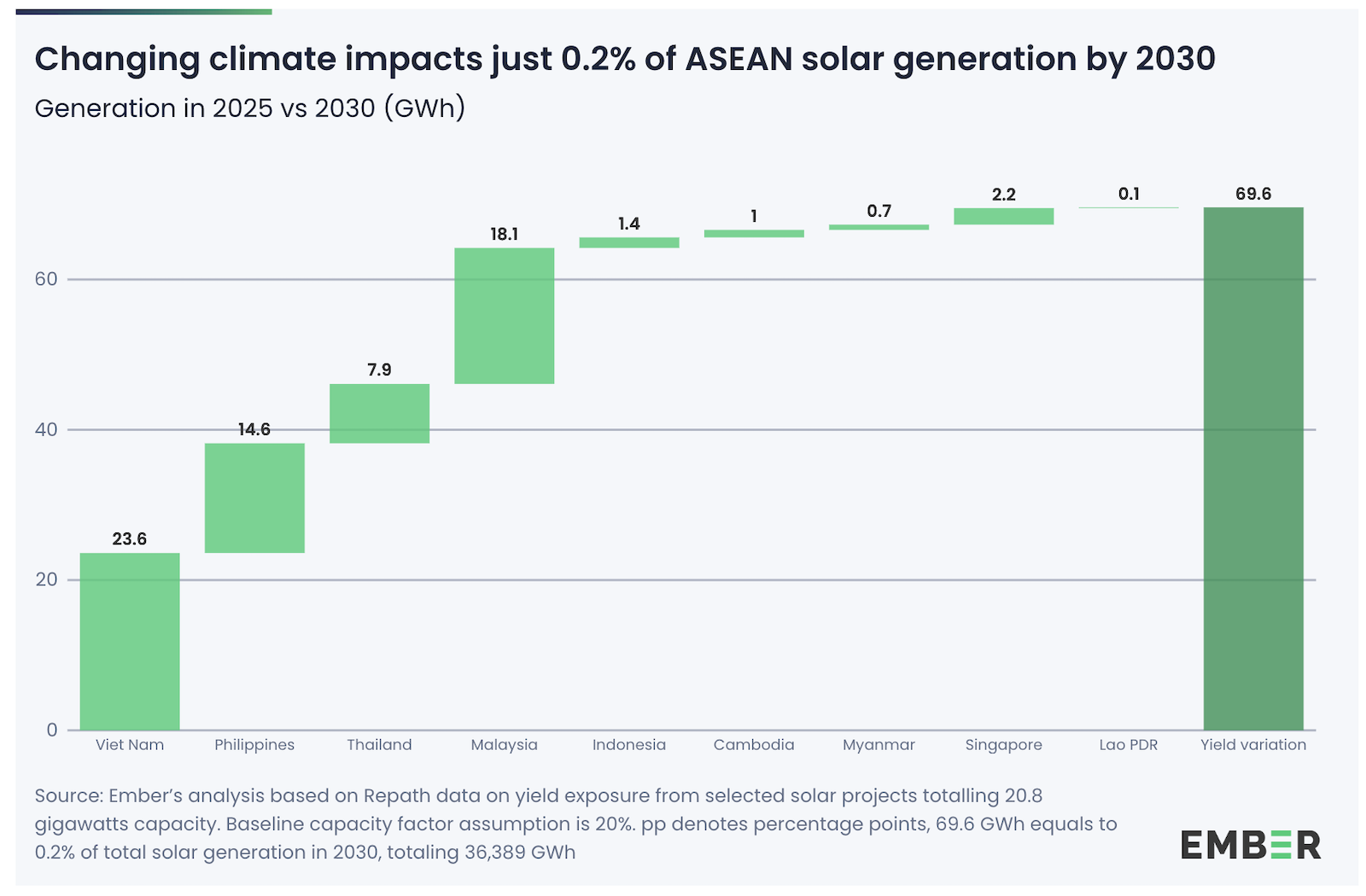
The Ember report distinguishes between two primary categories of climate-related threats: chronic stress and acute shocks. Chronic stress refers to the gradual increase in global temperatures and changing weather patterns. For thermal power plants (coal, gas, and nuclear), higher ambient temperatures and warming water sources reduce cooling efficiency, leading to significant output losses. In contrast, Ember’s modeling indicates that even under extreme warming scenarios projected for 2030, the variability of wind and solar generation will remain remarkably stable, fluctuating by less than 1% from normal output levels.
Acute shocks involve sudden, violent events such as super typhoons, landslides, and floods. In these scenarios, the modular nature of renewable energy becomes its greatest asset. A solar farm consists of thousands of individual panels; even if a portion of the farm is damaged, the remaining panels can often continue to generate power. Conversely, a coal-fired boiler or a steam turbine is a singular, complex machine. If a critical component is damaged or submerged, the entire multi-megawatt facility becomes inoperable.
Case Study: The 2018 Sulawesi Earthquake and the Coal Failure
A pivotal example cited in the research is the 2018 earthquake in Central Sulawesi, Indonesia. A 7.4-magnitude tremor and subsequent tsunami devastated the region, specifically disabling the Panau coal power plant. The damage was so extensive that it necessitated the rehabilitation of nearly 1,200 distribution units across the province. Despite this clear demonstration of coal’s vulnerability, current provincial energy plans for Central Sulawesi still aim to add 2.25 gigawatts (GW) of coal capacity by 2030.
Ember’s analysis proposes a more resilient alternative. The report suggests that by deploying 600 megawatts (MW) of solar power paired with 720 megawatt-hours (MWh) of battery storage, Indonesia could offset 250 MW of planned coal capacity. This distributed approach would not only provide 1.4 terawatt-hours (TWh) of clean generation but would also create a "patchwork" of power sources that are easier to defend against seismic activity and much faster to bring back online following a disaster.
The Philippines: Overcoming Diesel Dependence in Catanduanes
The Philippines serves as another critical laboratory for energy resilience. The province of Catanduanes has historically relied on an isolated grid powered primarily by expensive and dirty diesel generators. Because the island is frequently in the direct path of typhoons, these diesel-dependent systems often fail when fuel supply chains are disrupted or when the centralized generators are damaged.
To combat this, the Philippine government is moving toward greater interconnection. A planned 58 megavolt-ampere (MVA) interconnection with the main Luzon grid is expected to meet 22% of the island’s demand by 2030. When combined with local solar and wind resources, this interconnection allows for "bidirectional resilience." If the local grid is damaged, power can be imported; if the main grid faces issues, local renewables can provide emergency "islanded" power for essential services like hospitals and communication hubs.
Vietnam and the Challenge of Grid Flexibility
Vietnam has seen a massive surge in solar installations over the last five years, yet this growth has outpaced the development of the country’s grid infrastructure. In 2020, limited flexibility and a lack of storage capacity led to the curtailment of approximately 405 gigawatt-hours (GWh) of solar energy. This "wasted" electricity represented an economic loss of roughly US$26 million.
The Ember report emphasizes that for renewables to provide true resilience, they must be supported by smart grids and battery energy storage systems (BESS). By investing in transmission upgrades and storage, Vietnam can capture its full solar potential and ensure that its grid remains stable even when weather patterns shift or when physical infrastructure is tested by the region’s intense monsoon seasons.
Data Analysis: The Reliability of Renewables in 2030
The report’s data-driven projections for the year 2030 provide a compelling argument for a "renewables-first" policy. Researchers modeled various climate scenarios, including El Niño events and extreme heatwaves. The findings showed that:
- Thermal Losses: Coal and gas plants could see capacity de-ratings of 5% to 10% during extreme heatwaves due to cooling constraints.
- Hydro Variability: Hydropower, a major source for countries like Laos and Vietnam, is highly susceptible to droughts, with generation potentially dropping by 20% or more during dry years.
- Solar/Wind Stability: Due to the geographical spread of distributed assets, the aggregate output of wind and solar across the ASEAN region remains incredibly consistent. The "geographic smoothing" effect ensures that even if one province is cloudy or still, another is sunny or windy, maintaining a steady flow to the regional grid.
Official Responses and Regional Cooperation
The findings have garnered significant attention from Southeast Asian policymakers. Dr. Dinita Setyawati, Senior Energy Analyst for Asia at Ember, underscored that power system resilience is the "linchpin" of the green economy. She argued that strengthening grids should not be viewed as a technical afterthought but as the core of all future policymaking.

Felix William B. Fuentebella, Undersecretary and Philippine Senior Official on Energy, echoed these sentiments. As the Philippines prepares to chair the ASEAN Ministers on Energy Meeting (AMEM) in 2026, Fuentebella called for "deeper regional cooperation." He noted that the transition to renewables is a dual-purpose strategy: it achieves decarbonization targets while simultaneously serving as a safeguard against the intensifying climate risks that threaten the region’s economic stability.
Brian Eyler, the Southeast Asia Program Director at the Stimson Center, noted that the report provides a "timely roadmap" for governments. He highlighted that as El Niño cycles become more unpredictable, the ability to reduce exposure to hydropower variability and fossil fuel supply chain disruptions will become a defining factor in national energy security.
Strategic Recommendations for ASEAN Governments
The Ember report concludes with several actionable recommendations for ASEAN member states to bolster their power systems:
- Integrate Energy and Disaster Planning: Energy ministries should work closely with disaster management agencies. The ASEAN Agreement on Disaster Management and Emergency Response (AADMER) should explicitly include protocols for deploying mobile renewable energy units and microgrids during emergencies.
- Accelerate the ASEAN Power Grid (APG): Regional interconnection is vital. By linking the national grids of member states, ASEAN can share renewable surpluses and provide mutual support during localized disasters.
- Invest in Storage and Flexibility: Incentives for battery storage and "smart" demand-response technologies are needed to prevent the curtailment seen in Vietnam and to ensure 24/7 reliability from intermittent sources.
- Prioritize Decentralization: Rather than building massive new coal plants in remote areas, governments should prioritize "edge-of-grid" solar and wind projects that serve local communities directly, reducing the reliance on vulnerable long-distance transmission lines.
The Broader Impact: A Paradigm Shift in Energy Security
The implications of this shift extend far beyond engineering. Moving from a centralized fossil fuel model to a distributed renewable model fundamentally changes the geopolitics of energy in Southeast Asia. It reduces the need for imported coal and gas, shielding developing economies from the price volatility of global commodity markets.
Moreover, it democratizes energy access. In archipelago nations like Indonesia and the Philippines, distributed renewables allow remote islands to achieve energy independence without waiting for expensive undersea cables to connect them to the mainland. In the face of a changing climate, this independence is not just a luxury—it is the foundation of a resilient future. By embracing the modular, flexible, and robust nature of clean energy, ASEAN can build a power system that does not just survive the storms of the 21st century but thrives in spite of them.