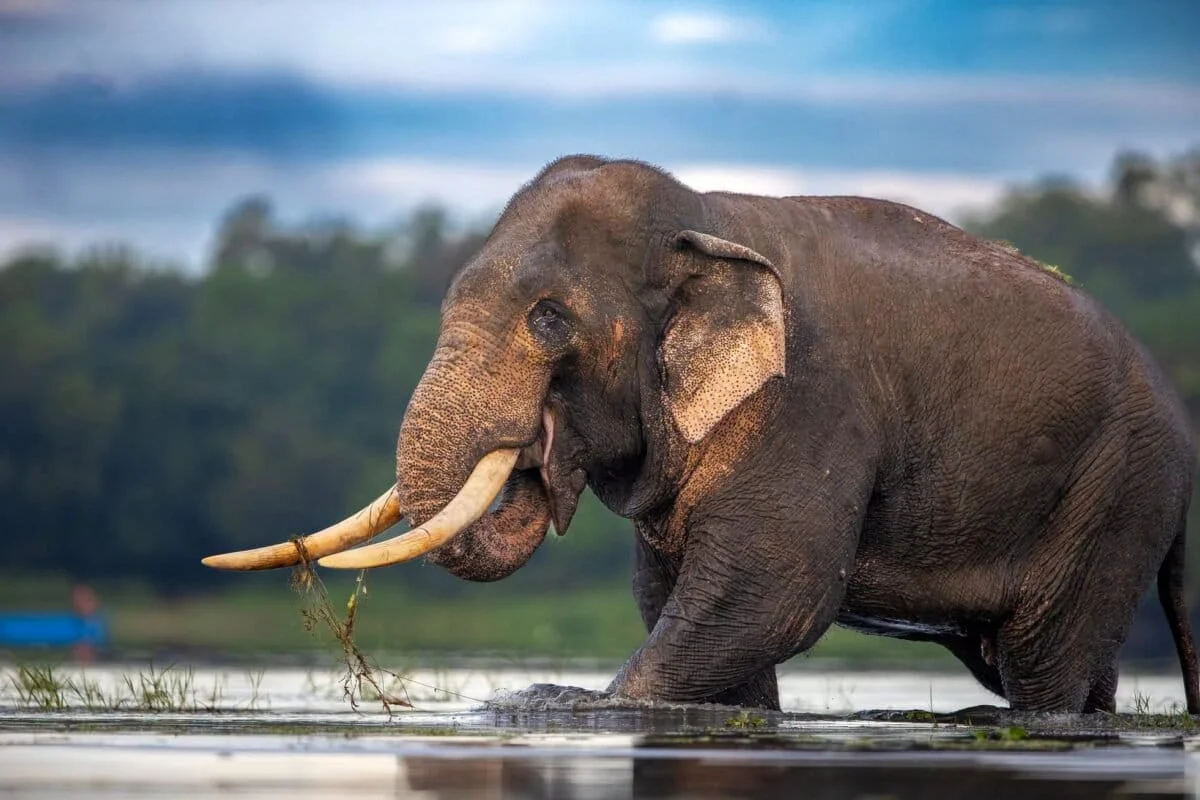
The tragic demise of Kavantissa, one of Sri Lanka’s most recognizable and beloved wild tuskers, has sparked an unprecedented wave of public grief, intense political introspection, and fierce criticism directed at wildlife management authorities. The majestic bull elephant, belonging to the Asian elephant subspecies Elephas maximus maximus, succumbed to a cardiac arrest on the evening of October 16, following weeks of agonizing decline triggered by a severe gunshot injury. Named after an ancient Sinhala king who ruled southern Sri Lanka in the second century BCE, Kavantissa was more than just a magnificent individual; he was a living symbol of the island nation’s rich natural heritage, a gentle giant whose frequent, peaceful sightings near Galgamuwa in northwestern Sri Lanka captivated wildlife photographers, tourists, and locals alike.

His final days united a polarized society in shared sorrow and desperation. The national crisis drew high-profile figures to his side, bridging political divides as opposition leader Sajith Premadasa was captured in viral photographs kissing the fallen elephant’s head, and Environment Minister Dhammika Patabendi braved heavy rains to visit the ailing creature. Spiritual solace was sought through traditional Buddhist monks chanting Pirith—sacred verses meant to invoke blessings—while prominent business leader Dudley Sirisena stepped forward to finance advanced medical interventions, including efforts to fly in a specialized foreign veterinary team. Former President Mahinda Rajapaksa joined a long list of public figures offering emotional tributes. Despite these extraordinary, last-ditch rescue attempts, Kavantissa’s battered body finally gave out, plunging the nation into mourning and igniting a fierce debate over wildlife conservation policies, veterinary efficacy, and the escalating human-elephant conflict (HEC).
A Chronology of Decline: The Final Weeks of Kavantissa
The sequence of events leading to Kavantissa’s death began in late September, a period during which the tusker was experiencing musth, a natural physiological condition in male elephants characterized by highly elevated reproductive hormones and aggressive behavior. On September 22, the iconic animal was first observed limping heavily, prompting immediate concern from local residents and conservationists. Two days later, on September 24, the Department of Wildlife Conservation (DWC) intervened, administering targeted antibiotics via darting, followed by chemical sedation the next day to assess the extent of the damage.

Initial updates from the DWC suggested the tusker was responding favorably to the medical regimen. However, subsequent monitoring proved sporadic. Kavantissa was not sighted again until October 2, raising concerns among local trackers regarding his recovery trajectory. The situation deteriorated sharply on October 5, when severe diarrhea was observed, signaling potential gastrointestinal distress or adverse reactions to heavy medication. Treatment was resumed on October 6, but the proud animal retreated into deep seclusion, frequently seen standing submerged in water and refusing food. His condition worsened rapidly over the ensuing days until he collapsed in a muddy paddy field on October 15. Despite senior wildlife veterinarians rushing to the scene—with one reportedly climbing onto his chest to administer desperate attempts at cardiopulmonary resuscitation (CPR)—Kavantissa was pronounced dead at approximately 6:18 p.m. on October 16.
Veterinary Care Under Intense Scrutiny
The tragic loss of such a high-profile animal immediately thrust the DWC into the crosshairs of public anger and media scrutiny. Social media platforms became arenas for fierce debates, with wildlife enthusiasts and amateur observers questioning whether Kavantissa had received appropriate, competent medical care. Allegations of gross negligence quickly surfaced online, with some commentators speculating wildly about a potential antibiotic overdose or improper darting procedures. Viral videos showing wildlife officers repeatedly deploying darts fueled public skepticism, even as wildlife professionals urged caution and patience pending empirical evidence.

The resulting public outcry left authorities visibly defensive. Ranjan Marasinghe, Director General of the DWC, staunchly defended the actions of the state veterinary team, asserting that every possible measure was taken to save the tusker. "When an iconic tusker like Kavantissa is injured, our team of veterinarians act together as a team," Marasinghe stated, emphasizing that operations of this magnitude involve broad consultation with senior veterinary experts across the country.
Echoing this sentiment, Dr. Tharaka Prasad, the former director of wildlife health at the DWC, cautioned against forming hasty conclusions based on social media narratives. He stressed the necessity of a rigorous, evidence-based scientific assessment. "The reported history of feeding difficulties, prolonged absence of faeces, and subsequent severe diarrhoea raises important clinical questions that must be assessed alongside the elephant’s medical records, treatment history, and any post-mortem findings," Prasad noted. A court-ordered post-mortem examination was subsequently scheduled to establish the definitive medical cause of death, aiming to separate emotional speculation from clinical reality.

Broader Implications: The Crisis of Human-Elephant Conflict
While Kavantissa’s death generated enormous media traction, prominent conservation scientists have urged the public to look beyond the tragedy of a single iconic animal and confront the systemic crisis plaguing Sri Lanka’s wildlife. Dr. Prithiviraj Fernando, a leading elephant scientist and head of the Center for Conservation and Research (CCRSL), pointed out that from an ecological standpoint, the death of a tusker caused by a trap gun or gunshot is fundamentally no different from the demise of any other wild elephant.
"From the perspective of its cause of death, there is no difference, as Kavantissa apparently died from a trap gun injury," Fernando explained. He argued that the intense emotional reaction triggered by Kavantissa’s fame should serve as a catalyst to spotlight the wider, unyielding human-elephant conflict that claims hundreds of lives annually.

Sri Lanka faces a catastrophic annual toll on its wild elephant population. According to official DWC statistics, the nation lost 488 wild elephants in 2023, approximately 388 in 2024, and 455 in 2025. Among these fatalities, gunshot injuries and illegal trap guns—frequently deployed by agrarian communities to protect crops from foraging wildlife—accounted for 98 deaths in 2023, 84 in 2024, and 79 in 2025. Although recorded shooting deaths have shown a marginal decline, firearms remain a devastating menace. Even elephants that survive initial gunshot wounds frequently endure prolonged suffering, systemic infections, and agonizing physical degradation.
The socio-economic drivers of this conflict are complex. Government policies that permit the distribution of firearms to farmers for crop protection are designed to safeguard rural livelihoods against devastating agricultural losses. However, conservationists warn that expanding civilian access to firearms inevitably exacerbates the violence, escalating the human-elephant conflict and resulting in heightened casualties among wildlife.

Furthermore, experts dismiss the notion that iconic tuskers can be safeguarded through intensive, round-the-clock individual surveillance. Because elephants possess expansive home ranges that span hundreds of square kilometers of fragmented forests and agricultural mosaics, maintaining constant physical protection for a single animal is logistically impossible. Field guards cannot permanently shield a roaming bull from concealed, primitive hazards like illegal trap guns. "Ultimately, the only effective way to protect iconic tuskers, or any other elephant, is to protect elephants in general and address the wider threats they face," Fernando emphasized.
The Debate Over Ivory and Commemoration
In the wake of Kavantissa’s death, protests erupted outside the DWC headquarters as outraged wildlife enthusiasts demanded comprehensive accountability and structural reforms in wildlife management. Following religious memorial services and the completion of the court-mandated post-mortem examination, authorities took precautions to secure the tusks. The tusker’s head was separated from the carcass and transported to a secure government location to prevent illegal ivory poaching, while the remainder of the body was cremated directly at the site in accordance with standard protocols.

This decision, however, sparked a philosophical debate regarding the commodification of wildlife parts. Dr. Fernando questioned whether retaining the tusks truly honored the legacy of the animal, arguing that preserving high-value ivory in state custody inadvertently perpetuates the very market forces that endanger tuskers in the wild. He suggested that cremating the entire carcass, including the tusks, would send an unequivocal message that ivory possesses zero intrinsic value once separated from a living animal, reinforcing the principle that the preservation of living biodiversity far outweighs the material worth of its remnants.
As Sri Lanka continues to grapple with the rapid loss of its natural habitats—driven by accelerating deforestation, agricultural expansion, and unchecked infrastructure development—the death of Kavantissa stands as a poignant reminder of a fragile coexistence. Whether this collective national grief will translate into enduring policy reforms and a genuine mitigation of the human-elephant conflict remains the defining challenge for the nation’s environmental authorities and political leadership.