
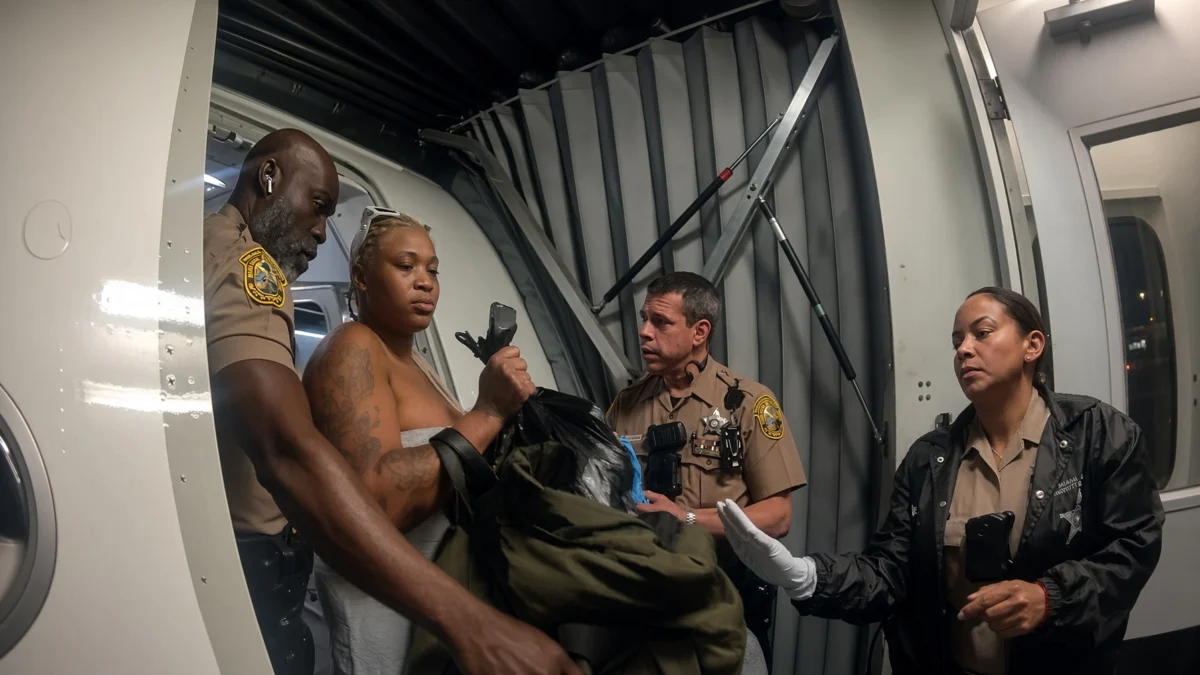
The landscape of modern commercial aviation has become increasingly fraught with incidents of passenger non-compliance, a trend that reached a volatile peak on March 29 at Miami International Airport. Frontier Airlines flight 1204, bound for Philadelphia, became the stage for a dramatic security intervention after three passengers, having been denied boarding due to an unresolved dispute over carry-on baggage fees, bypassed security protocols to force their way onto the aircraft. The ensuing confrontation, captured on police body-worn camera footage, serves as a stark case study in the intersection of airline operational policies, passenger frustration, and the escalating role of law enforcement in maintaining order at the gate.
The Sequence of Events: A Chronology of Escalation
The incident began in the terminal area as the passengers attempted to board flight 1204. According to internal reports from Frontier Airlines, the party of three had arrived at the gate with two carry-on bags; however, their travel documentation only accounted for one prepaid carry-on item. Gate agents informed the travelers that they were required to pay the supplementary fee for the second bag before proceeding through the boarding process.
What might have been a routine administrative correction rapidly devolved into a heated verbal dispute. As the passengers engaged in a loud, confrontational exchange with the gate staff, the employees determined that the situation had become untenable and informed the travelers that their boarding passes had been voided. The passengers were instructed that they would not be permitted to board the aircraft.
In a defiance of standard aviation safety protocols, one member of the party was heard instructing her companions to ignore the instructions of the airline staff, stating, “We don’t have to listen; let’s just go.” The trio subsequently moved past the gate agent’s station and proceeded down the jetbridge, successfully boarding the aircraft despite the explicit denial of service.
Upon notification that unauthorized individuals had breached the cabin, Frontier employees contacted local law enforcement. Before the aircraft was cleared for departure, police officers from the Miami-Dade Police Department arrived at the jetbridge. An airline employee briefed the responding officers on the situation, alleging that the passengers had not only bypassed the gate agent’s authority but also exhibited signs of alcohol intoxication.
The officers boarded the aircraft and informed the women that they were no longer authorized to fly and were required to deplane immediately. The recording of the encounter transitions to the jetbridge, where the situation intensified. The footage documents a physical struggle between the officers and the passengers, culminating in the deployment of handcuffs and the physical removal of the individuals from the aircraft. The scene attracted the attention of other passengers in the terminal, some of whom were recorded cheering as the trio was escorted away.
Legal Ramifications and Official Charges
Following their removal from the aircraft, all three passengers were taken into custody. The Miami-Dade Police Department filed formal charges of trespassing and resisting an officer without violence against each of the three individuals. In addition to these primary charges, one of the passengers faced a further allegation of battery, stemming from claims that she had spat on a Frontier Airlines employee during the initial altercation at the gate.
All three defendants have entered pleas of not guilty to the charges. The legal proceedings highlight the severe consequences of interfering with airline operations. Under federal and local statutes, interfering with a flight crew or airline personnel—especially during the boarding process—is treated as a significant security violation. Trespassing charges in an airport environment are particularly sensitive, as the secure areas of an airport are governed by stringent federal transportation security regulations that supersede standard public access rules.

Supporting Data and Industry Context
The March 29 incident is far from an isolated event. Over the past four years, the Federal Aviation Administration (FAA) and airline carriers have reported a significant surge in unruly passenger behavior. While the height of the COVID-19 pandemic saw record-breaking numbers of disruptive incidents related to mask mandates, the post-pandemic landscape has seen a persistent trend of confrontations linked to operational friction, such as baggage fees, seat assignments, and delays.
Data from the International Air Transport Association (IATA) suggests that disruptive passenger incidents occur once every 500 to 1,000 flights, with the majority involving verbal aggression, failure to follow cabin crew instructions, and physical altercations. The "low-cost carrier" model, which relies on a strict unbundling of services—charging for carry-on bags, seat selection, and refreshments—often creates high-friction touchpoints between passengers and gate staff.
When passengers feel that these fees are arbitrary or are not communicated clearly, the frustration can manifest in ways that disrupt the boarding process. However, industry analysts note that the legal threshold for "unruly behavior" is low. Once an airline voids a boarding pass, the passenger is legally required to vacate the area. Ignoring this directive transforms a consumer dispute into a criminal matter.
Broader Implications for Airline Security
The incident raises significant questions regarding the protocol for handling "gate-crasher" scenarios. In this instance, the airline’s decision to call the police was an exercise of their right to remove passengers who are deemed a safety or operational risk.
However, the body cam footage also sparked a separate debate regarding police conduct. During the arrest, an officer was recorded stating, “We’re going to put cuffs on you whenever we want. We’re not going to tell you anything. You’re going to do what you’re told.” Civil liberty advocates have pointed to this dialogue as problematic, noting that while law enforcement has the authority to make arrests, the professional conduct of officers remains a matter of public interest, particularly in highly regulated environments like airports.
From an operational standpoint, Frontier Airlines—like many carriers—has had to balance its role as a service provider with its role as a guardian of terminal security. While the airline has previously faced criticism for over-relying on law enforcement for minor customer service complaints, experts argue that the unauthorized boarding of an aircraft is an objective security breach that necessitates an immediate and firm response.
Conclusion and Future Outlook
The removal of the three passengers from flight 1204 underscores the thin line between a service dispute and a criminal security incident. As air travel continues to grow in volume, airlines and airports are likely to see more, not fewer, of these interactions.
For the passenger, the outcome of this incident serves as a cautionary tale: the gate agent’s authority is absolute within the context of boarding. Challenging that authority by force, rather than through formal customer service channels or legal recourse, results in significant legal exposure, including criminal records and potential lifetime bans from the airline. For the industry, the challenge remains to improve transparency in fee structures while ensuring that ground staff are equipped with the de-escalation training necessary to manage tensions before they necessitate police intervention. The case remains ongoing as the legal system evaluates the merits of the charges against the passengers.







Leave a Reply