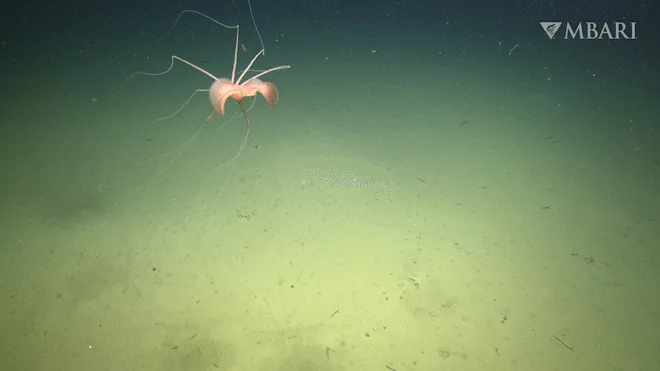
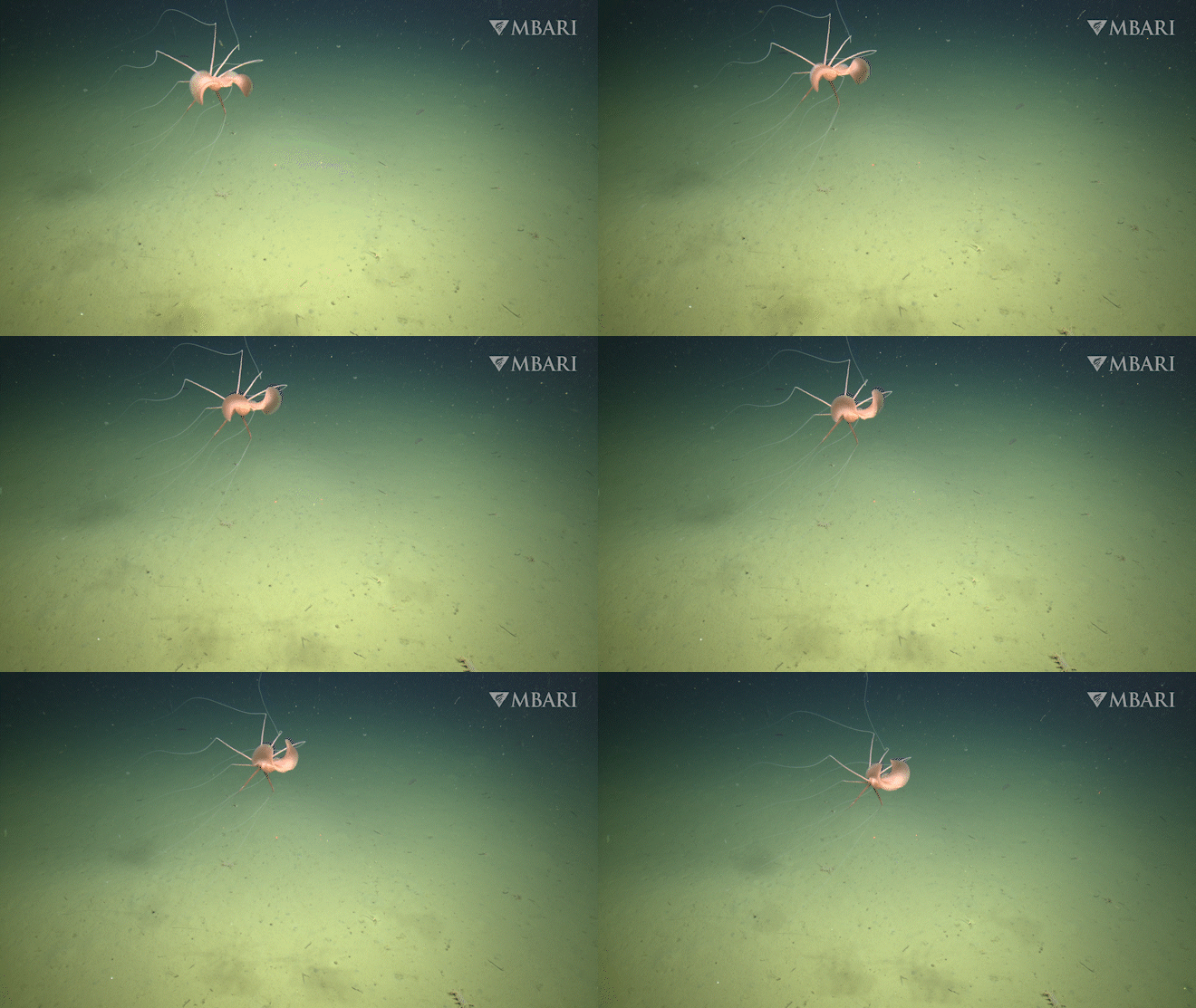
Deep-sea exploration continues to reveal the breathtaking and haunting biodiversity hidden beneath the surface of the world’s oceans. In a recent milestone for marine biology, researchers have captured rare footage of a bizarre and elusive bigfin squid (Magnapinna) drifting through the pitch-black waters of the northeastern Pacific Ocean. The ghostly cephalopod was spotted via remote video feed while an uncrewed submersible surveyed underwater mountain ranges, known as seamounts, off the coast of California. Operating at staggering depths exceeding 10,000 feet (3,000 meters), the robotic vehicle managed to document an organism that remains one of the most mysterious and rarely encountered creatures on Earth.
This encounter highlights the relentless challenges and profound discoveries associated with deep-sea research. While humanity has mapped the surfaces of distant planets with impressive precision, the crushing pressures, freezing temperatures, and absolute darkness of Earth’s abyssal plains and seamounts mean that vast stretches of our own planet remain entirely unexplored. The sighting of the Magnapinna off the California coast not only adds a crucial geographic data point to marine science but also reignites fascination with the alien-like anatomy and survival strategies of deep-dwelling cephalopods.
Anatomy and Behavior of the Enigmatic Bigfin Squid
The bigfin squid is instantly recognizable and profoundly unsettling due to its stark departure from traditional squid morphology. Scientifically classified within the family Magnapinnidae, these creatures are defined by their disproportionately massive, elbow-like fins, which make up a significant portion of their total body length. However, it is their tentacles and arms that truly capture the imagination of scientists and the public alike.
A mature bigfin squid possesses exceptionally long, slender, and thread-like appendages that can stretch up to 15 to 20 times the length of its mantle. These filament-like arms are held in a rigid, eerie posture, trailing far beneath the body like delicate wires. Marine biologists hypothesize that these trailing filaments are used as passive fishing lines. The squid likely drags them along or just above the seafloor to snare benthic organisms, small crustaceans, and other unsuspecting prey that drift within reach.
Unlike shallow-water squids known for rapid, darting movements and sophisticated schooling behaviors, the bigfin squid appears to be a slow-moving, solitary drifter. Its gelatinous body structure is well-suited to withstanding the immense hydrostatic pressure of the deep ocean, where bone-crushing forces render rigid skeletal structures impractical. The ghostly silhouette, combined with its erratic yet deliberate movements, has frequently led casual observers to liken the animal to an aquatic phantom or an extraterrestrial visitor.
The Chronology of Deep-Sea Discovery
To understand the significance of this latest sighting in the northeastern Pacific, it is necessary to examine the sparse history of human encounters with the Magnapinna genus. For decades, these animals were virtually unknown to science, existing only as fragmented specimens or mysterious glimpses captured by early deep-sea submersibles.
The historical timeline of bigfin squid documentation reveals just how infrequently researchers cross paths with the animal:
- Late 20th Century: The first physical specimens of Magnapinna larvae and juveniles were collected during mid-water trawls, but their damaged state prevented scientists from fully understanding their living form or scale.
- 1998: A remotely operated vehicle (ROV) operated by Shell Oil captured the first clear video footage of a bigfin squid near a drilling platform off the coast of-Hawaii, sparking intense scientific curiosity.
- 2000s: Additional sporadic sightings occurred in the Atlantic, Indian, and Pacific oceans, usually documented by deep-sea research institutions or industrial energy companies utilizing high-end ROVs.
- 2007: A notable encounter in the Gulf of Mexico, filmed by an ROV operating at a depth of roughly 7,600 feet (2,315 meters), provided unprecedented high-definition footage that circulated globally and cemented the creature’s iconic status.
- Present Era: The recent sighting off the coast of California at a depth exceeding 10,000 feet represents a modern triumph of robotic oceanography, showcasing how advanced submersible technology is slowly pulling back the veil on the abyss.
The Role of Submersible Technology in Abyssal Exploration
The successful documentation of the bigfin squid off California was made possible entirely by the advancement of uncrewed submersibles, commonly referred to as Remotely Operated Vehicles (ROVs). Sending human divers to a depth of 10,000 feet is physically impossible due to the lethal atmospheric pressure, which increases by one atmosphere for every 33 feet (10 meters) of descent. At 3,000 meters, the pressure is roughly 300 times greater than at sea level.
Consequently, marine science relies heavily on tethered or autonomous robotic systems equipped with high-definition optical sensors, powerful lighting arrays, and precision robotic arms. These technological marvels allow researchers to explore delicate benthic ecosystems without disturbing the organisms that inhabit them. Seamounts—the underwater mountains where the bigfin squid was recently spotted—are particularly rich biological hotspots. As ocean currents sweep nutrient-rich water up and around these slopes, they create thriving oases for corals, sponges, fish, and, by extension, apex predators and scavengers like deep-sea squids.
Scientific Implications and Ecological Context
Encounters with creatures like the bigfin squid are not merely curiosities; they provide vital data for understanding the complex dynamics of deep-sea food webs. The pelagic and benthic zones of the deep ocean represent the largest living space on Earth, yet they are also among the least understood.
Marine biologists face profound challenges when studying animals from the abyss. Because bigfin squids live under extreme pressure and cold, bringing them to the surface alive is practically impossible; their bodies rapidly degrade and succumb to thermal and pressure shock outside their natural habitat. Therefore, non-invasive observation via ROVs remains the single most effective tool for studying their behavior, locomotion, and ecological niche.
The presence of Magnapinna in the northeastern Pacific also raises questions regarding population distribution and migration. Whether these animals are globally distributed species or consist of multiple distinct regional species remains an open question in taxonomic research. Genetic sampling from shed tissue or environmental DNA (eDNA) collected from surrounding waters may eventually help scientists untangle the evolutionary tree of the family Magnapinnidae.
Conservation Concerns in the Deep Sea
As industrial interest in the deep ocean grows—driven by commercial fisheries, deep-sea mining proposals, and energy exploration—discoveries like the bigfin squid underscore the urgent need for comprehensive conservation frameworks. Many seamounts and abyssal plains remain vulnerable to habitat destruction, acoustic pollution from seismic testing, and potential chemical contamination.
Environmental organizations and marine policy experts argue that baseline scientific surveys, such as those utilizing robotic submersibles off the California coast, are essential for identifying vulnerable marine ecosystems before commercial exploitation expands into the deep sea. Protecting the habitats of elusive, slow-reproducing creatures like the bigfin squid requires international cooperation and science-based management strategies that account for the fragile nature of abyssal biodiversity.
Looking Forward: The Uncharted Abyss
The recent filming of the bigfin squid haunting the depths of the northeastern Pacific serves as a powerful reminder of the wonders that still lie hidden in Earth’s oceans. Each technological leap forward in sub-surface exploration brings new insights, challenging our understanding of life’s capacity to adapt to the most extreme environments imaginable. As oceanographic research continues to advance, marine scientists remain poised to uncover more secrets of the deep, illuminating a world that has remained hidden in darkness for millennia.