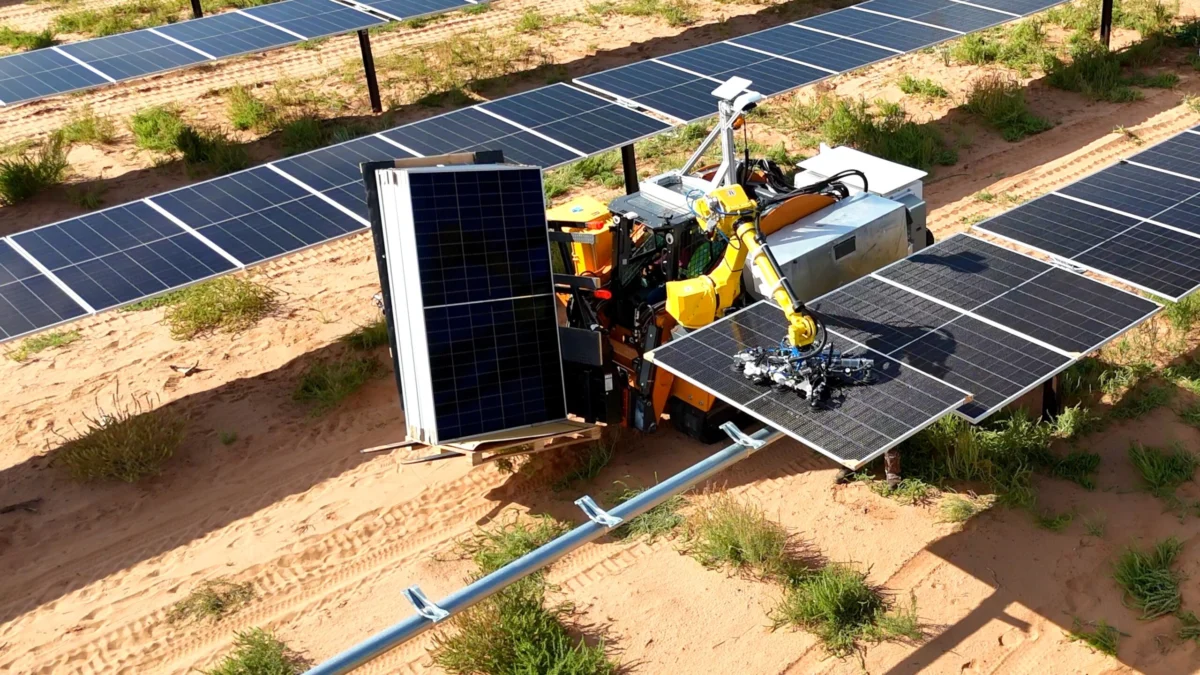
In a significant stride towards accelerating global renewable energy deployment, Gritt, a robotics startup founded by two Carnegie Mellon-trained roboticists, announced its exit from stealth mode on Tuesday. The company unveiled a substantial $26 million Series A funding round, spearheaded by Obvious Ventures, with additional participation from Union Square Ventures and Active Impact Investment. This latest injection of capital brings Gritt’s total funding to $34 million, building upon an earlier seed round backed by First Round Capital, Climactic, Congruent Ventures, and VSC Ventures. At its core, Gritt aims to address one of the most pressing challenges facing the burgeoning solar energy sector: a critical labor shortage that threatens to impede the rapid expansion necessary to combat climate change and achieve energy independence.
The global transition to solar energy is a cornerstone of contemporary environmental and economic policy, with nations and corporations worldwide racing to deploy photovoltaic panels and battery storage solutions at an unprecedented pace. This build-out, however, is increasingly confronting a bottleneck in the form of a limited supply of skilled workers, struggling to keep pace with the escalating demand for installation. Traditional industrial robots, historically confined to the predictable confines of factory floors, have largely been unsuitable for the dynamic, unstructured, and often hazardous environments of construction sites. Gritt’s founders, CEO Puneet Puri and CTO Vishal Dugar, believe that recent breakthroughs in artificial intelligence, particularly advanced AI models, have fundamentally altered this equation, enabling robots to operate effectively in such challenging conditions.
The Imperative for Accelerated Solar Deployment
The urgency for accelerated solar energy deployment cannot be overstated. According to the International Energy Agency (IEA), solar photovoltaic (PV) capacity is projected to nearly triple globally by 2027, surpassing coal as the largest source of power capacity worldwide. This rapid expansion is critical for nations to meet their commitments under the Paris Agreement, transition away from fossil fuels, and bolster energy security amidst geopolitical volatilities. For instance, the United States has set ambitious targets, aiming for a carbon-free electricity grid by 2035, a goal heavily reliant on substantial increases in solar and wind power.
However, the sheer scale of this undertaking presents formidable logistical and human resource challenges. The Solar Energy Industries Association (SEIA) consistently highlights the need for a rapidly expanding workforce, estimating that hundreds of thousands of new jobs will be required in the solar sector by 2030. Yet, the construction industry as a whole is grappling with a persistent labor shortage. Data from the Associated General Contractors of America (AGC) indicates that a vast majority of construction firms, around 85% in 2023, report difficulty in finding qualified workers. This scarcity leads to project delays, increased costs, and can compromise safety standards. It is within this critical context that Gritt’s innovation emerges as a potential game-changer.
Gritt’s Intelligent Approach: AI for Unstructured Environments
Gritt’s driving philosophy, as articulated by CEO Puneet Puri, centers on developing an "intelligence which can work in the outdoor, chaotic environments of these construction sites, and it has to be generalizable enough that it can work in these varied environments." Unlike many competitors who opt to build proprietary robotic hardware from the ground up, Gritt adopts a strategically distinct approach: it leverages off-the-shelf industrial hardware, such as rented skidders and robotic arms from manufacturers like Kawasaki, and integrates them with its proprietary AI models. This hardware-agnostic strategy allows Gritt to focus its expertise and resources on the sophisticated software that enables these machines to perform complex tasks with precision and adaptability.
This approach offers several strategic advantages. By avoiding the significant capital expenditure and lengthy development cycles associated with designing and manufacturing custom robots, Gritt can achieve faster deployment, greater scalability, and a leaner cost structure. This model allows the company to integrate readily available, robust machinery, making its solutions more accessible and adaptable to diverse project requirements and existing construction fleets.
The initial application of Gritt’s intelligent system focuses on one of the most labor-intensive and physically demanding aspects of solar farm construction: the handling and installation of large, heavy glass solar panels. Gritt’s robots are designed to autonomously unload these panels, transport them across rugged terrain to the metal frames where they will be installed, and position them with sub-millimeter accuracy. This precision is crucial for ensuring optimal performance and longevity of the solar arrays, allowing human workers to then efficiently fasten the panels into place.
Transformative Impact on Productivity and Safety
The immediate impact of Gritt’s technology on site productivity is profound. Puri notes that a typical eight-person crew can install approximately 800 solar panels per day. However, when augmented by Gritt’s systems, the same crew can dramatically increase their output to between 3,000 and 4,000 panels daily. This represents a 3x to 5x increase in efficiency, a critical factor in meeting the aggressive timelines demanded by utility-scale solar projects.
Beyond mere speed, Gritt’s robots also address significant safety concerns within the industry. The manual lifting and positioning of 100-pound solar panels overhead is physically arduous and a leading cause of musculoskeletal injuries among construction workers. By automating this "dirty, dull, and dangerous" task, Gritt’s systems can significantly reduce the risk of injury, improving worker welfare and potentially lowering insurance costs for contractors.
A Gritt customer, who requested anonymity for competitive reasons, expressed enthusiastic support for the system’s capabilities. He highlighted its potential to facilitate work at remote sites where attracting and retaining skilled labor is particularly challenging. "It’s a game-changer for projects in harder-to-reach areas," the customer remarked, "and the reduction in workplace injuries alone makes it an invaluable investment." This testimonial underscores the dual benefit of Gritt’s technology: boosting efficiency while simultaneously enhancing worker safety and well-being.
Growth and Market Penetration
Gritt is rapidly scaling its operations. The company has already deployed two systems in the field, actively collecting data to continuously refine and improve their AI models’ behavior and performance. Looking ahead, Gritt has secured contracts to assist in the installation of an impressive 2.8 gigawatts of solar panels over the next 18 months. Its clientele includes three of the top ten power construction companies in the United States, signifying strong validation from industry leaders. The company’s ambitious expansion plans include operating 48 of its intelligent systems within the next six months, demonstrating a clear trajectory for rapid market penetration.
The market for construction robotics, particularly in the renewable energy sector, is burgeoning. The global construction robotics market is projected to grow from hundreds of millions of dollars in the early 2020s to several billion by the end of the decade, reflecting a growing industry acceptance of automation. Gritt is operating within a competitive landscape, facing companies like Luminous Robotics, Cosmic, and China’s Trinabot, all of whom are developing their own panel-installing robots. However, Gritt’s distinctive strategy of focusing on software and leveraging off-the-shelf hardware positions it uniquely. While competitors invest heavily in proprietary hardware development, Gritt’s asset-light model could enable it to scale faster and with greater capital efficiency, potentially offering a significant competitive advantage as demand for solar installation robotics surges.
The Evolution of AI and Future Vision
The core enabler of Gritt’s vision, according to its founders, is the exponential advancement of new AI models. Puneet Puri explains that while creating a specialized robotic system for a single solution might have been feasible five years ago, contemporary AI makes the work "generalizable." This means the same underlying AI pipeline can be reused and continuously improved across a diverse range of tasks. Puri cites a compelling example: initially, training the system to stack cinder blocks took several weeks, but using the same generalized software, a similar demonstration for rebar tying—another labor-intensive construction task—was achieved in just one day. This rapid adaptability and transfer learning capability are hallmarks of modern AI and underpin Gritt’s ambitious long-term plans.
Gritt’s immediate roadmap includes expanding its system’s manipulation capabilities to perform additional tasks crucial for solar panel installation, such as fastening the panels, drilling posts, and even constructing the racks upon which the panels sit. Looking further ahead, the company aims to tackle other common, labor-intensive construction tasks beyond solar, such as tying rebar before concrete is poured. This strategic expansion into broader construction applications highlights the versatility and scalability of Gritt’s AI-powered platform.
The founders envision Gritt’s systems evolving beyond mere task execution. With their integrated suite of sensors and advanced intelligence, these robots can become vital data collection and decision-making hubs on construction sites. Puri imagines scenarios where Gritt’s system could detect an open trench as a storm approaches, automatically alerting workers to cover it before rain damages components, or flagging missing inventory in real-time. "Gritt becomes now this layer of physical AI, which is doing this dextrous, labor-intensive task, plus it can help you take decisions on the site," Puri states. This holistic approach, combining physical automation with intelligent site management, positions Gritt to not only optimize labor but also enhance overall project efficiency, safety, and oversight.
Broader Implications and Industry Outlook
Gritt’s emergence and its successful funding round signify a pivotal moment for the solar and broader construction industries. The implications are far-reaching:
- Accelerated Renewable Energy Transition: By alleviating labor bottlenecks, Gritt’s technology can directly contribute to faster and more cost-effective deployment of solar farms, bringing nations closer to their climate and energy independence goals.
- Transformation of the Construction Workforce: While concerns about job displacement often accompany automation, industry experts generally agree that construction robotics will lead to a shift in labor roles rather than outright elimination. Workers may transition from physically demanding tasks to supervisory roles, operating and maintaining robotic systems, or specializing in more complex installation aspects. This demands new training programs and a focus on upskilling the existing workforce.
- Enhanced Safety Standards: The reduction in manual handling of heavy materials and exposure to hazardous conditions promises a safer work environment, a long-standing challenge in the construction sector.
- Data-Driven Construction Management: The vision of robots acting as intelligent sensors and decision-support systems heralds a new era of data-driven construction. Real-time insights into site conditions, inventory, and progress can lead to optimized project management, reduced waste, and improved overall project delivery.
- Competitive Dynamics: Gritt’s software-centric model could disrupt traditional hardware-heavy robotics companies, demonstrating that specialized intelligence, not just advanced mechanics, is the key to success in unstructured environments. This could foster further innovation in AI applications for various industries.
Andrew Beebe, the partner at Obvious Ventures who led Gritt’s Series A round, encapsulated the company’s potential. "There are people who used to build rockets that went into space and had infinite budget for the smallest little part, and then there are people who know what it means to get into dirty, dull, and dangerous jobs and scale them like mad," Beebe commented. "These guys are in the second camp, and that’s a special kind of entrepreneur that has the technical chops, the AI, and the machine vision skills to make it work." This sentiment reflects the growing investor confidence in practical, scalable AI solutions addressing real-world industrial challenges.
As Gritt continues to deploy and refine its intelligent systems, its journey will be closely watched. The success of its AI-powered robotics in bridging the labor gap and accelerating solar installations could serve as a powerful blueprint for how advanced AI can fundamentally reshape heavy industries, driving efficiency, improving safety, and ultimately contributing to a more sustainable future. The fusion of robotics and cutting-edge AI is no longer a futuristic concept but a tangible solution actively contributing to the planet’s most critical infrastructure build-out.