
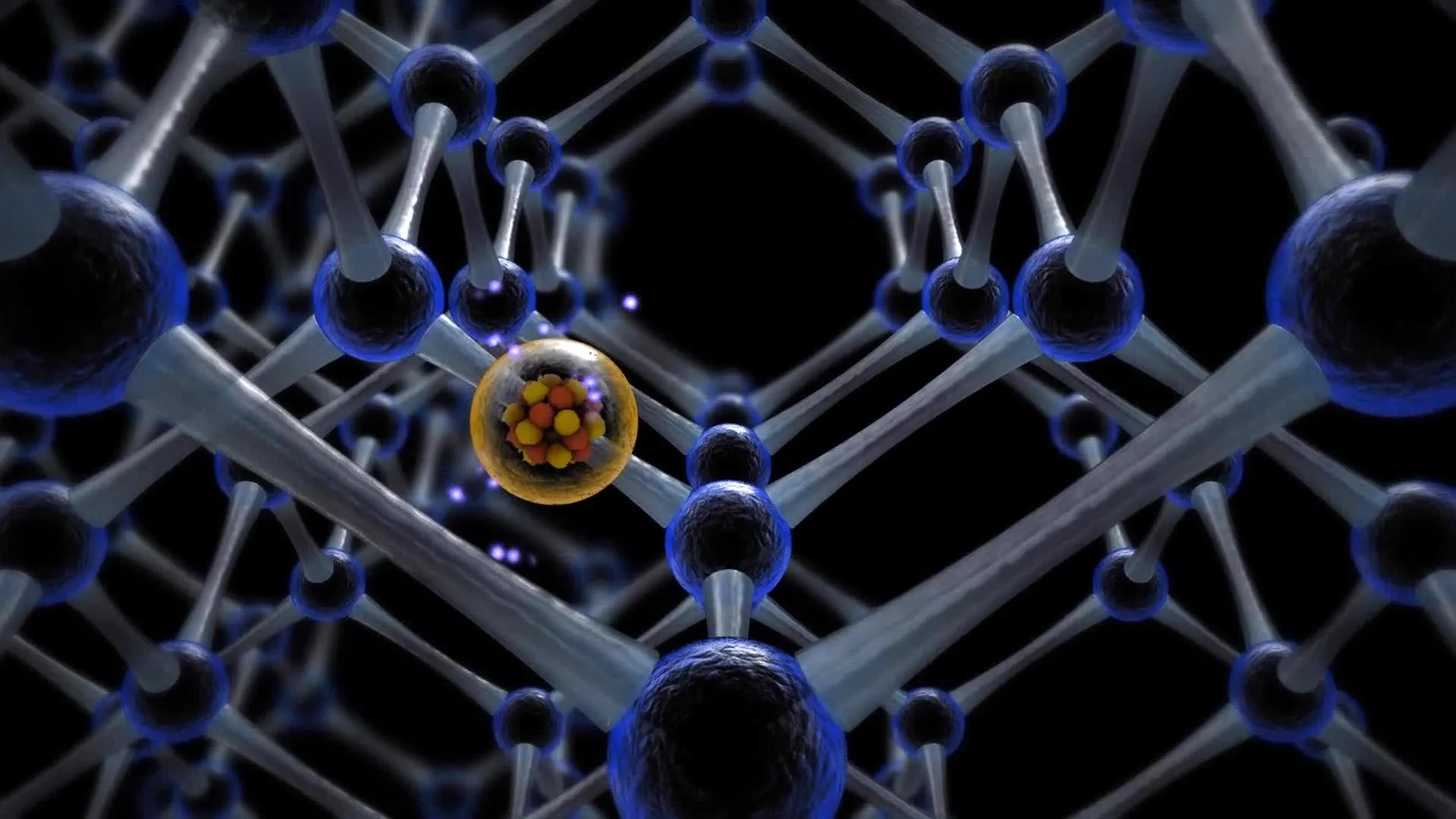
In a significant breakthrough for the field of quantum information science, researchers at the Harvard John A. Paulson School of Engineering and Applied Sciences (SEAS) have successfully demonstrated a method to protect delicate quantum states using mechanical vibrations. By leveraging microscopic sound waves—known as phonons—the team has effectively shielded silicon-vacancy spin qubits within diamond structures, a discovery that addresses one of the most persistent hurdles in the quest for scalable quantum computing: the preservation of quantum coherence.
The study, published in the journal Nature Physics, marks a departure from traditional microwave-based shielding techniques. Led by Eliza Cornell, a recent Ph.D. graduate from the lab of Marko Lončar, the Tiantsai Lin Professor of Electrical Engineering at SEAS, the research introduces the concept of "all-mechanical coherence protection." This approach allows a qubit to be "dressed" by a continuous acoustic field, shielding it from environmental noise while simultaneously maintaining its ability to interface with other quantum components.
The Evolution of Quantum Networking
The pursuit of a functional quantum internet and high-performance quantum computers has long focused on the transmission of information between stationary nodes. Traditionally, photons—particles of light—have been the primary candidates for this role due to their speed and ability to travel long distances. However, light presents integration challenges when attempting to pack multiple components onto a single semiconductor chip. Because light has a relatively long wavelength, the optical components required to guide and manipulate it are physically bulky, limiting the density of quantum circuits.
Phonons offer a distinct alternative. Because mechanical vibrations possess much shorter wavelengths than electromagnetic radiation at equivalent frequencies, they allow for the miniaturization of quantum network components. This enables the engineering of compact, chip-scale architectures where qubits can be placed in close proximity without significant crosstalk. Furthermore, phonons are uniquely versatile; they interact readily with both solid-state electron spins and electromagnetic fields, making them ideal candidates for hybrid quantum systems that integrate disparate types of qubits.
Chronology of the Breakthrough
The research conducted in the Lončar lab builds upon years of incremental progress in phononics. The foundational work began with the development of the "phononic cavity," a specialized nanostructure designed to trap mechanical vibrations. By confining these phonons, the researchers created an environment where mechanical energy could interact strongly with the electron spin of a defect in diamond—specifically, a silicon-vacancy center.
Over the past several years, the team has worked to refine the control of these interactions. The project reached a pivotal stage with the experimentation led by Cornell and Zhujing Xu, a former postdoctoral scholar in the group. The team faced a fundamental trade-off: while strong coupling to phonons is necessary for efficient information transfer, that same coupling often exposes the qubit to environmental noise, which degrades the quantum state. In 2022 and 2023, the team explored various configurations of phononic cavities, ultimately concluding that standard microwave decoupling techniques were incompatible with the tight integration required for on-chip systems. This led to the design of the "dressed" state protocol, which was finalized and validated in the months leading up to the 2024 publication.
The Mechanism of "Dressed" Qubits
To understand the innovation, one must look at the nature of quantum decoherence. A qubit’s quantum state is ephemeral; it is susceptible to "noise" from its environment, which causes it to lose its quantum information—a process known as decoherence. In traditional systems, researchers apply microwave pulses to periodically flip the state of the qubit, effectively canceling out the noise. However, when a qubit is integrated into a phononic cavity, these microwave pulses interfere with the mechanical interaction, forcing a choice between stability and connectivity.
The SEAS team bypassed this dilemma by replacing microwave pulses with a continuous mechanical driving field. By applying a steady stream of phonons, the qubit is "dressed" in an acoustic field, effectively modifying its energy landscape. In this "dressed" state, the qubit becomes significantly less sensitive to low-frequency background noise. Essentially, the very mechanism used to transport the information (the phonons) is repurposed to protect the integrity of that information.
Supporting Data and Performance Metrics
The experimental results confirmed that this mechanical shielding is highly effective. The team observed that the coherence time of the silicon-vacancy spin was extended by approximately a factor of three. While an extension by a factor of three may seem modest in a laboratory setting, in the context of quantum computing, it represents a substantial leap. Increased coherence time translates directly into higher gate fidelity and a greater number of computational operations that can be performed before the system succumbs to errors.
Furthermore, the integration of this technique within a phononic cavity demonstrates that the method is not merely a theoretical construct but a practical, scalable solution. By utilizing existing nanophotonic and phononic infrastructure, the team showed that this protection mechanism could be embedded directly into the fabric of a quantum circuit, avoiding the need for external, bulky control equipment.
Official Responses and Academic Context
"We are solving two problems," said Eliza Cornell. "We want the spin to have strong interaction with phonons, and we want the spin to have a long coherence time. Our paper demonstrates a method of extending the coherence time that is compatible with the silicon-vacancy center being in a cavity."
The collaborative nature of the research is underscored by the involvement of a wide array of specialists, including researchers from Yale University and the Technical University of Munich. The involvement of Q-NEXT, a Department of Energy National Quantum Information Science Research Center, highlights the strategic importance of this work to national interests in quantum computing. The project also utilized the Harvard Center for Nanoscale Systems, an facility essential for the nanofabrication of the diamond-based devices used in the study.
Broader Implications for the Quantum Industry
The implications of this research are far-reaching. As the industry moves toward "Quantum 2.0," the focus is shifting from simple proof-of-concept devices to modular, integrated systems. The ability to use phonons for both transport and protection simplifies the architectural requirements for quantum chips.
- Scalability: By reducing the footprint of quantum network components, researchers can envision chips containing hundreds or thousands of qubits, a prerequisite for fault-tolerant quantum computing.
- Hybrid Systems: The versatility of phonons in connecting different types of qubits—such as superconducting qubits and spin qubits—could lead to the development of heterogeneous quantum processors, where different components are optimized for different tasks (e.g., memory vs. logic).
- Environmental Robustness: If sound-based protection can be further refined, it could lead to quantum devices that are less reliant on extreme shielding from electromagnetic interference, potentially reducing the cost and complexity of quantum infrastructure.
Economic and Commercial Outlook
The Harvard Office of Technology Development has taken an active role in managing the intellectual property resulting from this study. By pursuing patent protection for the "all-mechanical coherence protection" method, the university signals that it views this technology as a potential commercial asset. As venture capital continues to flow into quantum startups, such foundational patents become critical for the commercial viability of future quantum hardware companies.
The research also benefits from significant federal backing, with funding from the National Science Foundation and the Air Force Office of Scientific Research. This level of support reflects the dual-use nature of quantum technology, which promises breakthroughs in everything from secure communications and materials science to cryptography and national defense.
Conclusion: A Sonic Path to Stability
The Harvard SEAS breakthrough does more than just extend coherence times; it provides a new paradigm for quantum engineering. By embracing mechanical vibrations—once considered a nuisance to be eliminated—researchers have found a way to turn the environment against itself, using sound to maintain the silence necessary for quantum states to persist.
As the field transitions from the era of exploration to the era of integration, the ability to pack complex components onto a single chip while ensuring they remain stable will be the deciding factor for success. While challenges remain in scaling these systems to a commercial level, the demonstration of all-mechanical coherence protection offers a robust, elegant solution to the problem of quantum fragility. The "dressed" qubit stands as a testament to the ingenuity of modern materials science and the potential for sound waves to play a foundational role in the quantum computers of the future.







Leave a Reply