The intersection of rigorous scientific research and popular culture has long been a source of subtle amusement within academic publishing, with scholars occasionally injecting clever witticisms, literary allusions, and iconic song lyrics into otherwise formal manuscripts. Among the vast pantheon of musical history, one legendary rock band stands head and shoulders above the rest in terms of academic penetration. According to a comprehensive new study published in the peer-reviewed journal PLoS ONE, compositions and lyrical phrases by The Beatles have been referenced thousands of times across the global scientific literature, cementing the Fab Four as an unexpected cornerstone of scholarly wordplay.
The investigation, spearheaded by a team of researchers from the Delft University of Technology in the Netherlands, utilized advanced computational tools to map the pervasive influence of John Lennon, Paul McCartney, George Harrison, and Ringo Starr across multiple academic disciplines. While previous studies have occasionally looked at the infiltration of popular music into specific scientific niches—such as biomedical journals or meteorological papers—this latest research expands the scope significantly, capturing a cross-disciplinary phenomenon that has been steadily accelerating over the past three decades.
A History of Academic Wit and Musical Allusions
The tradition of hiding musical easter eggs inside research papers is older and more widespread than many casual observers might realize. For years, scientists have engaged in quiet, lighthearted wagers or simply sought out creative ways to break the monotony of highly technical jargon. A notable historical precedent occurred in 2014, when researchers at the Karolinska Institute in Sweden confessed to a long-running inside bet involving the insertion of Bob Dylan lyrics into biomedical papers, a tradition that began quietly with a 1997 review in the journal Nature entitled “Nitric Oxide and inflammation: The answer is blowing in the wind.”
Subsequent analyses confirmed that Dylan’s poetic catalog was a favorite among medical researchers, public health experts, and even climate scientists. Yet, comparative studies conducted over the years consistently showed that while Dylan had a dedicated following in the lab, The Beatles ultimately commanded a far greater share of the academic spotlight. Other musical acts have also enjoyed brief moments of dominance; for instance, a 2023 analysis revealed that The Clash’s iconic single “Should I Stay or Should I Go” had accumulated an impressive 408 references in scientific literature, briefly outpacing individual Beatles tracks in certain subfields.
Despite these notable contenders, the sheer volume of Beatles-inspired literature remained largely unquantified on a global scale until the Delft University of Technology research team undertook their exhaustive investigation. The authors, all self-described fans of the band, noticed the frequent appearance of Beatles-related terminology in their own reading and decided to scale up the observation into a formal empirical study.
Methodology: Mapping the Fab Four Across Scopus and Google Scholar
To capture the true extent of The Beatles’ footprint in academia, the researchers abandoned traditional manual searches. Instead, they deployed a sophisticated large language model and automated data-gathering scripts to comb through massive academic indexing databases, primarily focusing on Scopus and Google Scholar.
Unlike previous efforts that relied strictly on exact title matches, the research team designed their search parameters to recognize a broader spectrum of literary devices. The system scanned not only for direct song titles but also for nuanced lyrical references, modified phrases, and clever wordplay. This methodological breadth allowed them to uncover thousands of creative mutations that would have otherwise bypassed conventional keyword filters.
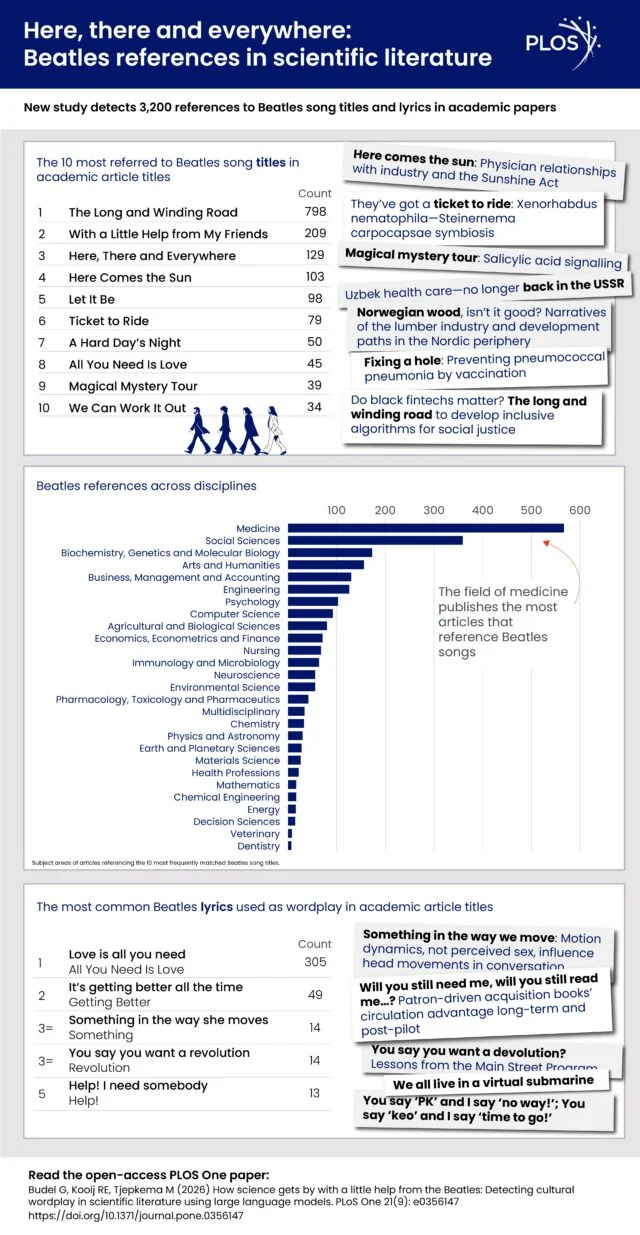
Co-author Gabriel Budel highlighted the ingenuity displayed by anonymous researchers during the data collection process. Pointing to specific examples found within the dataset, Budel noted the existence of a paper addressing Long COVID titled “The lung and winding road,” which cleverly altered a single vowel of the band’s classic 1970 track. Another standout example included a quantum computing paper concerning mathematical groups titled “Here comes the SU(N),” playing on the timeless George Harrison composition “Here Comes the Sun.”
The Long and Winding Data: Quantitative Findings
When the automated dust settled, the numbers revealed a staggering total of more than 3,200 explicit references to Beatles song titles and lyrics scattered throughout academic papers. Of those, exactly 2,048 were classified as direct, exact matches with song titles in the Scopus database, while the remaining occurrences encompassed variations and creative wordplay.
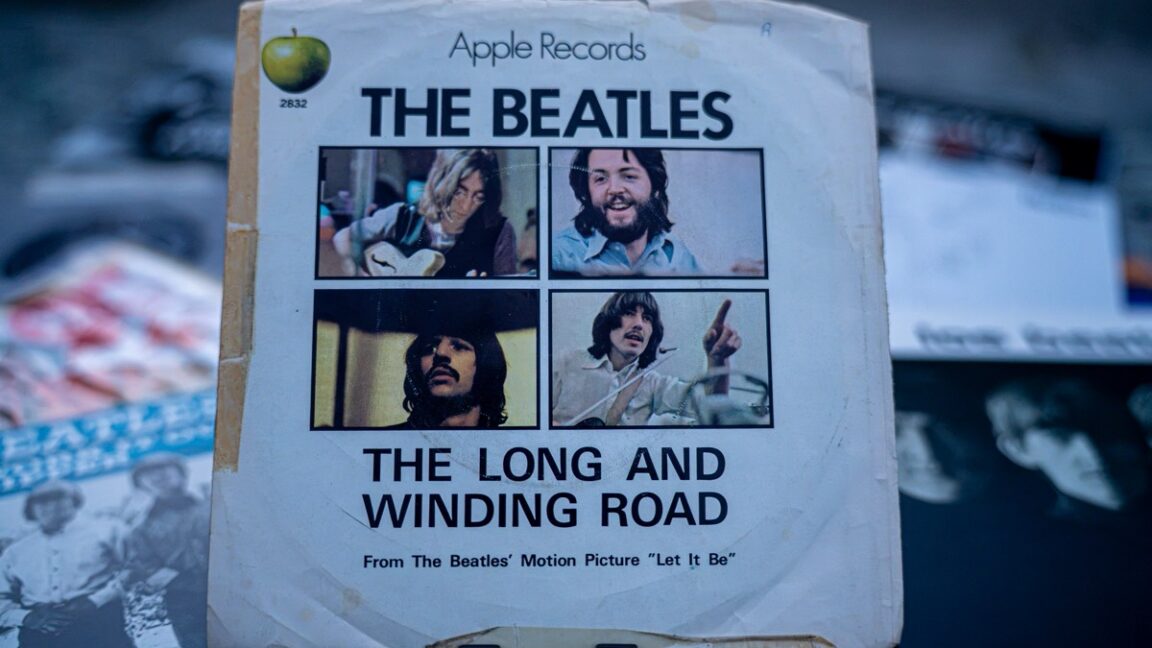
Leading the charge by a wide margin was the melancholy 1969 ballad “The Long and Winding Road,” which alone accounted for 798 references in the dataset. This figure towers above competing popular tracks, such as The Clash’s “Should I Stay or Should I Go?” or Bob Dylan’s “The Times They Are a-Changin’.”
To place these numbers in a broader comparative framework, the research team analyzed the top ten hits of several other legendary musical acts, including Elvis Presley and Michael Jackson. The data confirmed that no other artist or group comes close to matching the frequency of Beatles-inspired nomenclature in scientific titles.
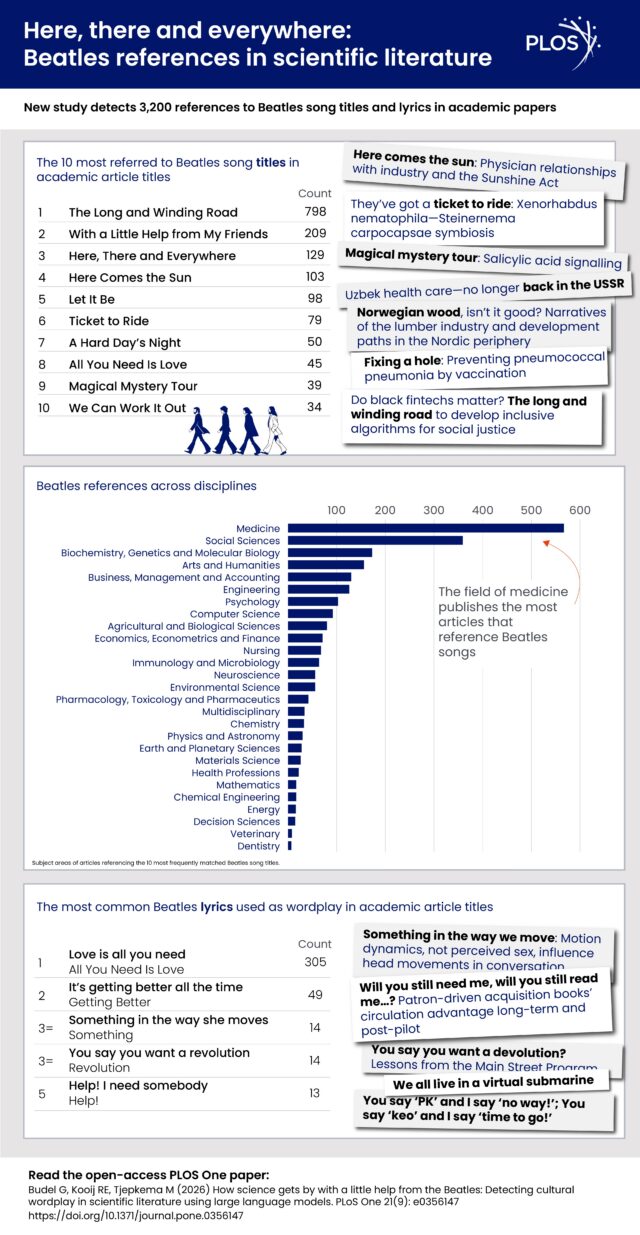
Interestingly, the statistical distribution of these references did not follow a uniform pattern. Instead, the data conformed strictly to a power law distribution, frequently referred to in mathematics as Zipf’s law. Co-author Robert E. Kooij observed the striking similarity between the citation habits of scientists and natural phenomena, noting that network scientists are accustomed to seeing power laws in complex systems such as earthquakes, social networks, and wealth distribution. In the case of academic song references, a small handful of tracks are cited constantly, while the vast majority of the band’s catalog appears only once or twice in the entire history of modern publishing.
Interdisciplinary Reach and Biomedical Dominance
While references to The Beatles were detected across virtually every major academic discipline cataloged in Scopus—supporting the authors’ thesis that this is a truly universal cultural phenomenon—certain fields demonstrated a distinct affinity for the band’s catalog.
Medicine and the social sciences emerged as the dominant sectors for Beatles-infused titles. High-impact papers utilizing these references often achieved extraordinary visibility within the scientific community. For instance, the study identified several heavily cited works incorporating the band’s phrasing, including “Good day sunshine: Stock returns and the weather,” which amassed over 1,000 citations, and “Seizure prediction: The long and winding road,” which garnered 954 citations.
The researchers suggest that songs like “The Long and Winding Road” serve as a particularly fitting metaphor for the arduous, iterative nature of the scientific process itself. Pointing to comments made by Paul McCartney regarding the song’s thematic focus on the unattainable and the door one never quite reaches, the study’s authors argued that scientific inquiry similarly progresses through trial and error toward meaningful, albeit temporary, conclusions amidst prolonged and unpredictable development.
A Chronological Surge: From the Anthology to Streaming Era
Breaking the dataset down chronologically revealed a clear temporal trend. The use of Beatles references in academic literature has experienced a steady, uninterrupted upward trajectory since 1990.
A particularly sharp surge occurred between 1995 and 2005, a timeframe that directly aligns with the commercial rollout of The Beatles’ massive archival multimedia project, Anthology. The researchers hypothesize that the Anthology releases successfully introduced the band’s timeless catalog to a fresh generation of young researchers who were entering graduate programs and beginning their publishing careers around the turn of the millennium.

This upward trend received a secondary reinforcement decades later with the advent of universal digital streaming. When The Beatles’ catalog officially landed on mainstream streaming platforms like Spotify in late 2015, the music became instantly accessible to researchers working around the clock at their university terminals, further cementing the band’s cultural ubiquity.
The Broader Implications for Academic Publishing
The proliferation of song titles in scholarly literature is not merely a harmless quirk; it reflects broader structural shifts in how academic research is communicated. In an era marked by the rapid digitization of publishing and an overwhelming daily output of new papers, modern researchers face intense pressure to ensure their work stands out in crowded academic databases.
A separate 2023 study previously suggested that embedding recognizable song titles into research headings is an effective strategy for capturing reader attention while gracefully bypassing dense, hyper-technical jargon. Budel and his colleagues view their findings as concrete, empirical evidence that academic writing is undergoing a cultural evolution—becoming progressively more informal, accessible, and attentive to reader engagement.
While heavily used titles like “The Long and Winding Road” run the risk of eventual creative saturation through overuse, the authors emphasize that novel and intricate wordplay continues to provide genuine delight within the academic community. Titles born from the band’s iconic White Album—such as “Happiness is a warm theorem” or complex puns addressing the patentability of cloned organisms—demonstrate that wit remains alive and well in the laboratory.
Ultimately, the research proves that beneath the white lab coats, heavy statistical models, and dense theoretical frameworks, the global scientific community shares a universal human appreciation for popular culture. As long as researchers continue to seek metaphors for complex, winding paths of discovery, it appears that The Beatles will remain right there beside them—here, there, and everywhere.