
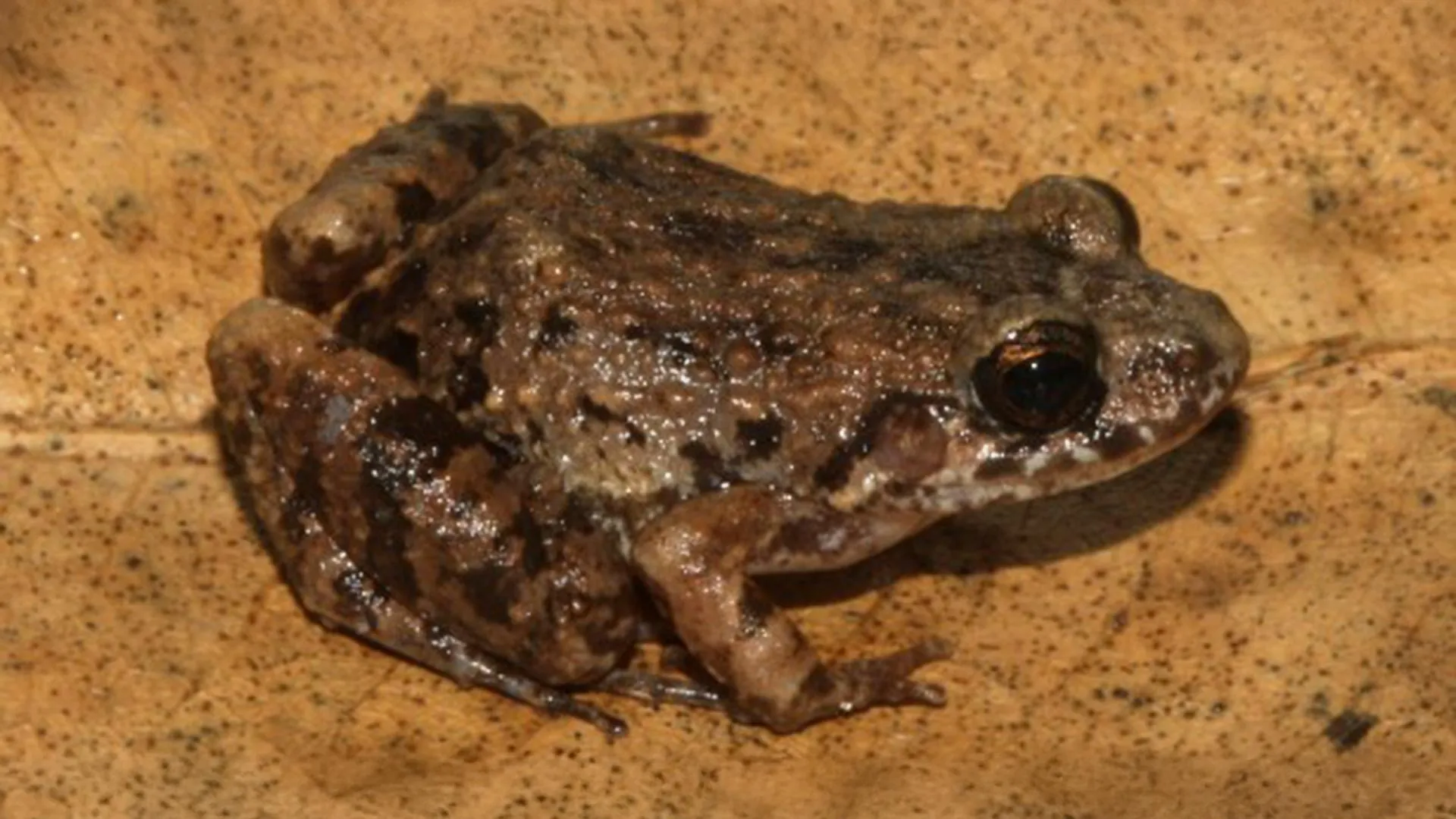
In the dense, water-logged forests of the western Amazon, a small amphibian has spent millennia adapting to a rhythm of seasonal inundation that few other members of its genus have managed to master. This creature, formally described as Adenomera varcena, has now been brought to the attention of the scientific community, serving as a profound reminder that the Amazonian basin remains one of the most enigmatic and under-documented biological frontiers on Earth. Its identification is not merely a triumph of taxonomy; it is a critical contribution to our understanding of cryptic diversity—the phenomenon where distinct species remain hidden in plain sight due to their near-identical physical appearances.
The discovery was spearheaded by a multidisciplinary team of researchers, including Célio F. B. Haddad of São Paulo State University (UNESP) and Thiago R. Carvalho of the Federal University of Minas Gerais (UFMG). Their findings, published in the journal Ichthyology & Herpetology, represent years of rigorous fieldwork and laboratory analysis. As part of the Center for Research on Biodiversity Dynamics and Climate Change (CBioClima), a Research, Innovation, and Dissemination Center (RIDC) funded by FAPESP, the team utilized a robust framework of integrative taxonomy to distinguish Adenomera varcena from its relatives.
The Geography of a Discovery
The journey to identifying Adenomera varcena began in the remote Upper Juruá River region of western Acre, Brazil. This area, located in close proximity to the municipality of Cruzeiro do Sul and the Moa and Crôa rivers, is characterized by complex, seasonally flooded forests. These ecosystems are defined by their hydrological instability; for significant portions of the year, the forest floor is submerged, forcing the local fauna to adopt specialized survival strategies.
For the research team, surveying these forest fragments was a logistical challenge that required deep-woods navigation and precise timing. The naming of the species—varcena—is a direct nod to these Amazonian floodplain forests, known locally as várzea. This nomenclature is significant because, until now, the genus Adenomera was primarily associated with terra firme (dryland) forests. Finding a representative of this lineage thriving in a periodically flooded environment suggests a broader ecological adaptability than previously assumed for the genus, potentially remapping the known habitat associations for these frogs.
Integrative Taxonomy: Beyond the Naked Eye
In modern herpetology, the era of relying solely on physical appearance for species identification has long passed. Cryptic diversity poses a major obstacle to conservationists, as animals that appear identical may, in fact, have divergent evolutionary paths, reproductive needs, and genetic structures. To confirm the status of Adenomera varcena, the team employed a multi-pronged analytical approach.
The researchers compared DNA sequences, which provided the primary evidence of a distinct evolutionary lineage. However, the genetic data was only one piece of the puzzle. They also conducted detailed morphological studies, comparing body proportions and specific anatomical markers against specimens stored in museum collections. A key diagnostic feature discovered was the absence of a distinct dark spot on the underside of the frog’s forearm—a subtle but reliable morphological marker that separates A. varcena from its closest morphological counterparts.
Furthermore, the team performed extensive bioacoustic analyses. The mating call of an amphibian serves as an essential isolating mechanism in the wild; it is the primary way a female identifies a mate of her own species. The call of Adenomera varcena is characterized by a short, rhythmic sound that is distinct in its frequency and cadence. By cataloging these acoustic signatures, the researchers were able to create a definitive "audio fingerprint" that effectively delineates this species from others in the complex.
The Clockwork of Climate Change
The discovery of Adenomera varcena arrives at a pivotal moment in the history of the Amazon. As the region experiences the dual pressures of deforestation and shifting climate patterns, the stability of floodplain ecosystems is increasingly in question.
Thiago R. Carvalho, one of the lead researchers, expressed concern regarding the lack of long-term ecological data for the species. "Since we don’t yet know in detail the species’ ecological requirements and its natural history—such as its reproductive period and mode—it is difficult to predict the impacts of climate change," Carvalho noted. He highlighted that these ecosystems are highly sensitive to hydrological shifts. If the timing or depth of the seasonal floods changes due to erratic precipitation patterns, the frog’s reproductive cycle—which is intrinsically linked to the flood pulse—could be disrupted.
This unpredictability creates a "conservation blind spot." If a species’ life history is unknown, it cannot be effectively managed or protected. There is a tangible risk that Adenomera varcena could face population declines or localized extinction before scientists fully comprehend its role within the floodplain food web.
The Urgent Need for Taxonomic Cataloging
The discovery of A. varcena is part of a larger, systemic effort to catalog Brazil’s vast amphibian diversity. Célio F. B. Haddad, a veteran of Neotropical herpetology, emphasizes that the speed of biological documentation is currently failing to keep pace with the speed of environmental degradation.
"The pace of ecosystem destruction outpaces the capacity of taxonomic studies to keep up," Haddad explains. This statement highlights a grim reality: when a species remains undescribed, it is invisible to the law. Undescribed species do not appear on the "Red Lists" of threatened fauna, they are not accounted for in environmental impact assessments for infrastructure projects, and they receive no specific protection under national or international legislation.
Taxonomy, therefore, is not merely a desk-bound academic exercise; it is a foundational tool for conservation. By formally naming Adenomera varcena, the researchers have effectively granted the species a "legal identity." This identity allows for future inclusion in conservation planning and provides a baseline for monitoring its population health. Without such formal recognition, an entire lineage could vanish from the historical record without ever having been acknowledged by the scientific community.
Broader Implications and Future Research
The collaborative effort behind this discovery involved a network of prestigious institutions, including the University of São Paulo (USP), the Federal University of Uberlândia (UFU), and the Pontifical Catholic University of Ecuador (PUCE-Quito). This institutional cooperation reflects the global nature of biodiversity research and the shared responsibility of protecting the Amazon basin.
Looking forward, the research team intends to conduct further surveys to determine the geographic range of Adenomera varcena. Understanding whether the species is endemic to a small patch of the Juruá River or if it possesses a wider distribution across the western Amazon will be essential for assessing its extinction risk. Furthermore, ongoing genetic studies on other Adenomera lineages suggest that there are several more species within this group waiting to be identified.
The implications of this study reach beyond a single frog. It forces a re-evaluation of how we categorize biodiversity in the Amazon. If a genus previously thought to be terrestrial is now found to have specialized floodplain-dwelling members, it is highly probable that other, as-yet-undiscovered species are occupying niche environments that have been overlooked in previous surveys.
As the global community grapples with the accelerating loss of natural habitats, the story of Adenomera varcena serves as both a success story and a warning. It is a success because it demonstrates the power of modern scientific methodology to uncover the hidden complexities of the natural world. It is a warning because it underscores how much remains unknown. In the race to understand the Amazon, taxonomy is the vanguard. Every new species identified is a small victory against the tide of biodiversity loss, providing the data necessary to argue for the protection of habitats that are as fragile as they are biologically significant. The work of Haddad, Carvalho, and their colleagues ensures that at least one more voice in the Amazonian chorus has been identified, cataloged, and brought into the light.










Leave a Reply