
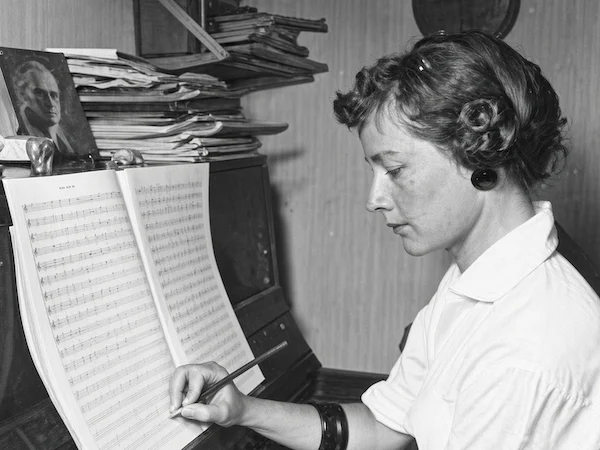
The history of electronic music is deeply intertwined with tales of resilience, wartime espionage, and profound personal transformation. Among its most remarkable pioneers is Else Marie Pade, a Danish composer whose journey to the forefront of avant-garde sound design began not in a conservatory, but in the harrowing confines of Nazi-occupied Denmark and a Gestapo prison cell. Overcoming severe childhood illness, the trauma of wartime imprisonment, and the gender barriers of mid-century high art, Pade emerged as Denmark’s first female electronic composer. Her story illuminates how the crucible of political oppression and acute isolation can occasionally forge unprecedented artistic innovation.
Formative Years and the Sounds of Isolation
Else Marie Pade’s path to musical pioneering was foreshadowed by the enforced stillness of her early life. Born in Denmark, she suffered from chronic kidney inflammation during her childhood. These recurring medical crises consigned her to bed for extended periods, isolating her from the typical social development of her peers. Confined to her room, Pade turned her heightened attention toward the auditory world around her. Without the distractions of a bustling childhood, she developed a deep fascination with ambient soundscapes.
Rather than viewing silence as empty, Pade learned to listen to the symphony of everyday life: the rhythmic dripping of sponges, the whistling of kettles, the calls of birds outside her window, and the clip-clop of horses trotting on the street below. These sensory experiences planted the seeds for a lifelong preoccupation with sound, texture, and noise—concepts that would later form the bedrock of her contributions to musique concrète.
As she grew older, Denmark was overtaken by the geopolitical turmoil of World War II. When Nazi Germany occupied her homeland, the young Pade did not remain passive. In an act of youthful defiance that portended her lifelong rejection of rigid authority, she brazenly spat upon a column of marching German soldiers. Narrowly avoiding immediate capture, she fled directly into the arms of the Danish Resistance, choosing a path of active sabotage and underground journalism.
Resistance, Arrest, and the Birth of a Vocation
Within the ranks of the Danish Resistance, Pade took on dangerous responsibilities. She distributed clandestine underground newspapers that challenged the Nazi occupation narrative and underwent rigorous training in handling explosives. Her specific wartime assignment was high-stakes: she was tasked with learning how to sabotage and cut off enemy telephone lines in the event of an Allied invasion.
However, her resistance career was abruptly cut short in 1944 when she was arrested by the Gestapo. Thrown into a solitary confinement cell, Pade faced the absolute terror of wartime imprisonment. Decades later, she vividly recalled the psychological weight of that environment in an essay published in The Wire:
"I screamed out loud in fear and helplessness in my solitary cell — but no one came. It was then I promised myself that if I survived this I would work with music for the rest of my life. And then I felt a strange calm: light, warmth and love were all around me. I was no longer alone. This was the turning point in my life."
True to her vow, the transformation was immediate. The very next day, utilizing the metal fastener from her garter belt, Pade began frantically scratching musical staves directly onto the prison wall, transcribing a thematic melody born from her nocturnal vision of survival.
Her unorthodox method of composition initially infuriated the prison commandant. Yet, recognizing her unyielding determination, the commandant eventually relented, offering a pragmatic compromise. He promised that the Red Cross would supply her with proper music paper and writing utensils, provided she ceased defacing the prison infrastructure and refrained from violent outbursts.
Imprisonment at Frøslevlejren and Wartime Compositions
Following her initial interrogation and detention, Pade was transferred to the Frøslevlejren internment camp. Despite the bleak conditions of the camp, her creative output accelerated. Fortuitously, she was reunited within the barracks with Karen Brieg, the very piano teacher who had initially introduced her to the Danish Resistance.
In the women’s barracks, Brieg and Pade collaborated to sustain morale among their fellow inmates. Brieg transcribed traditional Danish songs for a three-part women’s choir, while Pade composed schlagers—catchy, sentimental popular songs of the era. Pade harbored a practical motivation for writing these lighter pieces: she intended to use the potential earnings from these commercial songs to fund her formal music studies once peace was restored and the occupation ended.
The women imprisoned alongside her recognized her dedication. Her compatriots in the barracks made a solemn pact, promising to ensure she gained entry to the Royal Danish Academy of Music once the war concluded. Following the liberation of Denmark, that promise was fulfilled.
The Catalyst of Musique Concrète
Pade entered the Royal Danish Academy of Music with conventional ambitions, expecting to train as a classical pianist. For a time, her education followed traditional lines. However, the trajectory of her artistic life was permanently altered in 1952 when she listened to a landmark broadcast on Denmark Radio concerning Pierre Schaeffer’s revolutionary French audio experiments known as musique concrète.
Schaeffer’s technique of recording natural, environmental, and industrial sounds onto magnetic tape, and then manipulating, looping, and collaging them into musical compositions, struck a profound chord within Pade. The methodology validated the exact sonic observations she had made years prior while bedridden with childhood illnesses and listening to the world through her window.
Channeling this inspiration, Pade created A Day at Dyrehavsbakken, widely recognized as the first piece of electronic musique concrète ever composed in Denmark. Seeking to refine her craft, she traveled and studied alongside some of the defining avant-garde architects of the era, including Pierre Schaeffer himself, as well as Karlheinz Stockhausen, György Ligeti, and Pierre Boulez.
Although the austere, mathematically rigorous soundscapes of these European modernists contrasted sharply with the sentimental schlager ballads she had once written in wartime barracks, her foundational ear remained unchanged. The same imaginative faculty that once heard an ambient symphony in whistling kettles and dripping sponges now drove her to manipulate magnetic tape with sophisticated precision.
Broader Impact and Legacy in Electronic Music
Else Marie Pade’s trajectory from a rebellious teenager spitting on occupying troops to a pioneering electronic composer reflects a broader historical narrative regarding women’s roles in the genesis of electronic music. For decades, the foundational decades of electronic music—spanning the late 1940s through the 1960s—were predominantly framed through the lens of male innovators. Yet, institutions like the BBC Radiophonic Workshop and independent studios across Europe quietly relied on visionary women who transformed studio engineering into an expressive art form.
Pade’s contributions place her alongside international contemporaries such as Daphne Oram and Delia Derbyshire in the United Kingdom. While Oram created the BBC’s first electronic music piece and Derbyshire engineered the iconic, mind-bending Doctor Who theme, Pade carved out an equally formidable legacy in Scandinavia. Her works bridged the gap between acoustic environmental noise and the structured parameters of serialism and tape manipulation.
Musicologists and historians analyzing the mid-century avant-garde frequently highlight the political subversion inherent in Pade’s work. Her transition from literal sabotage—planning to cut telephone wires to impede military occupation—to sonic sabotage—tearing, splicing, and rebuilding magnetic tape to disrupt traditional harmonic structures—serves as a compelling metaphor for her life.
Today, Pade’s legacy is preserved through scholarly re-evaluations, archival releases, and retrospectives that celebrate her indomitable spirit. By scratching a melody onto a Gestapo prison wall with a garter belt fastener, Else Marie Pade ensured that neither war, imprisonment, nor institutional gender barriers could silence her vision. Her work continues to inspire new generations of electronic musicians, standing as an enduring testament to the power of art to transcend the most harrowing circumstances of human history.







Leave a Reply