
Decoding Parking Lot Pavement Failures: A Comprehensive SEO Guide
Parking lot pavement failure is a pervasive issue plaguing commercial properties, municipalities, and private entities alike. Understanding the root causes and identifying the specific types of degradation is crucial for effective maintenance, repair, and long-term pavement management. This article delves deep into the various forms of parking lot pavement failure, their underlying mechanisms, and the implications for property owners, providing SEO-friendly insights for those seeking information on this critical infrastructure concern.
One of the most prevalent forms of parking lot pavement failure is alligator cracking, also known as fatigue cracking. This distinctive pattern, resembling the scales of an alligator, arises from repeated stress applied to the asphalt pavement, often exacerbated by insufficient base or subbase support. When vehicles repeatedly traverse the same paths, the asphalt flexes under their weight. Over time, this repeated flexing leads to tensile stresses within the asphalt layer. If the underlying layers are not robust enough to distribute this load effectively, the asphalt will eventually fracture. Initial cracks are typically longitudinal and parallel, but as the damage progresses, interconnected transverse cracks develop, forming the characteristic polygonal pattern. Factors contributing to alligator cracking include heavy traffic loads, inadequate pavement thickness, poor drainage that weakens the subgrade, and a deteriorated base layer. The underlying principle is a failure of the pavement structure to withstand repeated traffic loading, leading to fatigue failure of the asphalt binder and aggregate matrix. The presence of water beneath the pavement, particularly during freeze-thaw cycles, significantly accelerates this degradation by weakening the subgrade and increasing the internal pressures within the pavement structure. The loss of structural integrity in the base course, often due to poor compaction or the presence of expansive soils, also directly contributes to the premature development of alligator cracking. Ignoring alligator cracking allows it to propagate, leading to more significant structural failures, pothole formation, and ultimately, the need for expensive reconstruction. Early detection and repair, such as crack sealing or patching, can prevent the progression of this damaging phenomenon.
Another significant issue is longitudinal and transverse cracking. Longitudinal cracks typically run parallel to the centerline of the pavement, often occurring in wheel paths. These cracks can form due to a variety of factors, including shrinkage of the asphalt binder as it ages and cools, reflective cracking from underlying pavement layers, or differential settlement of the subgrade. Transverse cracks, on the other hand, run perpendicular to the pavement’s centerline and are often caused by thermal contraction of the asphalt. As temperatures fluctuate, asphalt expands and contracts. If the pavement is restrained from movement, tensile stresses build up, leading to cracking. Poorly constructed pavement joints, where different pavement sections meet, are also susceptible to transverse cracking due to differences in material properties or construction practices. The width and depth of these cracks are indicative of the severity of the underlying issue. Wide and deep cracks allow water infiltration, which can further damage the pavement structure by weakening the base and subgrade, leading to a cascade of further failures. The aging process of asphalt, where the binder becomes brittle and less flexible, also plays a significant role in the propensity for thermal cracking. Proper joint design and construction, as well as regular maintenance of existing cracks, are crucial for mitigating these types of failures.
Potholes are perhaps the most visibly alarming form of pavement failure, representing a complete disintegration of the asphalt surface. Potholes typically begin as small cracks, often exacerbated by water infiltration. During freeze-thaw cycles, water trapped within these cracks freezes, expands, and forces the pavement apart. When the ice melts, it leaves a void. Subsequent traffic loads passing over this weakened area cause the asphalt to break away, forming the characteristic hole. Potholes can also form rapidly due to structural failures in the base or subgrade, where the underlying support has been compromised, leading to the collapse of the asphalt surface. The depth and size of a pothole are direct indicators of the extent of the underlying damage. While seemingly isolated incidents, a proliferation of potholes on a parking lot signals a systemic problem with drainage, structural integrity, or inadequate maintenance. The rapid deterioration caused by potholes poses significant safety hazards to vehicles and pedestrians, leading to potential damage and liability for property owners. Prompt repair, often involving patching or full-depth reconstruction in severe cases, is essential to prevent further damage and ensure safety.
Rutting is a form of deformation that appears as depressions or channels in the wheel paths of a parking lot. This failure is primarily caused by the plastic deformation of the asphalt layer or the underlying base course under repetitive traffic loading. It indicates a loss of stability in the pavement materials. Rutting can occur due to several reasons: insufficient compaction of the asphalt during installation, a mixture that is too soft or contains an insufficient amount of aggregate, or a weakened base and subgrade that cannot adequately support the pavement structure. High temperatures can exacerbate rutting as asphalt becomes more pliable. The presence of excess fine aggregates or a lack of sufficient coarse aggregates in the asphalt mix can also contribute to rutting by reducing the interlock between aggregate particles, leading to a less stable pavement structure. The accumulation of water within the rutted areas can further accelerate deterioration by weakening the subgrade. Identifying and addressing the root cause of rutting is critical; simply filling the ruts without addressing the underlying structural issue will result in a recurrence of the problem. Stabilization of the base course, recalibration of asphalt mix designs, or even full-depth reconstruction may be necessary depending on the severity of the rutting.
Edge failures occur along the perimeter of the parking lot, manifesting as cracking, crumbling, or erosion. These failures are commonly associated with inadequate support at the pavement edges and poor drainage. When water is allowed to accumulate along the edges, it can saturate and weaken the subgrade, leading to settlement and subsequent cracking of the pavement. The absence of proper edge support, such as curbs or adequate shoulder material, means the pavement is more susceptible to damage from traffic overhang and environmental factors. Vegetation growth along the edges can also exacerbate the problem by penetrating cracks and displacing the pavement material. The loss of aggregate from the edge can also contribute to a widening of the failure. Proper edge treatment, including well-designed drainage systems and robust edge support, is crucial for preventing these types of failures. Regular inspection and sealing of edge cracks can prevent water intrusion and further degradation.
Depression and settlement are indicative of underlying structural problems, particularly with the subgrade or base course. Depressions, or low spots, can form due to the consolidation of weak subgrade soils, improper compaction during construction, or the erosion of material from beneath the pavement. This can lead to water ponding, which further accelerates deterioration. Settlement, a more gradual sinking of the pavement, often signifies a loss of bearing capacity in the underlying layers. This can be caused by the presence of expansive soils that swell and shrink with moisture content changes, or by the decomposition of organic matter in the subgrade. Inadequate drainage is a significant contributor to both depressions and settlement, as it allows water to saturate and weaken the supporting layers. The presence of underground utilities that may have settled or leaked can also contribute to localized depressions. Addressing these issues often requires excavation and repair of the subgrade or base course, followed by reconstruction of the pavement.
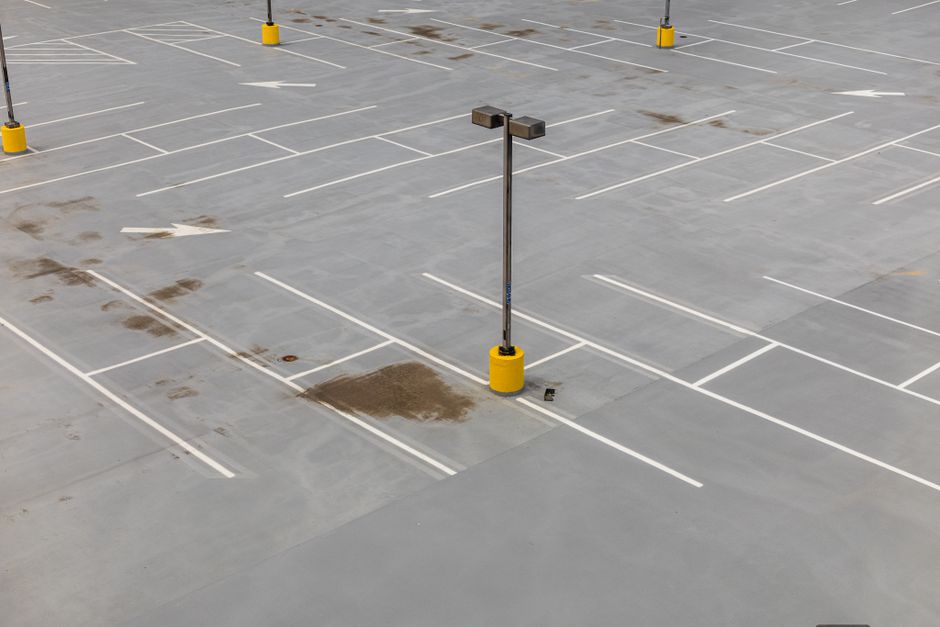
Oil and chemical spots are visually distinct discolorations on the asphalt surface. While not always a structural failure in themselves, they can indicate potential problems and accelerate deterioration. Spills of gasoline, oil, diesel fuel, and other chemicals can break down the asphalt binder, softening the pavement and making it more susceptible to wear and tear. Repeated exposure can lead to the formation of localized soft spots that can eventually develop into potholes or ruts. These spots also contribute to a general aesthetic decline of the parking lot. Prompt cleanup of spills is essential to minimize damage. In cases where the binder has been significantly degraded, localized patching or resurfacing may be required. The porous nature of asphalt makes it susceptible to the penetration of these chemicals, leading to degradation of the asphalt binder’s chemical structure.
Stripping is a failure where the asphalt binder separates from the aggregate particles. This typically occurs when water penetrates the asphalt mixture and interferes with the bond between the binder and the aggregate. This is particularly problematic with certain types of aggregate that have a hydrophilic (water-attracting) surface. The presence of moisture, especially during freeze-thaw cycles, can exacerbate stripping by forcing water between the binder and aggregate, leading to debonding. The loss of this bond weakens the asphalt mixture, making it more prone to cracking and other forms of distress. Using anti-stripping agents in the asphalt mix during construction can significantly mitigate this problem. Proper pavement design that incorporates effective drainage also plays a crucial role in preventing water from reaching and saturating the asphalt layer. Aggregate selection based on its affinity for asphalt binder is also a critical factor in preventing stripping.
Understanding these various types of parking lot pavement failures, their underlying causes, and the contributing environmental and structural factors is paramount for effective pavement management. Proactive inspection, routine maintenance, and prompt repairs are not only cost-effective in the long run but also crucial for ensuring the safety, functionality, and longevity of parking lot infrastructure. Ignoring these signs of distress can lead to escalating repair costs, significant business disruptions, and potential liability. The integration of proper drainage solutions, sound engineering practices during construction, and a commitment to regular maintenance are the cornerstones of preventing and mitigating parking lot pavement failures.





Leave a Reply