The digital detox began at the door of 100 Sutton St. in Greenpoint on a brisk Thursday evening, where roughly 300 campaign staffers, political consultants, organizers, founders, and journalists surrendered their smartphones to security pouches just five days before a high-stakes midterm election. Located deep within the informal political strip known as the “commie corridor”—stretching from northwest Queens through northern Brooklyn—the venue hosted Newsreel’s “Midterm Mania” panel. For an industry that subsists on the constant hum of social media feeds and real-time polling data, the event offered a rare evening of analog introspection for the architects of modern progressive politics.
As political prognosticators weigh the trajectory of the upcoming congressional elections, the gathering laid bare the deep-seated ideological fractures within the Democratic Party. While recent polling data points to strong momentum for Democratic candidates, the internal debate over policy priorities, economic populism, and technological disruption highlights a party still searching for a unified identity.
Main Facts and Event Atmosphere
The evening’s proceedings kicked off with a palpable energy when New York City Councilmember Chi Ossé, a democratic socialist representing Bedford-Stuyvesant and Crown Heights, took the stage. Addressing the Brooklyn crowd, Ossé commanded immediate attention, though his rhetorical flourishes underscored lingering foreign policy divisions within the party. When he called for Democrats to adopt an unequivocally anti-war stance regarding Iran, a portion of the room remained silent—prompting Ossé to assert that anyone withholding applause was inherently supportive of military conflict.
The event’s underlying tension stemmed from a central question posed by Newsreel founder and CEO Jack Brewster to event RSVPs: “What’s the one election question you want answered?” With more than 150 responses plastered across the venue’s walls on Post-it notes, Brewster encapsulated the evening’s core theme prior to the final panel: “Democrats are on track to win big according to polls, but they still cannot agree on who they are.”
Throughout the 90-minute discussion, panelists debated foundational questions concerning the party’s ideological tilt toward democratic socialism, the economic impact of burgeoning artificial intelligence infrastructure, and how to address the explosive public backlash against regional data centers.
Chronology and Political Background
The ideological tug-of-war within the progressive movement has intensified following the 2024 presidential election cycle and subsequent local primary battles. Ossé, who previously weighed a high-profile primary challenge against House Minority Leader Hakeem Jeffries before dropping out after failing to secure the endorsement of the Democratic Socialists of America (DSA), addressed the pragmatic realities of coalition-building.
During the panel discussion moderated by Forbes’ Isabel Togoh, Ossé was pressed on whether candidate branding—specifically the label of "socialist"—matters in the current political climate.
“The number one thing that I care about within our party is taking back this country from the right,” Ossé said, endorsing a big-tent pragmatism. “Whatever you need to do in order to do that at this point in time, you know, I do support that.”
Ossé pointed to figures like Michigan Democrat Abdul El-Sayed, who secured a Senate primary victory with the backing of prominent progressives Bernie Sanders and Alexandria Ocasio-Cortez, yet has publicly rejected the socialist label. Ossé affirmed his support for such strategic positioning if it aids in defeating conservative governance, while maintaining his personal belief that the long-term institutional direction of the party trends toward democratic socialism.
Supporting Data and Shifting Electoral Dynamics
The sense of electoral urgency is underscored by shifting national numbers. A New York Times/Siena national survey released on October 21 showed Democrats leading by 10 points on the generic congressional ballot, alongside a 36% approval rating for former President Donald Trump. Despite this favorable macroeconomic and political tailwind heading into Tuesday, the party enters the legislative battlegrounds without a cohesive consensus on the rapid, capital-intensive expansion of AI infrastructure—a point of friction as local communities push back against the physical footprint of technological advancement.
According to a recent POLITICO poll conducted by PF Global, roughly half of all Americans express opposition to the construction of a data center within three miles of their residence. Yet, political figures remain divided on how to regulate or tax the industry. When asked about AI regulation, Ossé admitted limited personal usage and understanding of the technology, yet advocated for aggressive punitive measures, suggesting that major tech and AI executives should testify before Congress and “maybe be put behind bars for a little bit.” He also expressed full support for Senator Bernie Sanders’ proposed one-time 50% stock tax on the nation’s largest artificial intelligence corporations.
The Data Center Flashpoint: Energy and Working-Class Realignment
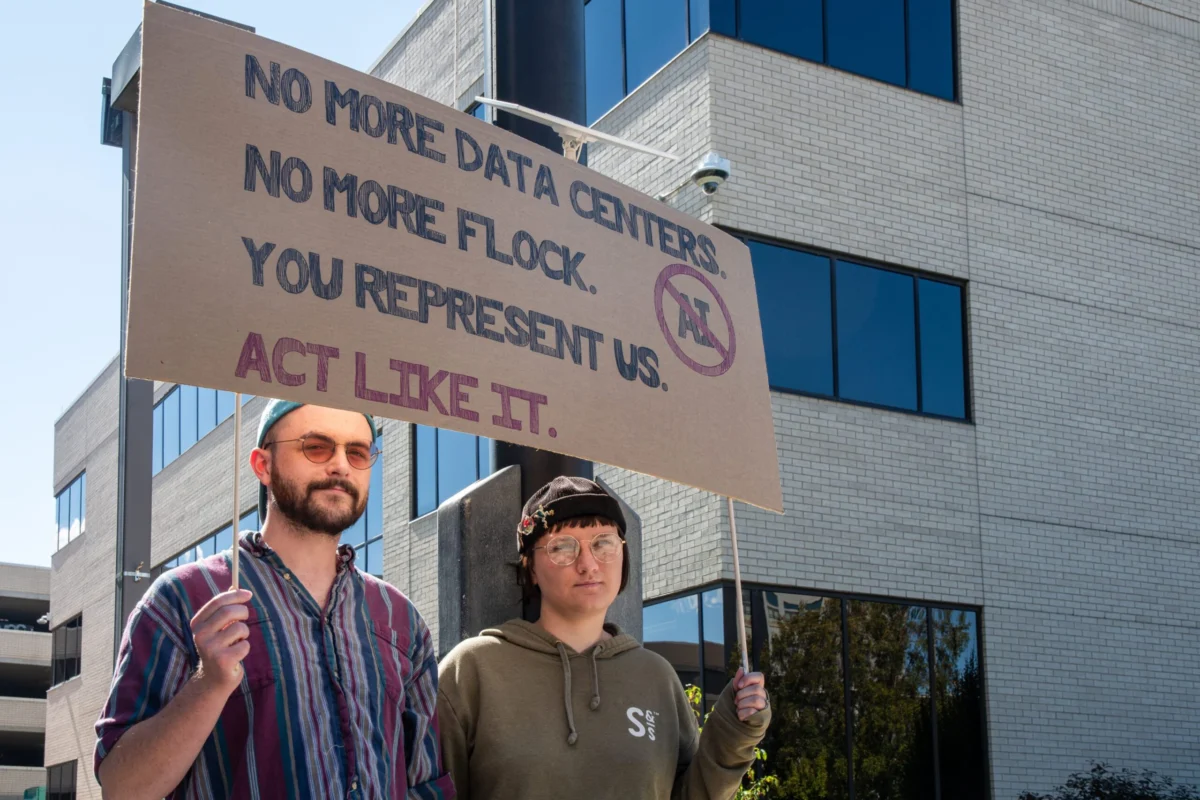
The panel dedicated to data centers proved to be the evening’s most contentious yet unifying discussion, revealing a rare convergence of bipartisan grassroots opposition. Moderated by TechCrunch’s Dominic-Madori Davis, the conversation highlighted a widening gap between corporate economic strategies and local environmental concerns.
Hilary Flint, an organizer with the Center for Oil and Gas Organizing in Pennsylvania, noted that while political divides typically separate right-leaning property rights concerns from left-leaning environmental protectionism, data centers have forged an unprecedented coalition. Flint pointed to the Pennsylvania Data Center Resistance Facebook group, which has rapidly expanded to more than 44,000 members across the political spectrum.
Maia Woluchem of the Data & Society research institute placed the current data center buildout within a historical pattern of industrial expansion, noting that facilities are frequently sited in communities already bearing the environmental burdens of hydraulic fracturing wells and coal mining operations.
The national numbers highlight the sheer scale of the resource consumption involved. While international datasets from the International Energy Agency, compiled by Carbon Brief, indicate that data centers account for roughly 1.5% of global electricity demand and 0.5% of global carbon dioxide emissions, domestic consumption is far more concentrated. Lawrence Berkeley National Laboratory research shows data centers consumed 4.4% of U.S. electricity in 2023—a figure projected to surge between 6.7% and 12% by 2028. In states like Virginia, data centers already account for 26% of total electricity consumption.
This heavy energy burden has placed Democratic governors in precarious political positions. In Pennsylvania, Governor Josh Shapiro initially championed a $20 billion Amazon data center investment. However, intense local pushback has forced a recalibration. Flint noted that relentless grassroots activism is gradually compelling state leadership to adopt stricter regulatory frameworks, with organizers vowing to push the administration until policy fully reflects constituent opposition.
Conversely, Morris Katz, a partner at Fight Agency and lead media strategist, suggested that the political fallout from data center expansion presents an opening for Republicans to claim the pro-development mantle—potentially putting traditionally safe or competitive districts into play.
However, this dynamic complicates traditional labor alliances. Batya Ungar-Sargon, NewsNation host and self-described "MAGA leftist" who voted for Trump in 2024, argued that national trade unions are increasingly crossing party lines to endorse Republicans because data center construction guarantees lucrative employment for electricians and pipefitters. Katz countered that organized labor has historically been forced into difficult compromises by decades of establishment economic policies that neglected working-class interests.
Ungar-Sargon contended that the broader political realignment—exemplified by working-class voters shifting toward the Republican Party and lower-income demographics supporting conservative candidates—has been accelerated by progressive policy proposals. She cited Medicare for All as an example of a policy that enjoys broad theoretical support until voters realize the accompanying tax implications. Katz pushed back against this economic assessment, maintaining his stance as a populist advocate for an inclusive big-tent party. Astead Herndon, host of Vox’s America, Actually, further contextualized the 2024 political shift, characterizing it not merely as a partisan realignment, but as an “establishment collapse.”
Broader Impact and Implications
As the evening concluded with a rapid-fire prediction round, panelists remained cautious regarding the immediate legislative outlook. Aryan Ranjan, co-founder and Chief Financial Officer of campaign software startup Baraza, offered an optimistic projection of 231 House seats and 52 Senate seats for Democrats. Conversely, Ungar-Sargon expressed skepticism regarding Senate control, predicting a Republican retention of the chamber.
Katz urged political strategists to remain clear-eyed about the structural challenges facing the party, regardless of the midterm outcome.
“Even in the best-case scenario where we win big,” Katz concluded, “I think we still need to be ready to have harder conversations about where we go from here.”
With the panel concluded, the venue lights shifted, the DJ began to play, and the attendees reclaimed their phones at the door—stepping back into a digital world where the very questions debated in Greenpoint would soon be tested at the ballot box.